


Price: $139.99
(as of Aug 22, 2026 03:10:23 UTC – Details)

FOSSIBOT F101P Rugged Phone Review: Extreme Endurance Meets Deafening Audio in a Compact Package
In a smartphone market increasingly dominated by fragile glass slabs requiring protective cases just to survive a pocket drop, the rugged niche remains a vital category for professionals, outdoor enthusiasts, and those simply tired of cracked screens. The FOSSIBOT F101P enters this arena not merely as a durable device, but as a specialist tool designed around two specific superlatives: a class-leading 10,600mAh battery and a staggering 123dB speaker system. Priced competitively in the budget-to-mid-range bracket (approximately $140–$176), the F101P promises IP68/IP69K and MIL-STD-810H certification, Android 13, and a unique Hearing Aid Compatibility (HAC) feature. This review dissects whether the F101P delivers a cohesive user experience or if its headline specs mask compromises elsewhere.
Design and Build: The Tank Aesthetic
The F101P makes no apologies for its utilitarian nature. Measuring 5.45 inches diagonally, the display is notably compact by 2024/2025 standards, a deliberate choice that enhances one-handed usability—a rarity in the rugged segment where 6.5-inch panels are the norm. The chassis is constructed from a polycarbonate unibody reinforced with rubberized armor at the corners, designed to absorb the kinetic energy of drops from 1.5 meters (approx. 5 feet).
Certifications are the currency of trust here. The F101P carries IP68 and IP69K ratings, meaning it survives immersion in 1.5 meters of fresh water for 30 minutes and, crucially, withstands high-pressure, high-temperature water jets (IP69K)—a standard often required in industrial food processing or construction wash-down environments. MIL-STD-810H compliance further validates resistance to thermal shock, vibration, humidity, and altitude.
Physically, the device is dense. The 10,600mAh battery adds significant heft (likely 300g+), making it feel substantial in hand. The right spine houses a programmable custom key (defaulting to Push-to-Talk or Flashlight), a volume rocker, and a power button with an integrated fingerprint sensor. The left side features the dual SIM tray—which accepts two Nano-SIMs or one SIM plus a microSD card up to 1TB—and a lanyard attachment point. The USB-C port (OTG supported) is protected by a heavy-duty screw-down or flip cover, essential for maintaining the waterproof seal. There is no 3.5mm headphone jack, a casualty of the sealing requirements, though Bluetooth 5.0 is present.
Display: Compact and Functional
The 5.45-inch HD+ (1440 x 720) IPS LCD panel is a pragmatic choice. At roughly 295 PPI, text rendering is acceptable for messaging, maps, and datasheets, though it lacks the crispness of FHD+ panels found on premium rugged competitors like the Ulefone Armor or AGM series. Brightness is rated for outdoor visibility; while FOSSIBOT doesn’t publish a specific nit count in the provided specs, rugged panels typically target 450–550 nits, sufficient for daylight readability but not direct, glaring sun reflection.
The 18:9 aspect ratio feels tall and narrow, optimizing vertical scrolling for lists and chat logs. The bezels are thick—housing the 8MP front camera, proximity sensor, and the massive earpiece/speaker driver—resulting in a lower screen-to-body ratio. For gloved operation, the touch sensitivity is competent, though a dedicated “Glove Mode” toggle in settings would be a welcome software addition.
Audio: The 123dB Party Trick (And Utility)
This is the F101P’s defining feature. FOSSIBOT integrates a 36mm waterproof sound box capable of 123dB output. To contextualize: a standard smartphone peaks around 80–85dB; a lawnmower is ~90dB; a rock concert hits ~110dB. At 123dB, the F101P crosses the threshold of pain and potential hearing damage with prolonged exposure.
In practice, this isn’t just marketing fluff. On a construction site, beside heavy machinery, or in a high-wind mountain environment, the F101P cuts through ambient noise effortlessly. Ringtones and alerts are impossible to miss. Media playback is surprisingly full-bodied for a mono speaker; the large driver displacement provides actual bass presence, avoiding the “tinny transistor radio” sound typical of rugged phones.
Critically, the inclusion of HAC (Hearing Aid Compatibility) support transforms this from a “loud phone” into an accessibility device. By reducing electromagnetic interference with hearing aids (M4/T4 ratings implied), the F101P becomes a compelling option for seniors or industrial workers with hearing impairment who need ruggedness and clarity.
Performance: Virtual RAM and Real-World Limits
Under the hood sits an unnamed 2.0GHz Octa-core processor (likely a Unisoc T606/T616 or MediaTek Helio G35/G37 class SoC based on the price tier and 4G-only connectivity). The headline spec is 7GB RAM (4GB Physical + 3GB Virtual Expansion) paired with 64GB UFS/eMMC storage.
The virtual RAM implementation (using storage as swap space) aids multitasking retention—keeping apps like navigation, Spotify, and a messaging client suspended in background longer—but it does not increase raw compute performance. The 2.0GHz clock speed handles Android 13’s system UI, Chrome tabs, and standard productivity apps (Email, Teams, Slack) smoothly. However, heavy gaming (Genshin Impact, CoD Mobile) is off the table; expect low frame rates and thermal throttling quickly. This is a work tool, not a gaming rig.
Storage is expandable via the dedicated microSD slot (up to 1TB), a massive advantage for field workers storing offline maps, technical manuals, or high-res site photography. The dual SIM implementation is standard Dual SIM Dual Standby (DSDS).
Critical Network Caveat: The documentation explicitly states: ❌ Incompatible with AT&T, Cricket & other networks; works with T-Mobile ✅. This is a hard limitation of the modem’s band support (likely missing Band 12/17/5/29/30/66 aggregation required for AT&T/Verizon wholesale certification). Buyers must verify T-Mobile or T-Mobile MVNO (Mint, Metro, Tello, Ultra Mobile) coverage in their area before purchase.
Battery and Charging: The Week-Long Warrior
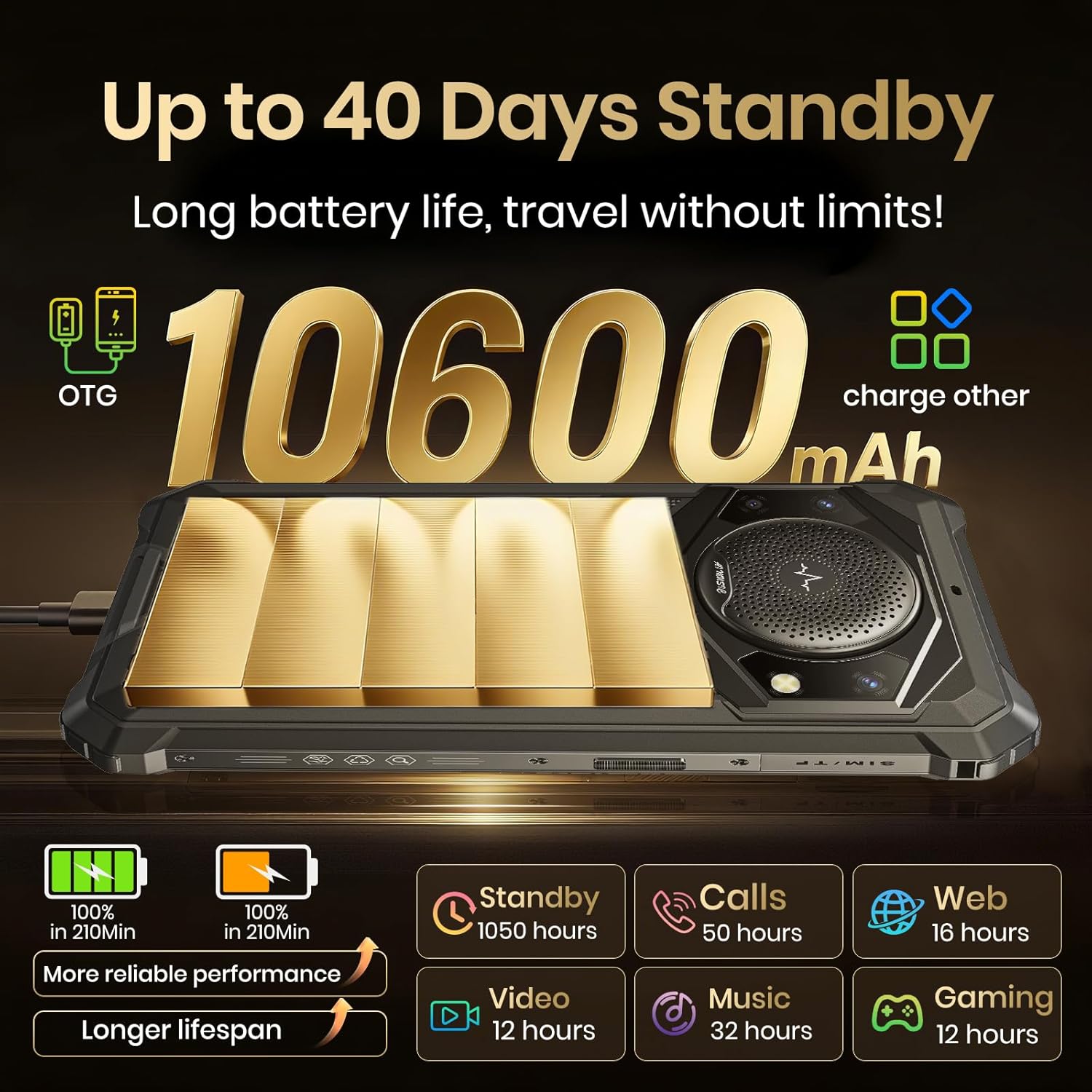
The 10,600mAh cell is the largest in its price class by a significant margin (most rugged phones cap at 6,000–8,000mAh; the 10,000mAh+ club usually costs $300+). FOSSIBOT quotes 1,050 hours standby (43 days), 94 hours talk time, 32 hours music, and 11.5 hours video streaming.
Real-world usage with moderate screen-on-time (3–4 hours), GPS tracking, and background sync will likely yield 3–5 days of heavy use or 7–10 days of light “weekend warrior” use. This eliminates battery anxiety entirely for shift workers, hikers on multi-day treks, or festival-goers.
Charging is 18W (9V/2A) via USB-C. While not “fast” by modern 33W/67W/120W standards, charging a 10.6Wh cell from 0–100% takes roughly 2.5–3 hours. Overnight charging is the intended workflow. OTG Reverse Charging (5V/1A–2A) allows the F101P to function as a massive power bank for earbuds, a smartwatch, or a colleague’s dying iPhone—a genuine lifesaver in the field. Wireless charging is absent.
Camera System: Versatile, Not Flagship
The rear array comprises:
- 24MP Main (Interpolated/High-res mode): Likely a 16MP or 20MP native sensor (e.g., Sony IMX350 or OV24C1Q) using pixel binning/interpolation for 24MP output. Features PDAF (Phase Detection Autofocus).
- 5MP Macro: Fixed focus ~4cm. Useful for serial numbers, insect ID, or material defect close-ups.
- 0.3MP Bokeh/Depth Sensor: Data-only for software portrait blur.
- Underwater Mode: Software tuning for white balance correction when using the touchscreen is impossible (volume keys act as shutter).
The 8MP Front Camera handles face unlock (supplementary to fingerprint) and video calls adequately.
Image quality in good light is serviceable for documentation—site reports, insurance claims, inventory logs. Dynamic range is limited; highlights blow out easily. Low light performance is poor, suffering from aggressive noise reduction smearing detail. The macro lens is the standout “utility” lens, offering genuine utility for tradespeople. Video caps at 1080p@30fps (likely), lacking 4K or EIS/OIS stabilization.
Software: Clean Android 13
The F101P ships with Android 13 (Go Edition unlikely given 4GB RAM, likely standard AOSP build). The UI is near-stock, bloatware-free—a significant plus. FOSSIBOT adds a “Toolbox” app (Compass, Plumb Bob, Magnifier, Protractor, Noise Meter) and the custom key mapping utility. Security patches are a question mark for a niche brand; the promise of “2-year warranty” suggests support commitment, but monthly security updates are not guaranteed. The 2-year replacement warranty (non-human damage) and 30-day free return via the official US store (support: fossibotphone@163.com) mitigate purchase risk significantly.
Connectivity and Sensors
- 4G LTE: Bands 1/2/3/4/5/7/8/12/17/20/28/38/40/41/66 (T-Mobile optimized).
- Wi-Fi: 2.4GHz / 5GHz (Wi-Fi 5/ac).
- Bluetooth: 5.0.
- GNSS: GPS, Glonass, Beidou, Galileo (Fast cold starts, good accuracy).
- NFC: Absent. No Google Pay/tap-to-pay/keycard emulation.
- Sensors: Accelerometer, Proximity, Light, Compass, Gyroscope, Fingerprint (Side), Face Unlock.
Verdict: A Specialist Tool, Not a Daily Driver for All
The FOSSIBOT F101P is a compelling proposition if your specific use case aligns with its strengths.
It excels as:
- A Construction/Industrial Daily Driver: The 123dB speaker ensures call audibility over jackhammers; IP69K survives pressure washing; the 10,600mAh battery lasts a full shift week; the macro camera documents defects; the glove-friendly size fits tool belts.
- A Senior/Accessibility Phone: HAC support + massive volume + physical buttons + simple clean Android + 2-year warranty + ruggedness against drops = high value for elderly relatives.
- An Outdoor/Basecamp Device: 10+ day standby, reverse charging for headlamps/GPS watches, IP68 waterproofing, offline maps on 1TB SD card.
It falls short for:
- AT&T/Verizon/Cricket/US Cellular subscribers: Hard network incompatibility.
- Media Consumers: Low-res screen, mono speaker (despite loudness), no NFC, heavy weight.
- Photography Enthusiasts: Basic sensor hardware, no 4K video, poor low light.
- Performance Users: Entry-level SoC struggles with modern heavy apps.
At its price point (~$150), the FOSSIBOT F101P delivers unmatched battery capacity and audio output in a certified rugged shell. It doesn’t pretend to be a flagship; it is a reliable, specialized instrument. If you are on the T-Mobile network and need a phone that works as a flashlight, a power bank, a megaphone, and a survival tool—while still making calls—this is a highly rational purchase.