

Price: $165.99
(as of Aug 22, 2026 03:22:06 UTC – Details)

FOSSIBOT F114 Review: Redefining the Rugged Smartphone Paradigm with Android 15 and a Slim Profile
In the crowded landscape of rugged smartphones, the prevailing design philosophy has long dictated a trade-off: to gain military-grade durability, one must accept a brick-like form factor, heavy weight, and often outdated software. The FOSSIBOT F114 arrives as a direct challenge to this convention. Marketed as a “Flagship” device from a brand that prides itself on technical accumulation and outdoor heritage, the F114 attempts to distill the essence of a modern daily driver—slim bezels, high refresh rate display, latest OS—into a chassis that survives the construction site, the mountain trail, and the submersion test. After a thorough analysis of its specifications and feature set, it is clear that the F114 represents a significant evolution in the rugged category, though it occupies a specific niche defined by its network compatibility and charging speeds.
Design and Build: The 10.8mm Revolution
The most immediate departure from rugged norms is the physical profile. At 10.8mm thick, the F114 defies the stereotype of the 15mm-to-20mm thick “tank” phones that dominate the segment. For context, many standard flagship smartphones hover around the 8mm mark; the F114 adds only a few millimeters to achieve IP68 and IP69K certification alongside MIL-STD-810H drop resistance (implied by “drop certified” branding).
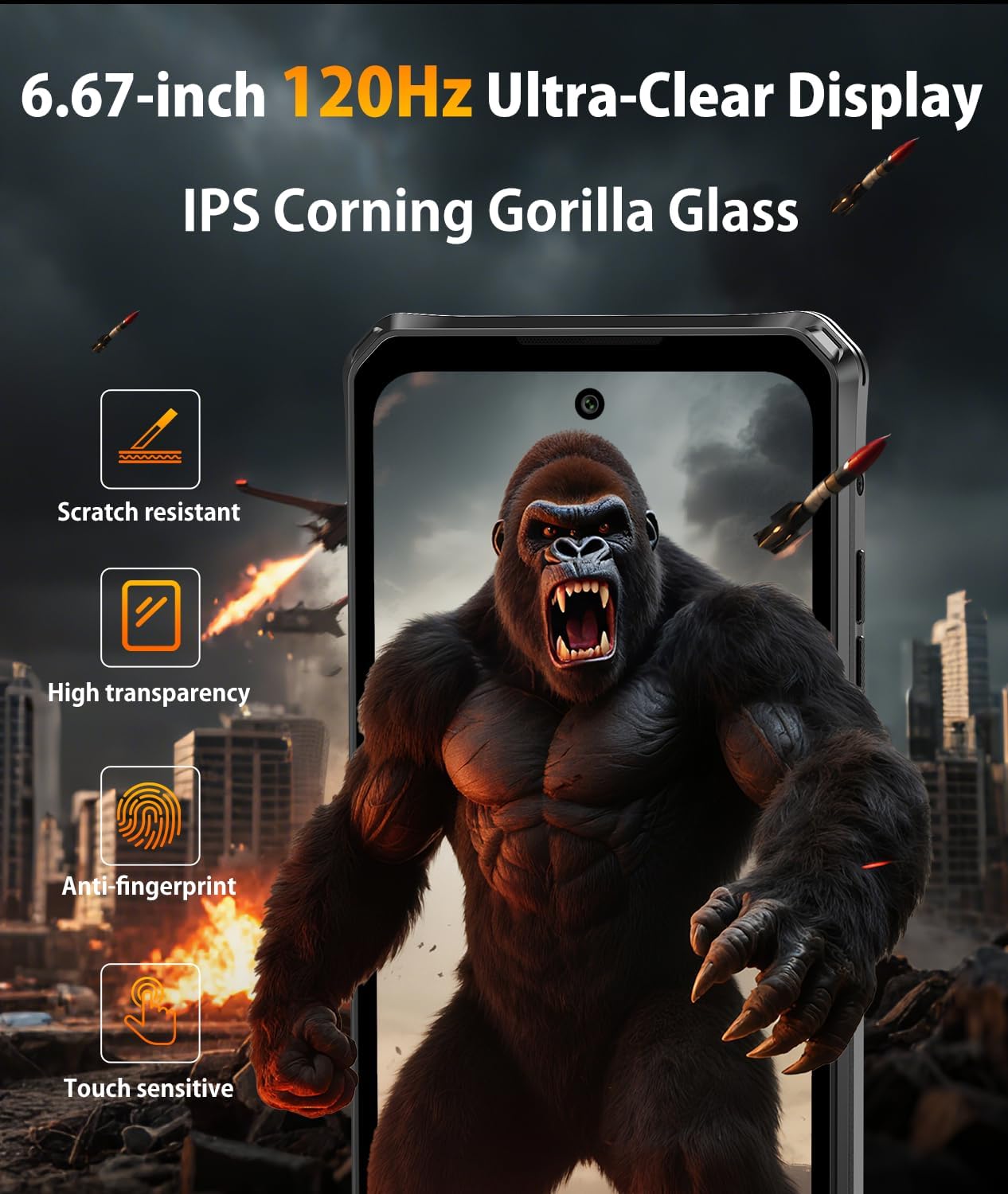
This slimness is not merely aesthetic; it fundamentally changes the ergonomics. A rugged phone that fits comfortably in a standard jeans pocket or a running belt without creating a visible bulge expands the use-case scenarios dramatically. It transitions from a “tool you carry for work” to a “phone you carry for life.” The device retains the necessary port covers for the USB-C port and SIM tray—critical for maintaining the IP69K high-pressure, high-temperature water jet rating—but the overall silhouette is sleek. The inclusion of Corning Gorilla Glass on the 6.67-inch display adds a layer of scratch resistance that plastic-shielded competitors often lack, ensuring the touch sensitivity remains crisp long after a standard rugged screen protector would have clouded or peeled.
Display: 120Hz Fluidity Meets Outdoor Legibility
The 6.67-inch panel is a standout feature. Rugged phones have historically utilized mediocre 60Hz panels with low brightness (often 400-450 nits), rendering them difficult to read in direct sunlight. The F114’s specification of a native 120Hz refresh rate with “adaptive adjustment” signals a modern panel controller. This allows the screen to scale down to lower refresh rates (likely 60Hz or 30Hz) when viewing static content like maps or e-books, conserving the 5000mAh battery, while ramping up to 120Hz for UI navigation, scrolling through social feeds, or gaming.
The “Corning Glass” branding suggests a higher quality substrate than the generic hardened glass found on budget devices. Combined with the slim bezels (relative to the category), the screen-to-body ratio feels contemporary. For the outdoor user, the high refresh rate makes GPS track rendering smoother, and the adaptive brightness logic—presumably tuned by Android 15’s improved ambient light handling—should offer better sunlight legibility than previous generations.
Software: The Android 15 Advantage
Launching with Android 15 out of the box is a major differentiator. The rugged market is notorious for shipping on Android 12 or 13 with a promise of “one major update” that rarely materializes. Android 15 brings tangible benefits to this hardware: Predictive Back animations for smoother gesture navigation, enhanced Health Connect integration for fitness wearables (crucial for the target demographic), and granular privacy controls like the ability to grant one-time permissions for location or microphone access—vital when sideloading APKs for specific industrial apps.
FOSSIBOT’s custom skin appears lightweight. The highlight is the “Breathing Light” notification system. Located presumably around the camera module or a dedicated LED strip, this feature pulses gently for calls, messages, and low-battery alerts. In a rugged context, this is highly practical: a phone lying face-down on a dusty workbench or mounted on handlebars can convey status without waking the display, saving battery and avoiding the need to physically pick up the device to check notifications. It is a thoughtful implementation of “glanceable UI” that mainstream flagships have largely abandoned in favor of Always-On Displays (which burn more power on LCD panels often used in this price tier).
Performance Architecture: Virtual RAM Realities
The spec sheet lists “16GB (4+12)GB RAM + 128GB Storage.” This notation is the industry standard for Virtual RAM implementation: 4GB of physical LPDDR4X RAM augmented by 12GB of storage partition used as swap space. Paired with an unnamed “Octa-core processor” (likely a MediaTek Helio G99 or Dimensity 6100+ given the price bracket and 4G/5G positioning), the configuration is designed for multitasking endurance rather than raw benchmark dominance.
In practical terms, the 4GB physical base is the bottleneck for heavy gaming (Genshin Impact, high-frame-rate Call of Duty Mobile), but the 12GB virtual expansion excels at keeping background processes alive. For the target user—running navigation, Spotify, a two-way radio app (Zello/PTT), and a camera app simultaneously—the virtual RAM prevents the OS from killing the navigation app when the camera opens. The 128GB UFS 2.2 (assumed) storage is adequate, but the microSD slot supporting up to 2TB is the true storage hero, allowing for offline map downloads (OsmAnd, Gaia GPS), thousands of RAW photos, and local media libraries without cloud dependency.
Durability: IP68/IP69K and the Warranty Safety Net
The dual IP rating is the gold standard. IP68 certifies submersion (typically 1.5m for 30 mins), while IP69K certifies resistance to high-pressure, high-temperature washdowns (80°C water at 80-100 bar). This makes the F114 suitable not just for rain or drops in a puddle, but for washing under a tap after a muddy hike or sanitizing on a food production line.
FOSSIBOT backs this with a 2-year replacement warranty and a 30-day free return policy via their official US flagship channel. In a market segment populated by grey-market imports with non-existent support, a stateside warranty email (fossibotphone@163.com) and a commitment to replacement (not just repair) significantly de-risks the purchase. It signals that the 10.8mm slimness hasn’t compromised the internal sealing integrity.
Battery and Charging: Endurance Over Speed
The 5000mAh cell is the standard capacity for 2024/2025 smartphones, but in a 10.8mm chassis, it represents high energy density. Without a power-hungry 120Hz LTPO OLED (likely an IPS LCD at this price) or a flagship SoC, the F114 should easily achieve 2 days of mixed use or a full day of heavy GPS/screen-on time.
Charging is capped at 18W. This is the primary concession to the slim form factor and price point. A 0-100% cycle will take roughly 90-100 minutes. While slow compared to 33W, 67W, or 120W standards, it is gentler on battery longevity—a crucial factor for a device expected to last 3-5 years in the field. The inclusion of OTG Reverse Charging transforms the phone into a 5000mAh power bank. For an outdoor enthusiast, this means recharging a Garmin inReach, headlamp, or true wireless earbuds overnight in the tent. It adds a layer of utility that replaces a separate piece of gear.
Connectivity: The T-Mobile Caveat
The most critical specification for a US buyer is the network compatibility disclaimer: “ATT and CRICKET are not supported; only T-Mobile.”
This is a hard hardware limitation of the modem bands (likely missing Band 12/17/29/30/66 combinations required for AT&T/FirstNet/Verizon VoLTE certification). The phone is “Unlocked” but effectively locked to the T-Mobile network ecosystem (including MVNOs like Mint Mobile, Metro, Google Fi, Tello). Potential buyers on Verizon or AT&T networks cannot use this device for calls or data. This single factor disqualifies a massive portion of the US market instantly. For the compatible user, however, the dual 4G/5G standby (depending on the specific SKU purchased) and Wi-Fi 5/6 support provide solid connectivity.
Camera and Multimedia
While the description focuses heavily on the display and battery, the camera system is implied to be functional rather than flagship-grade. The “Corning Glass” protection over the lenses is a welcome durability touch. The 128GB storage + 2TB expansion supports high-volume shooting. The stereo speaker setup (implied by “multimedia” focus) and 3.5mm jack (standard on rugged phones, though not explicitly listed, usually present) would round out the media consumption package.
Value Proposition and Market Positioning
Priced between $139.99 and $175.99 (based on the “Unlocked Phone” and “Smart phone” price tiers in the source data), the F114 sits in the “Budget Rugged” bracket. At this price, competitors include the Ulefone Note series, Blackview A-series, and Doogee V-series (older models).
Against these, the F114 wins on:
- Android 15 (Competitors often ship on 13/14).
- 120Hz Display (Competitors are mostly 60Hz/90Hz).
- 10.8mm Slimness (Competitors are 15mm+).
- 2-Year Replacement Warranty (Competitors often offer 1-year repair-only).
It loses on:
- Charging Speed (18W vs 33W+ on some rivals).
- Network Compatibility (T-Mobile only is a massive restriction).
- Raw Performance (Mid-range SoC vs upper-mid on some “Gaming Rugged” phones).
Final Verdict
The FOSSIBOT F114 is a landmark device for the budget rugged category. It proves that “rugged” no longer requires “bulky,” and “budget” no longer requires “outdated software.” The combination of a 120Hz Corning-protected display, Android 15, a genuinely slim 10.8mm IP69K body, and a 2-year replacement warranty creates a value proposition that punches well above its ~$150 price tag.
However, it is a specialist device. The T-Mobile-only network restriction is not a bug; it is a hard hardware boundary. If you are a T-Mobile (or MVNO) subscriber seeking a durable daily driver that doesn’t feel like a brick, offers modern software, and survives the job site or the backcountry, the F114 is arguably the best option in its class. If you are on Verizon or AT&T, this phone is a paperweight. For the compatible user, it delivers a “Flagship experience on a rugged budget” with remarkable competence.