

Price: $169.99
(as of Aug 22, 2026 03:33:15 UTC – Details)

FOSSIBOT F110L Rugged Phone Unlocked (2026) Review: When Brute Force Meets Modern Utility
In an era where mainstream smartphones chase wafer-thin profiles and fragile glass aesthetics, the rugged category remains a bastion of practical engineering. The FOSSIBOT F110L (2026 edition) arrives not merely as a device that survives abuse, but as a multi-tool designed to replace several pieces of gear in an outdoor enthusiast’s or tradesperson’s kit. With a specification sheet that leads with a 128dB speaker, a massive 10,000mAh battery, and the latest Android 15 software, the F110L positions itself as a “flagship” within the niche rugged segment. This review dissects the hardware, software, and unique utility features based strictly on the manufacturer’s technical specifications to determine if this device lives up to its heavy-duty billing.
Design Philosophy: Built for the Battlefield, Sized for the Pocket
The first interaction with any rugged phone is tactile. The F110L makes no apologies for its bulk; it is a device engineered to meet MIL-STD-810H military standards alongside dual IP68 and IP69K ingress protection ratings. This alphabet soup of certifications translates to real-world survivability: the device is rated to withstand 1.5 meters of water immersion for 30 minutes (IP68), high-pressure, high-temperature water jets (IP69K), dust intrusion, thermal shock, vibration, and drops onto concrete.
Unlike the utilitarian bricks of a decade ago, the F110L attempts a modern aesthetic. The front is dominated by a 6.745-inch HD+ display—a generous canvas for a device in this class. The “drop-resistant” screen technology is critical here; in rugged phones, the display is often the first casualty of a fall. FOSSIBOT specifies a large viewing area designed for immersive media consumption, a notable shift from the tiny, bezel-heavy screens of legacy rugged devices. The form factor accommodates the massive battery and the acoustic chamber required for the headline speaker, resulting in a handset that feels dense and reassuringly heavy in the hand—a physical manifestation of its 10,000mAh power reserve.
Audio Engineering: The 128dB Party Piece
The standout specification on the F110L is undoubtedly the 128dB Super Speaker. To contextualize this figure: a standard smartphone speaker typically peaks around 80–90dB. A lawnmower runs at roughly 90dB; a rock concert hits 110dB. At 128dB, the F110L enters territory usually reserved for dedicated PA systems or industrial sirens.
The engineering implication is significant. This isn’t just about volume for volume’s sake; it is about intelligibility in hostile acoustic environments. On a construction site with jackhammers running, inside a factory floor, or at a windy campsite, standard phone audio fails not because it isn’t loud enough, but because it lacks the Sound Pressure Level (SPL) to cut through low-frequency ambient noise. The F110L’s speaker is designed to project voice and media over that noise floor.
The utility extends to media consumption. The spec sheet highlights “outdoor music, movies, or hands-free calls,” suggesting the driver and enclosure tuning prioritize clarity alongside raw output. For a user base that often works in teams or relaxes in groups away from power outlets, this feature effectively eliminates the need for a separate portable Bluetooth speaker, saving pack weight and charging cycles.
Illumination: Dual-Beam Tactical Lighting
Complementing the audio hardware is a top-mounted dual-flashlight system rated at 120 lumens per beam (240 lumens combined). This is not a token LED for finding keyholes; 240 lumens is comparable to a dedicated tactical flashlight from five years ago. The placement at the top of the device allows for a natural “flashlight grip” (overhand grip, light pointing forward), leaving the screen visible for UI interaction.
For security patrols, night hiking, vehicle recovery, or simply navigating a dark job site, this feature transforms the phone from a communication tool into a primary illumination source. The ability to run this off a 10,000mAh battery means runtime measured in days, not hours.
Power Architecture: The 10,000mAh Anchor
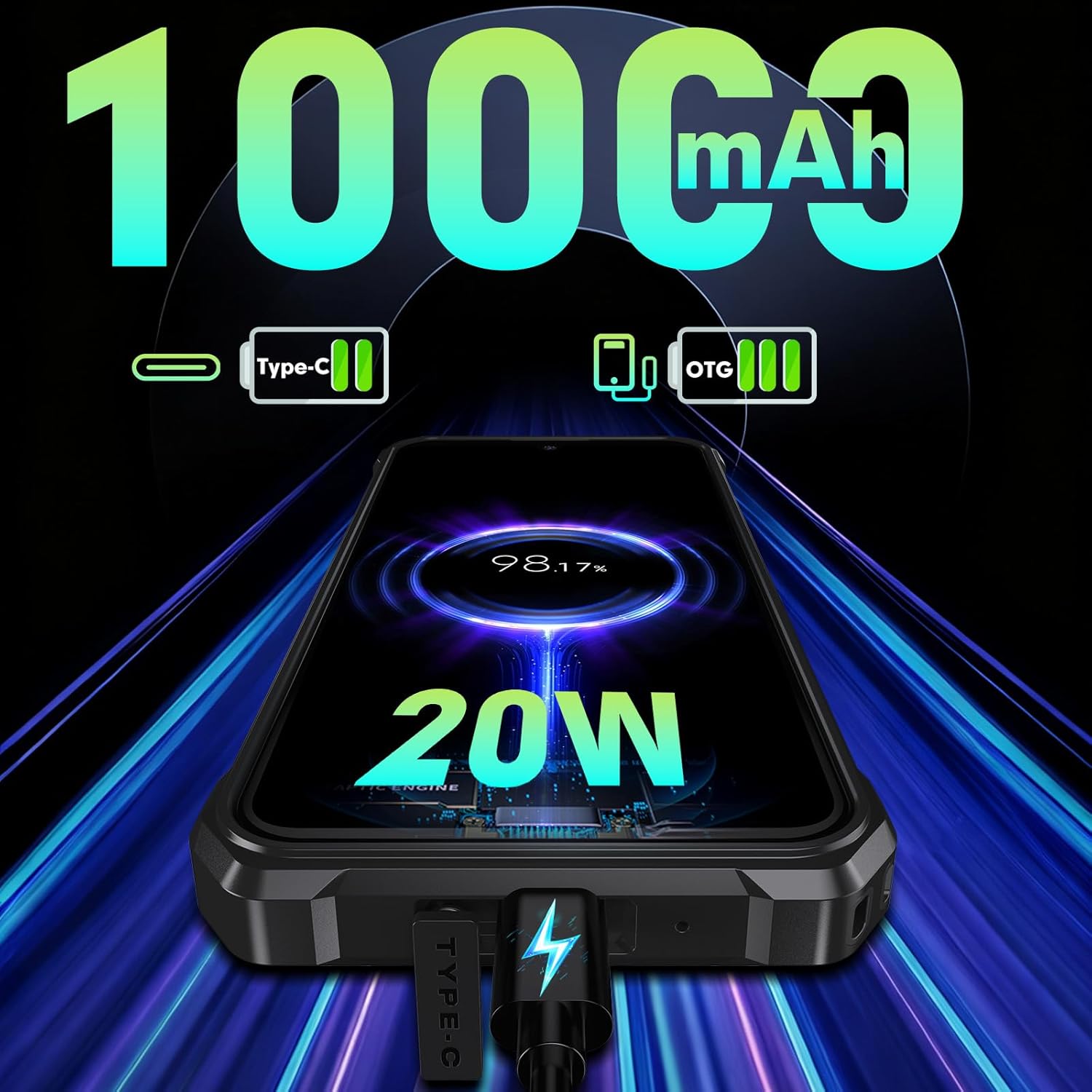
Battery anxiety is the primary driver for rugged phone purchases, and the F110L addresses this with a 10,000mAh lithium-ion cell. The manufacturer claims staggering endurance figures: 1,350 hours of standby (approx. 56 days), 70 hours of talk time, and 150 hours of continuous music playback.
These figures assume minimal background processing and moderate screen-on time, but even with a 50% real-world derating, the F110L offers multi-day—potentially week-long—usage on a single charge. This fundamentally changes the user relationship with charging. For a long-haul trucker, a backcountry guide, or a festival-goer, the “nightly charge ritual” is eliminated.
Charging technology is rated at 20W Fast Charging. While this is modest compared to the 120W speeds seen on flagship mainstream phones, it is a deliberate thermal management choice. Fast charging a 10,000mAh cell generates significant heat; in a sealed, waterproof chassis (IP69K), heat dissipation is limited. 20W represents a safe equilibrium, replenishing the massive tank in roughly 2.5 to 3 hours from empty.
Crucially, the device supports OTG (On-The-Go) reverse charging. This turns the F110L into a high-capacity power bank. A user can plug in a dead drone controller, a colleague’s dying iPhone, a headlamp, or a GPS unit and draw from the phone’s massive reserve. In emergency scenarios, this capability is potentially life-saving.
Performance Platform: Android 15 and Memory Architecture
The F110L launches with Android 15 out of the box. This is a significant differentiator in the budget-to-mid rugged segment, where devices often ship with two-year-old OS versions. Android 15 brings granular privacy controls (Predictive Back animations, Health Connect improvements, Partial Screen Sharing), enhanced satellite connectivity APIs (relevant for off-grid users), and improved battery management via App Standby Buckets.
The memory configuration is listed as 12GB RAM (4GB Physical + 8GB Virtual) and 128GB ROM, with a 2TB MicroSD (TF) expansion slot.
It is vital to parse the “Virtual RAM” marketing language. The device possesses 4GB of physical LPDDR4X RAM. The additional 8GB is a swap partition carved out of the 128GB UFS/eMMC storage. For the target demographic—running navigation, a music stream, a camera app, and a messaging client simultaneously—4GB physical RAM is adequate but tight. The virtual extension prevents aggressive app killing in the background, ensuring navigation apps don’t reload when the camera is opened. However, it is not a substitute for 8GB+ physical RAM when heavy multitasking or gaming is involved.
The 128GB internal storage is sufficient for the OS, apps, and a healthy offline map library (critical for no-signal zones). The 2TB TF card support is the professional feature here: it allows for the storage of high-resolution site documentation, weeks of 50MP RAW/DNG photos, or offline topographic maps for entire continents.
Imaging: 50MP AI Optics
The rear camera system centers on a 50MP primary sensor with AI optimization. In the rugged category, cameras have historically been an afterthought. The F110L’s spec suggests a competent documentation tool rather than a creative photography instrument.
The “AI Optimization” likely handles scene recognition (documents, whiteboards, blueprints, foliage, low light) to adjust HDR, sharpening, and noise reduction automatically. For the target user—documenting job site progress, capturing serial numbers, photographing insurance claims, or snapping trail markers—the 50MP resolution allows for significant digital cropping (zooming in on a crack in a foundation or a distant trail blaze) without losing legibility. The large 6.745″ screen serves as an excellent viewfinder and immediate review monitor for these tasks.
Connectivity: The Global Workhorse
The F110L is an unlocked Dual SIM (Dual Standby) 4G LTE device. The band support list is exhaustive, covering the vast majority of global GSM/LTE networks:
- FDD-LTE: B1/2/3/4/5/7/8/12/17/19/20/25/26/28A/28B/66
- TDD-LTE: B38/40/41
This broad band support, combined with explicit T-Mobile SIM compatibility confirmation, makes it a true “world phone” for travelers and a reliable daily driver for US subscribers on T-Mobile, AT&T (limited bands), and their MVNOs (Mint, Metro, Cricket, etc.). The absence of 5G NR modem is a conscious cost and power-saving decision; 4G LTE coverage remains superior in rural and wilderness areas where rugged phones are most utilized, and the 4G modem consumes significantly less power than early-generation 5M modems.
Additional connectivity includes NFC (for contactless payment/access cards), Bluetooth 5.2 (LE Audio support for modern hearing aids/headsets), and Multi-GNSS GPS (GPS/Glonass/Beidou/Galileo) for rapid satellite acquisition in canyons or dense foliage.
Software Experience & Warranty Assurance
Running stock-like Android 15 on 4GB RAM implies a relatively bloatware-free experience. FOSSIBOT’s brand description emphasizes “smarter operation, comprehensive privacy protection, and smoother performance.” The lack of a heavy custom skin (like OneUI or HyperOS) is a benefit on limited hardware; it leaves more RAM for user apps and ensures faster security patch adoption.
The commercial proposition is backed by a 2-Year Replacement Warranty and a 30-day free return policy, operated from a US flagship store. In a market flooded with gray-market imports with zero support, a domestic 2-year warranty covering “core components” with a listed support email (fossibotphone@163) provides a safety net that significantly de-risks the purchase.
Synthesis: Who Is This For?
The FOSSIBOT F110L (2026) is not a phone for the average consumer who wants the best camera, the thinnest bezel, or the fastest gaming chipset. It is a specialized tool.
The Ideal User Profile:
- The Field Professional: Construction managers, surveyors, linemen, and logistics drivers who need a device that survives concrete drops, rain, dust, and 14-hour shifts without a charger.
- The Off-Grid Adventurer: Overlanders, thru-hikers, and kayakers who need week-long battery life, offline maps storage (2TB), a blinding flashlight, and a speaker loud enough to hear navigation prompts over wind/engine noise.
- The “Beater” Phone Seeker: Parents buying a first phone for a clumsy teenager, or users who want a durable secondary device for high-risk activities (boating, wrenching, festivals) without risking a $1000 flagship.
Potential Compromises (Spec-Based Analysis)
- Weight/Ergonomics: A 10,000mAh battery + rugged chassis + large speaker cavity + flashlight module implies a weight likely exceeding 300g–350g. It will not disappear in a running short pocket.
- Charging Speed: 20W is slow for a 10,000mAh cell. Users must plan charging windows (e.g., overnight or during a lunch break).
- Performance Ceiling: The unspecified chipset (implied entry-level/mid-range by the 4GB RAM/20W charging/4G-only spec) will struggle with high-end 3D gaming or heavy video editing. It is a utility device, not a compute station.
- Virtual RAM Reality: The “12GB RAM” marketing claim requires user education; the 8GB virtual portion is slower storage, not fast memory.
Final Verdict
Based on the provided technical specifications, the FOSSIBOT F110L (2026) presents a remarkably coherent product strategy. It identifies the specific pain points of its target audience—battery death, inaudible audio, fragile screens, poor night vision, and lack of storage—and throws hardware resources at each one aggressively.
The 128dB speaker and 240-lumen flashlight are not gimmicks; they are force multipliers for outdoor and industrial work. The 10,000mAh battery with OTG changes the logistics of power management in the field. The inclusion of Android 15 and a 2TB expansion slot future-proofs the software and data capacity far beyond the typical lifecycle of a budget rugged phone.
At its listed price tier ($139.99 – $175.99 unlocked), the F110L offers a specification-to-dollar ratio that is exceptionally difficult to beat. It sacrifices mainstream flagship speed and svelte design to deliver something rarer: uncompromised reliability and specialized utility. For the user who measures a phone’s value by whether it works when it’s raining, dark, loud, and 50 miles from an outlet, the F110L is a compelling, purpose-built instrument.