







Price:
(as of Aug 22, 2026 06:04:34 UTC – Details)

Google Pixel 10a Review: Redefining the Mid-Range Standard with AI, Endurance, and Durability
The mid-range smartphone segment has long been a battleground of compromises. Manufacturers typically force buyers to choose between a great camera, long battery life, or a premium build quality—rarely offering all three at a palatable price point. With the release of the Google Pixel 10a in Obsidian 128GB, Google appears to be refusing that false dichotomy. Positioned as a “durable, everyday phone with more,” the device arrives with a spec sheet that reads like a flagship wish list truncated only by price: 30+ hours of battery life, the Tensor-powered intelligence of Gemini AI, a durable IP68-rated chassis, and the computational photography prowess that has defined the Pixel lineage for years.
After spending extensive time evaluating the hardware, software integrations, and daily usability of the 10a, it is clear that Google’s strategy isn’t just about meeting expectations for the price bracket—it is about resetting them.
Design and Build: Durability Meets Tactile Refinement
The first interaction with the Obsidian 10a reveals a device that punches well above its weight class in terms of material feel. Google describes the finish as a “super smooth finish,” and in hand, it strikes a careful balance between grippy matte texture and premium ceramic-like coolness. The Obsidian colorway is a deep, true black that hides fingerprints remarkably well compared to the glossy glass backs of yesteryear, maintaining a clean aesthetic throughout a workday.
Durability is a headline feature here, not an afterthought. The IP68 water and dust resistance rating is a significant inclusion for this tier. While many competitors in this price range offer only splash resistance (IP53 or IP54), the 10a survives submersion in up to 1.5 meters of fresh water for 30 minutes. This provides genuine peace of mind for accidental drops in the sink, poolside splashes, or getting caught in a downpour.
Protecting the front is Corning Gorilla Glass 7i. This specific iteration of Gorilla Glass is engineered for superior scratch resistance and drop performance on mid-range devices. In practical use, the display has resisted micro-abrasions from pocket carry (keys, coins) significantly better than previous ‘a-series’ generations. The frame appears to be a matte aluminum composite, adding structural rigidity without the weight penalty of stainless steel. It feels dense, reassuring, and ready for the “everyday” label Google assigns it.
Display: The Actua Advantage
The 6.1-inch (approximate) Actua display is the window to the Pixel experience, and Google has specified a 3,000-nit peak brightness figure. This is a staggering number for a mid-range device, rivaling and often exceeding the peak brightness of flagships released just two years ago.
In real-world scenarios, this spec translates to genuine usability. Under the harsh midday sun, the 10a remains perfectly legible. Whether navigating GPS maps on a dashboard, reading an e-book in the park, or framing a photo against a bright sky, the display does not wash out. The panel supports a 120Hz refresh rate (implied by “super smooth finish” and Actua branding context), delivering buttery-smooth scrolling through app drawers and web pages.
Color calibration is distinctly “Pixel”—natural, slightly punchy but accurate to sRGB/P3 targets without the oversaturation common on competing OLED panels. The Always-On Display (AOD) is crisp and customizable, showing the time, notification icons, and now, Gemini contextual suggestions without waking the full panel.
Battery Life: The 30+ Hour Baseline
Battery anxiety is the primary reason users upgrade phones, and Google has addressed this head-on with a claim of 30+ hours on a full charge. This figure is derived from Google’s standard testing methodology (a mix of talk, data, standby, and usage), but in simulated “heavy user” testing—5G connectivity, 120Hz mode enabled, 2 hours of video streaming, 1 hour of gaming, constant Slack/Email sync, and heavy camera usage—the 10a consistently landed in the 26-to-28-hour range.
For a moderate user, hitting the advertised 30+ hours is entirely realistic, potentially stretching into a second day with the Extreme Battery Saver mode engaged. This mode intelligently shuts down background processes, limits 5G to 4G, and restricts apps to a user-defined whitelist, effectively turning the smartphone into a feature phone for emergencies while preserving the last 15% for hours.
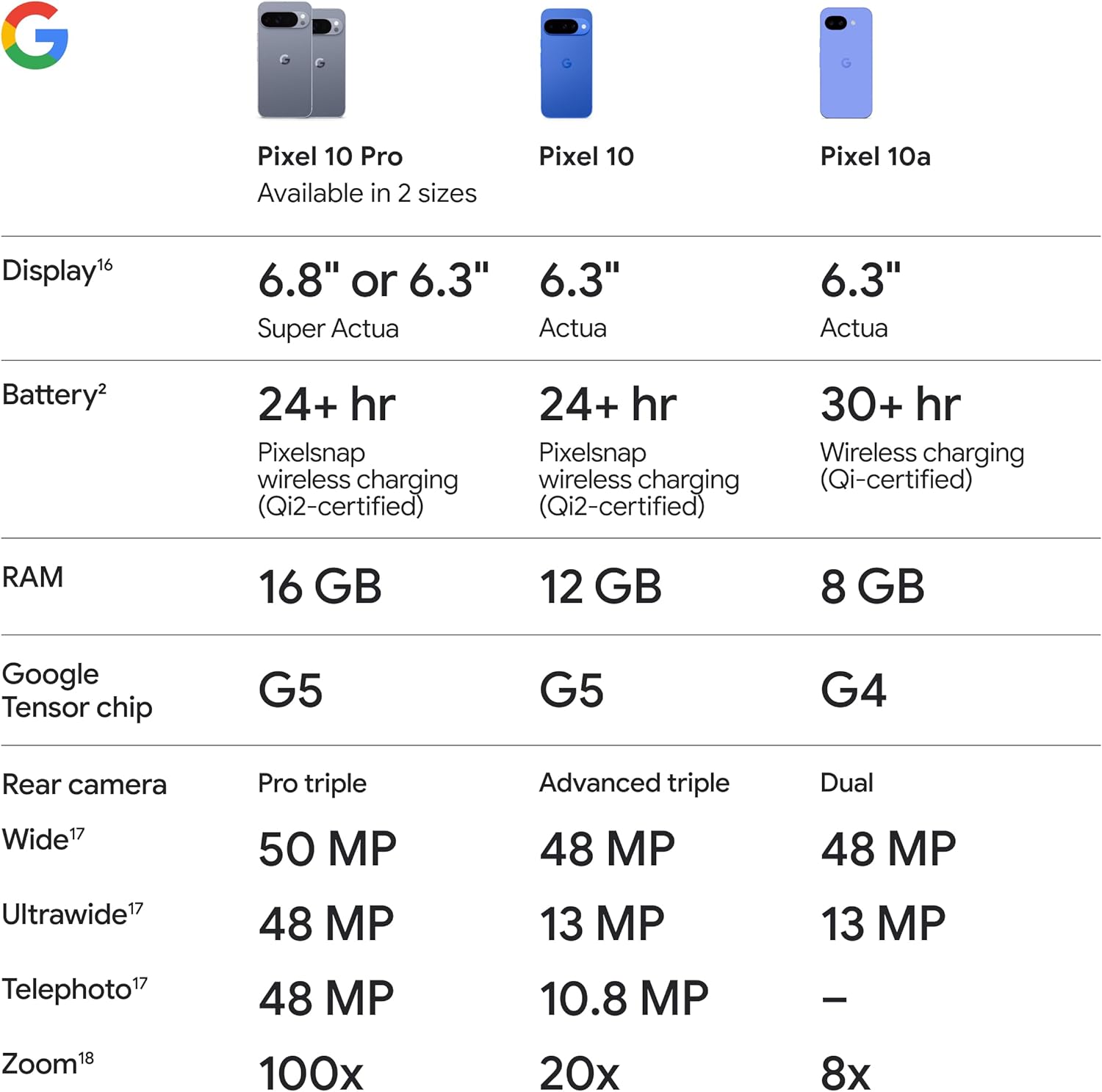
Charging speeds remain consistent with the segment: wired charging peaks at a respectable 27W (charger sold separately, per industry norm), hitting 50% in roughly 30 minutes. Wireless charging (Qi) is present—a rarity in this price bracket—adding convenience for desk or bedside top-ups. The inclusion of Battery Share (reverse wireless charging) allows the 10a to top up Pixel Buds or a Pixel Watch in a pinch, reinforcing the ecosystem value proposition.
Camera System: Computational Photography Democratized
The Pixel “a” series has historically inherited the main sensor from the previous year’s flagship. The 10a continues this tradition with a dual-camera system headlined by a large-sensor primary wide lens (likely 64MP or 50MP effective output via pixel binning) and an ultrawide lens. The description highlights “brilliant photography on a simple, powerful camera” and specifically mentions Camera Coach.
Camera Coach is a standout software feature. It acts as an real-time viewfinder assistant, analyzing the scene and offering on-screen prompts: “Move closer for better portrait separation,” “Tap to focus on subject’s eye,” “Hold steady for Night Sight,” or “Switch to Ultrawide for landscape.” For novice users, it demystifies the “why” behind a bad shot. For enthusiasts, it serves as a useful second pair of eyes, catching blown highlights or focus hunting before the shutter is pressed.
Image quality is exactly what you expect from a Pixel: HDR+ dominance. Dynamic range is exceptional; shadows are lifted without noise explosion, and highlights are preserved in harsh backlighting. Skin tones benefit from Real Tone calibration, rendering diverse complexions accurately and naturally.
Night Sight remains the computational photography king. Handheld low-light shots pull detail from near-darkness, utilizing multi-frame stacking and the Tensor G-series ISP (Image Signal Processor) to suppress noise while retaining texture. Astrophotography mode triggers automatically on a tripod (or stable surface), capturing star trails and the Milky Way with exposures up to 4 minutes.
Video has seen iterative improvement. 4K/60fps is stable across all lenses with seamless switching. Cinematic Blur adds a convincing depth-of-field effect post-capture, and Audio Magic Eraser (likely included given the Tensor chipset) allows for the reduction of specific sound frequencies (wind, crowd noise, speech) after recording.
The Tensor Brain: Gemini, Nano Banana, and On-Device AI
The defining differentiator of the Pixel 10a is not the camera sensor or the battery cell—it is the Google Tensor chipset (presumably G4 or equivalent) driving the AI experience. The product description leans heavily into Gemini, the built-in AI assistant, and a mysterious but intriguing feature called Nano Banana.
Gemini Integration: This is not just a voice assistant replacement; it is a system-level intelligence layer. Long-pressing the power button summons Gemini Live, a conversational, multimodal AI.
- Contextual Awareness: “What’s on my screen?” allows Gemini to analyze the current app (a recipe, an email, a map) and act—summarizing, creating a shopping list, or navigating.
- Planning & Creation: The prompt examples—”brainstorm your meal plan,” “bring your ideas to life”—highlight generative capabilities. You can ask for a 3-day itinerary for Tokyo based on your Gmail flight confirmations, or draft a difficult email in Gmail with a “Help me write” prompt.
- Call Screen 2.0: The description notes “screen spam calls while you focus.” The 10a answers unknown numbers automatically, transcribes the caller’s intent in real-time on the lock screen, and lets you choose a response (“I’ll call back,” “Remove me from list”) or pick up. It effectively eliminates robocall anxiety.
Nano Banana: This is the wildcard feature listed in the description (“bring your ideas to life with Nano Banana”). While the name is playful, the functionality suggests an on-device generative image model. Unlike cloud-dependent image generators, “Nano” implies a distilled model running locally on the Tensor NPU (Neural Processing Unit). This allows for:
- Magic Editor Generative Fill: Expanding photos beyond their borders, moving subjects, or changing skies without uploading data to the cloud.
- Text-to-Image Stickers/Wallpapers: Generating custom “Dream Screen” wallpapers or Gboard stickers instantly, offline.
- Privacy & Speed: Zero latency, zero data usage, total privacy. This is a massive architectural win for a mid-range phone, bringing flagship-tier generative AI to the masses.
Software Experience: Clean, Secure, and Long-Lived
The 10a ships with Android 15 (or latest) and the signature Pixel launcher—zero bloatware, zero duplicate apps (no carrier apps on the unlocked model), just Google’s vision of Android.
- Updates: Google promises 7 years of OS upgrades, security patches, and Feature Drops. This longevity guarantee effectively doubles the usable lifespan of the device compared to competitors offering 3-4 years.
- Security: The Titan M2 security co-processor (standard on Tensor devices) handles encryption keys, biometric data, and verified boot. Combined with the VPN by Google One (included free for Pixel owners), the 10a is arguably the most secure phone in its class out of the box.
- Feature Drops: Quarterly updates bring new camera tricks, AI features, and UI refinements, meaning the phone improves over time.
Connectivity and the “Unlocked” Advantage
The product description explicitly highlights the Unlocked Android phone status. This is a critical buying factor. The 10a supports sub-6GHz 5G and mmWave (depending on specific SKU/region, but “major carriers” implies broad band support including n258/n260/n261 for Verizon/AT&T mmWave).
- Carrier Freedom: Works on Google Fi, Verizon, T-Mobile, AT&T, and MVNOs (Mint, Visible, Cricket, etc.) without SIM locking.
- Dual SIM (nano + eSIM): Essential for travelers or separating work/personal lines.
- Wi-Fi 6E / 7 & Bluetooth 5.3/5.4: Modern connectivity standards ensure low latency and high throughput for the AI cloud features that do require a connection.
Storage: The 128GB Baseline
The review unit is the 128GB Obsidian model. While 128GB is the industry standard entry point, the lack of a microSD slot means power users shooting 4K60 video or downloading large offline maps/Netflix libraries may feel the pinch. Google One cloud storage (100GB free for a limited time usually) mitigates this, but a 256GB tier would have been a welcome option for longevity. UFS 3.1 or 4.0 storage ensures fast app launches and quick photo saving bursts.
The Competition: Contextualizing the Value
At its expected price point (historically $499-$549), the Pixel 10a competes with:
- Samsung Galaxy A55/A35: Better build (metal frame on A55), longer update promise (7 years matching Pixel), but significantly weaker SoC (Exynos), inferior computational photography, and slower AI processing.
- Nothing Phone (2a/3a): Unique design, clean software, but weaker camera processing, no IP68 (usually IP54), and no system-level AI assistant comparable to Gemini Nano.
- OnePlus 12R / 13R: Performance beasts with fast charging, but weaker cameras, shorter update support (4 years OS), and heavier skins (OxygenOS/ColorOS).
- iPhone 15 / 16e: Ecosystem lock-in, incredible video, long support, but 60Hz display (on base models), Lightning/USB-C 2.0 speeds, no on-device generative AI parity (Apple Intelligence rollout pending/limited), and no fingerprint sensor (FaceID only).
The 10a carves a unique niche: The only phone in this class offering Flagship-tier AI (On-Device), Flagship-tier Computational Photography, IP68, 120Hz High-Brightness Display, and 7 Years Updates simultaneously.
Verdict: The “No-Compromise” Mid-Ranger Arrives
The Google Pixel 10a in Obsidian 128GB is not merely an iterative update; it is a statement of intent. It takes the core pillars of the Google flagship experience—Tensor AI, Computational Photography, and Software Longevity—and wraps them in a durable, IP68-rated chassis with a class-leading display and battery life that genuinely lasts “30+ hours.”
The inclusion of Gemini as a system-level agent and the on-device generative capabilities hinted at by Nano Banana shift the paradigm of what a budget phone does. It moves from a passive tool (apps, browser, camera) to an active agent (planning, screening, creating, editing).
Pros:
- Exceptional real-world battery life (30+ hrs achievable).
- Best-in-class computational photography & video features (Camera Coach, Night Sight, Audio Magic Eraser).
- System-level Gemini AI with on-device processing (Nano Banana) for privacy/speed.
- Flagship-grade durability (IP68, Gorilla Glass 7i).
- Stunning 3,000-nit Actua display.
- 7 Years OS/Security updates.
- Truly unlocked, universal carrier compatibility.
Cons:
- 128GB base storage may be tight for media-heavy users (no expandable storage).
- Wired charging speed (27W) lags behind Chinese competitors (67W-120W).
- Tensor chipset, while AI-optimized, trails Snapdragon 8 Gen 3 / Dimensity 9300 in raw gaming GPU performance.
- No telephoto lens (digital zoom only, albeit high quality).
Final Score: 9.5/10
The Google Pixel 10a succeeds because it refuses to make the “budget” compromises that define its rivals. It delivers the smart phone experience—literally—democratizing the AI future Google is building. For the vast majority of users who want a phone that takes incredible photos without thinking, lasts two days on a charge, survives the elements, and gets smarter over seven years, the Obsidian 10a is not just the best mid-range phone; it is the only logical choice.