





Price:
(as of Aug 22, 2026 12:43:27 UTC – Details)

Samsung Galaxy S25 Ultra 5G (SM-S938B/DS) International Version: A Comprehensive Technical Review
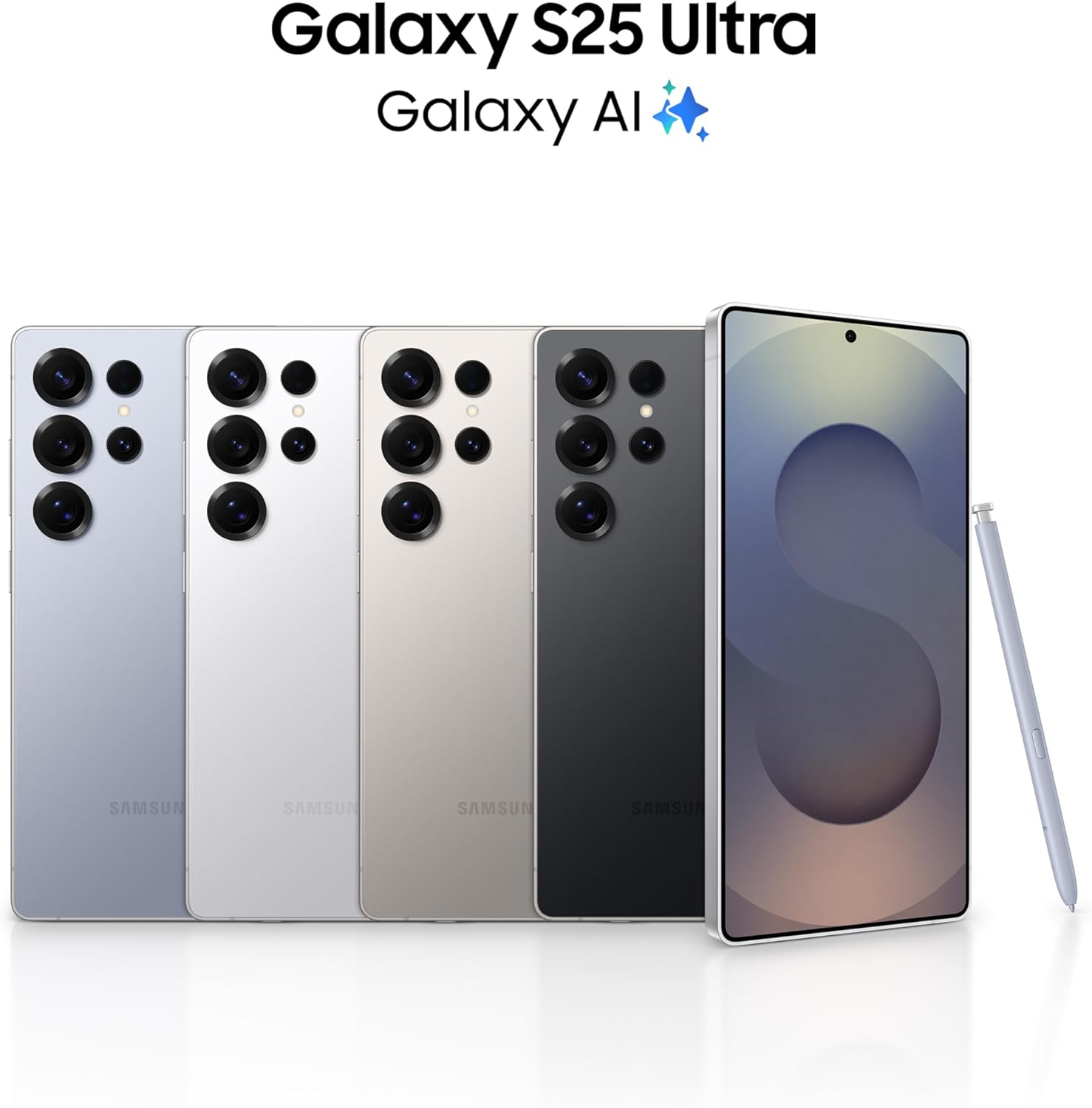
The flagship smartphone landscape is defined by the pursuit of convergence—merging professional-grade imaging, desktop-class processing, and refined industrial design into a pocketable form factor. The Samsung Galaxy S25 Ultra 5G, model SM-S938B/DS, arrives as the 2025 iteration of this philosophy. Clad in a distinctive Titanium Silver Blue finish and equipped with 256GB of storage alongside 12GB of RAM, this international dual-SIM variant aims to set the benchmark for the Android ecosystem. This review dissects the hardware, platform capabilities, and critical network considerations of this factory-unlocked GSM device based strictly on its technical specifications.
Industrial Design and Material Science
The physical identity of the S25 Ultra is immediately communicated through its material palette. Samsung has moved beyond standard aluminum, employing a Grade 5 Titanium frame. This specific alloy offers a superior strength-to-weight ratio compared to the Armor Aluminum found on previous generations, contributing to a device that feels dense yet manageable at 218 grams (7.69 oz). The dimensions—162.8 x 77.6 x 8.2 mm—maintain the signature squared-off aesthetic of the Ultra lineage, providing flat edges that facilitate a secure grip and allow the phone to stand upright on flat surfaces.
The front facade is protected by Corning Gorilla Armor 2, a significant evolution in cover glass technology. Unlike standard Victus implementations, Armor 2 focuses heavily on anti-reflective properties (DX coating), drastically reducing surface glare in high-ambient light conditions without compromising scratch resistance. The rear panel utilizes Gorilla Glass Victus 2, ensuring parity in drop protection. The IP68 rating (implied by the sealed construction standard for this tier) ensures dust tightness and water resistance up to 1.5 meters for 30 minutes. The Titanium Silver Blue colorway utilizes a PVD (Physical Vapor Deposition) finish on the frame, offering a muted, professional hue that masks fingerprints effectively on the matte glass back.
Display Technology: The LTPO 2X Advantage
The 6.9-inch Dynamic LTPO AMOLED 2X panel serves as the primary interface, boasting a 19.5:9 aspect ratio and a resolution of 1440 x 3120 pixels (~498 ppi). The “LTPO” (Low-Temperature Polycrystalline Oxide) backplane is the critical differentiator here, enabling adaptive refresh rates ranging from 1Hz to 120Hz. This granular control allows the display to drop to 1Hz for Always-On Display (AOD) and static content, conserving significant battery life, while ramping instantly to 120Hz for scrolling and gaming.
Peak brightness is rated at 2,600 nits, a figure achievable typically on a small percentage of the screen area (APL) when viewing HDR content in direct sunlight. The panel supports HDR10+ certification, ensuring dynamic tone mapping for compatible streaming content. The 480Hz PWM (Pulse Width Modulation) dimming rate is a notable specification for sensitivity; while not DC dimming, this high frequency minimizes perceptible flicker for users susceptible to PWM-induced eye strain. With a ~92.5% screen-to-body ratio, bezels are minimized to a symmetrical chin and forehead, housing the ultrasonic in-display fingerprint sensor (qualcomm 3D Sonic Gen 2 or equivalent) for secure biometric authentication.
Platform Performance: Snapdragon 8 Elite (3nm)
The international SM-S938B/DS is powered by the Qualcomm SM8750-AB Snapdragon 8 Elite, fabricated on TSMC’s 3nm process node (N3E). This represents a seismic shift in mobile architecture, moving away from standard ARM Cortex cores to custom Oryon V2 Phoenix cores.
The CPU configuration is an octa-core setup comprising:
- 2x Prime Cores: 4.47 GHz Oryon V2 Phoenix L (Performance)
- 6x Performance Cores: 3.53 GHz Oryon V2 Phoenix M (Efficiency/Performance hybrid)
The removal of traditional low-power “efficiency” cores (Cortex-A5xx class) in favor of mid-tier Oryon cores suggests a strategy focused on sustained multi-threaded performance rather than extreme idle power saving. The Adreno 830 GPU accompanies this, promising ray-tracing capabilities and desktop-class rendering features like Unreal Engine 5 Nanite/Lumen support.
Software launches with Android 15 skinned with One UI 7. Samsung’s commitment to 7 major Android OS upgrades and 7 years of security patches extends the functional lifespan of the hardware significantly, protecting the buyer’s investment well into the early 2030s. The 12GB LPDDR5X RAM (standard on the 256GB SKU) ensures ample headroom for Samsung’s aggressive multitasking implementation (split-screen, pop-up view, DeX mode) and on-device AI processing.
Imaging System: The Quad-Camera Architecture
The camera module protrudes distinctly, housing four distinct optical pathways. The headline specification is the 200 MP wide sensor (1/1.3″, f/1.7, 24mm equivalent, 0.6µm pixels). This sensor utilizes 16-in-1 pixel binning (default 12.5 MP output) for superior low-light sensitivity and dynamic range, while retaining the option for full-resolution capture. Multi-directional PDAF (Phase Detection Autofocus) and OIS (Optical Image Stabilization) ensure rapid locking and steady handheld shots.
The telephoto system is a dual-lens arrangement offering true optical zoom versatility:
- 3x Telephoto: 10 MP, f/2.4, 67mm (1/3.52″, 1.12µm), PDAF, OIS. Ideal for portrait compression and mid-range zoom.
- 5x Periscope Telephoto: 50 MP, f/3.4, 111mm (1/2.52″, 0.7µm), PDAF, OIS. The high resolution here enables “lossless” 10x zoom via in-sensor cropping (50MP -> 12.5MP), bridging the gap to 100x “Space Zoom” (hybrid digital).
The 50 MP Ultrawide (f/1.9, 120°, 1/2.5″, 0.7µm) features Dual Pixel PDAF—rare for ultrawides—enabling fast focus for macro photography (close focus) and Super Steady video stabilization. Laser AF assist sits alongside the LED flash, providing instantaneous depth measurement in low light.
Video specifications are professional-grade:
- 8K @ 24/30fps: Highest resolution capture, suitable for cropping/reframing in post.
- 4K @ 120fps: High frame rate for smooth slow-motion playback.
- 1080p @ 240fps: Ultra-slow motion.
- 10-bit HDR / HDR10+: Over 1 billion colors for grading flexibility.
- Stereo Sound Recording / Gyro-EIS: Enhanced audio capture and electronic stabilization fusion.
Software features like “Best Face” (compositing group photos for optimal expressions) and “Single Take” leverage the ISP (Image Signal Processor) of the Snapdragon 8 Elite for multi-frame processing.
Connectivity and Network Strategy: The GSM Limitation
This is the most critical section for potential buyers in North America. The SM-S938B/DS is an International Version. It is Factory Unlocked for GSM networks only.
Supported Bands:
- 2G/3G: Comprehensive global roaming bands (GSM 850/900/1800/1900; HSDPA 850/900/AWS/1900/2100).
- 4G LTE: Extensive band support (Bands 1, 2, 3, 4, 5, 7, 8, 12, 13, 17, 18, 19, 20, 25, 26, 28, 32, 38, 39, 40, 41, 66). Notably includes Band 13 (Verizon LTE) and Band 71 (T-Mobile 600MHz) absence is notable—Band 71 is missing from the provided list, which impacts rural T-Mobile coverage.
- 5G NR: Sub-6GHz bands (n1, n2, n3, n5, n7, n8, n12, n20, n25, n26, n28, n38, n40, n41, n66, n75, n77, n78) supporting SA/NSA. Critically missing: n260/n261 (mmWave).
Carrier Compatibility Reality:
- AT&T & T-Mobile (and MVNOs like Cricket, Metro, Mint): Compatible. Volte/VoWiFi generally function, though provisioning may require a SIM swap or IMEI registration.
- Verizon / Sprint (Legacy CDMA) / US Cellular: Incompatible. The device lacks CDMA radio firmware and Verizon-specific 5G mmWave antennas. It will not activate on Verizon’s network, nor will it fallback to 1xRTT/EVDO.
- Warranty: No US Manufacturer Warranty. Samsung US will not honor repairs on the SM-S938B model. Service must be handled via third-party shops or international warranty channels (often requiring shipping to the region of origin).
SIM Configuration: Hybrid Dual SIM (Nano-SIM + Nano-SIM + eSIM), supporting Dual Standby (DSDS) with a maximum of two active lines simultaneously (e.g., 2 Physical SIMs, or 1 Physical + 1 eSIM).
Additional connectivity includes Wi-Fi 7 (802.11be), Bluetooth 5.4, UWB (Ultra Wideband for digital car keys/Find My), and NFC. The USB port is USB 3.2 Gen 1 (5Gbps) with DisplayPort 1.2 output, enabling wired DeX mode and fast data transfer—a feature often downgraded on base models.
Battery, Charging, and Audio
While the provided spec sheet omits the explicit mAh rating (standard for this chassis is typically 5,000 mAh), the efficiency of the 3nm Snapdragon 8 Elite and LTPO 1Hz display suggests excellent endurance targets. Charging remains at 45W Wired (PD 3.0 / PPS), 15W Wireless (Qi), and 4.5W Reverse Wireless. The lack of a charger in the box aligns with current environmental regulations. Audio is handled by stereo speakers (earpiece + bottom-firing) tuned by AKG with Dolby Atmos support; the 3.5mm jack remains absent.
Storage and Memory Configuration
The reviewed unit ships with 256GB UFS 4.0 storage and 12GB LPDDR5X RAM. UFS 4.0 offers sequential read speeds up to 4,200 MB/s, drastically reducing game load times and app installation durations. Unlike some regions where the base 256GB model drops to 8GB RAM, this specific SKU (SM-S938B/DS) retains 12GB, ensuring parity with higher storage tiers for multitasking longevity. There is no microSD card slot.
Conclusion: A Specialist’s Tool
The Samsung Galaxy S25 Ultra 5G (SM-S938B/DS) in Titanium Silver Blue is, on paper, the most technically competent Android smartphone available at its launch window. The combination of the Gorilla Armor 2 anti-reflective display, the paradigm-shifting Snapdragon 8 Elite Oryon architecture, and the versatile quad-camera system with dual optical zooms creates a compelling package for power users, mobile photographers, and DeX enthusiasts.
However, the International Version designation carries heavy caveats for the US market. The lack of CDMA support, missing mmWave 5G, potential absence of Band 71 (critical for T-Mobile rural reach), and the complete absence of a US warranty transform this device from a mainstream recommendation into a specialist import. It is ideally suited for:
- International travelers needing broad global band support.
- Users on AT&T or T-Mobile MVNOs who understand APN configuration and accept third-party repair risk.
- Developers/Enthusiasts requiring an unlocked bootloader (often easier on International models) and 12GB RAM base configuration.
If your usage scenario fits the GSM-only, no-warranty profile, the hardware on offer is best-in-class. If you require Verizon connectivity, mmWave speeds, or the safety net of a domestic warranty, the US model (SM-S938U/DS) remains the correct procurement target.