



Price: $70.29
(as of Aug 22, 2026 13:13:42 UTC – Details)

MIRO 4G Cell Phone (Android 14 Go Edition) Review: The Ultimate Budget-Friendly Bridge for Kids, Seniors, and Minimalists
In a market saturated with flagships boasting quadruple-camera arrays, 120Hz displays, and four-figure price tags, the MIRO 4G Cell Phone—marketed specifically as the “A1” model in its branding—arrives as a deliberate antithesis to modern excess. It does not pretend to be a powerhouse. Instead, it positions itself as a specialized tool: a “bridge that brings families closer,” targeting the often-overlooked demographics of young children taking their first steps into digital independence and seniors seeking connection without complexity. Priced aggressively in the entry-level tier and running Android 14 Go Edition, this Blue handset makes a compelling case for the “dumb-smartphone” hybrid category. After a thorough analysis of its specifications, design philosophy, and feature set, here is a detailed breakdown of where the MIRO A1 shines, where it draws the line, and exactly who should buy it.
Design Philosophy: Lightness as a Feature
The first thing you notice about the MIRO A1 is its absence of heft. Weighing in at approximately 6.42oz (182g)—though the product listing also cites 7.05oz (200g) in a separate bullet, suggesting a slight variance with the battery installed—it is startlingly light. In an era where 200g+ is the standard baseline, the A1 feels almost hollow in the hand, but in the best possible way. For a senior with arthritis or a child with developing motor skills, this weight reduction isn’t just a spec sheet number; it is a usability requirement.
The ergonomics are built around the “One-Hand Perfect Grip.” The chassis is compact enough to be navigated entirely by a thumb, eliminating the need for precarious two-handed balancing acts. The Blue finish is understated and matte, resisting fingerprints well. Crucially, the design incorporates rounded edges and “anti-drop durability.” While no phone is indestructible, the marketing emphasizes “no stress over accidental drops”—a direct nod to the target audience. The removable back cover (necessary for the battery and SIM/microSD access) adds a layer of utilitarian ruggedness; if the back cracks, it’s a cheap replaceable part, not a shattered unibody glass sandwich.
The Display and Interface: Big, Bold, and Simple
The 6-inch display hits a sweet spot for this category. It is large enough to render text legible for aging eyes and video calls enjoyable for grandparents, yet the phone’s overall footprint remains manageable. Don’t expect AMOLED contrast or high refresh rates; this is a standard LCD panel suitable for reading, browsing, and basic media consumption.
The real star of the show is the software implementation. Running Android 14 Go Edition, the MIRO A1 utilizes Google’s optimized lightweight OS designed explicitly for devices with 2GB of RAM or less. This is not a skinned, bloatware-heavy experience. It is near-stock Android, stripped of heavy animations and background processes that would choke 2GB of RAM. For the intended user, this translates to a “streamlined interface” with “intuitive touch controls.” The Go Edition apps (Maps Go, Camera Go, Gallery Go) launch faster and consume less storage than their full-fat counterparts. The description highlights “Simple controls for independent use,” and the OS delivers on that promise—large icons, clear menus, and a lack of confusing gesture navigation systems that often confound first-time users.
Performance: Managing Expectations with 2GB/32GB
Let’s be clear: The MediaTek chipset (implied by the 4G/Go Edition class) paired with 2GB of RAM and 32GB of internal storage is not built for multitasking heavy apps, gaming, or 4K video editing. It is built for sequential tasking: Open WhatsApp -> Send message -> Close. Open Camera -> Take photo -> Close.
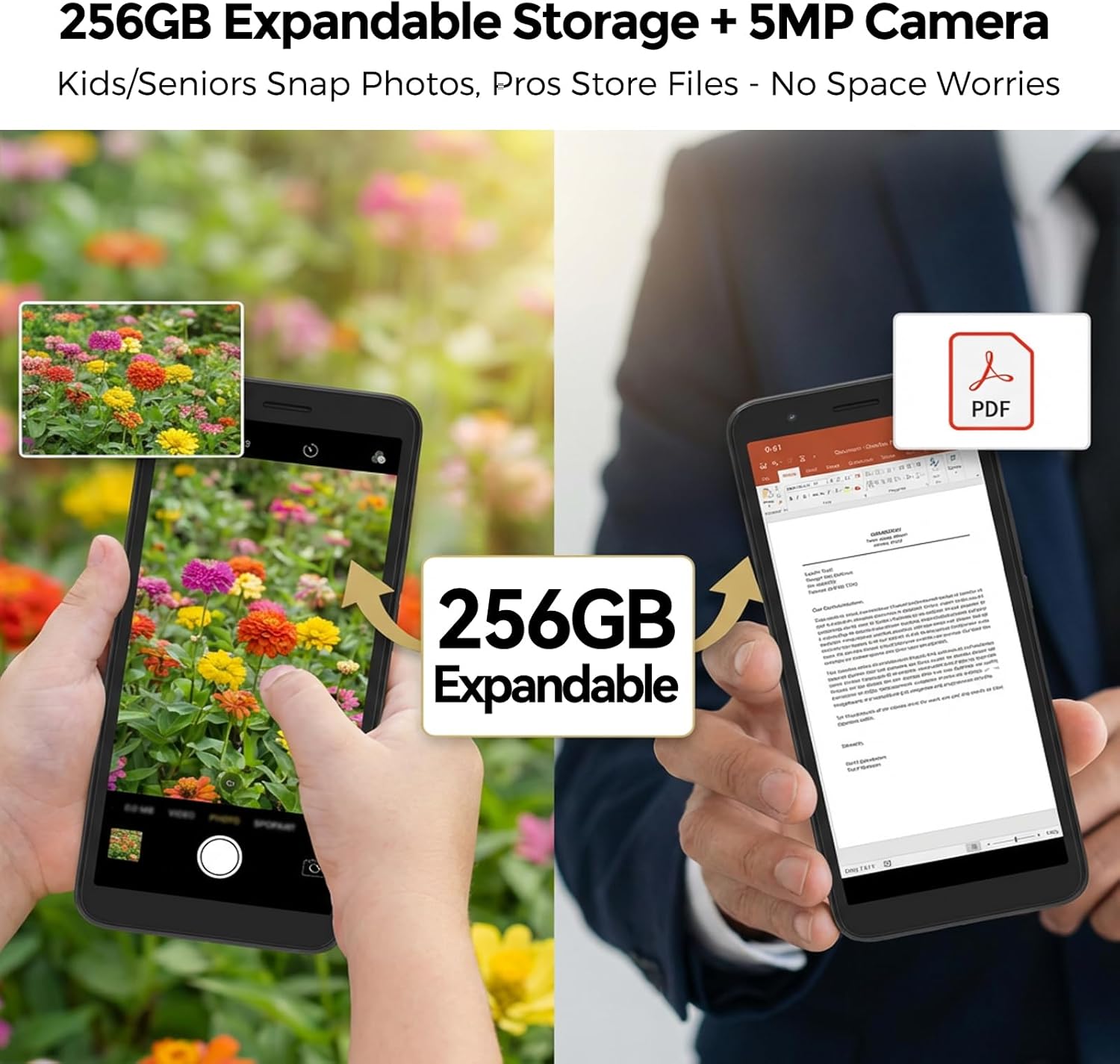
For a child running educational apps (drawing, math, reading) or a senior running WhatsApp, Facebook Lite, and the dialer, this configuration is adequate. The 32GB internal storage would be a dealbreaker on a modern phone, but the 256GB microSD expandability saves the day. The product description frames this perfectly: “From work files to childhood memories… eliminates the stress of ‘running out of space.'” For a kid saving hundreds of drawings and photos, or a senior storing years of family pictures received via chat, the expansion slot transforms the device from a frustrating bottleneck into a “portable storage hub.” Note that Android Go handles adoptable storage well, allowing the SD card to function seamlessly as internal space for apps.
The Camera: Functional, Not Photographic
The 5MP main + 2MP depth/assist sensor rear setup and a basic front-facing camera are strictly utilitarian. In 2024, 5MP is low resolution, but context is king. This camera is not for Instagram influencers; it is for:
- Video Calling: The front camera facilitates the “Grandparents video chat with grandchildren” use case highlighted in the marketing.
- Document Scanning: Snapping a prescription label or a school permission slip.
- Visual Memory Aids: Seniors photographing parking spots, medication labels, or grocery lists.
- Kid Creativity: The “drawing/creative tools” mentioned likely utilize the camera for AR filters or simple photo decoration.
Low-light performance will be poor, and shutter lag will be noticeable. But for “snapping photos without deleting favorites” (enabled by the 256GB SD support), it serves its purpose.
Battery Strategy: The Removable Revolution
This is the MIRO A1’s most distinct hardware differentiator: a 3000mAh Removable Battery.
In 2024, this is a rarity. The product description leans heavily into this: “Tired of waiting hours for your phone to charge? Swap in a fully charged spare battery for instant power—no more being tied to an outlet or carrying heavy power banks.”
For the target demographics, this is genius.
- Seniors: Often forget to plug phones in overnight. A charged spare in a kitchen drawer means the phone is never dead during an emergency.
- Travel/Backup Use: As a “travel backup phone,” carrying a flat spare battery takes up less space than a power bank and cable.
- Longevity: Lithium-ion batteries degrade. In two years, when the battery holds 60% charge, the user buys a $10 replacement battery rather than a $100 new phone (or a $80 repair fee).
The 3000mAh capacity is modest, but on a low-res 6-inch screen with a low-power 4G chipset and Android Go, “all-day use for calls, texts, and light browsing” is a realistic claim. The inclusion of a dedicated charger in the box (not just a cable) facilitates charging the spare battery externally if the user purchases a standalone cradle, though the phone itself charges via standard USB cable.
Connectivity: The Global Communicator
The Dual SIM (Dual Standby) implementation is a major value add. The description explicitly mentions compatibility with AT&T, T-Mobile, and Mint Mobile (T-Mobile MVNO), covering the major GSM networks in the US. It lacks Verizon certification (common for uncertified budget devices), so buyers on Verizon or US Cellular should verify IMEI compatibility before purchasing.
The utility here is threefold:
- Work/Life Separation: One SIM for personal, one for work/business.
- Travel: Keep home SIM active for 2FA texts while using a local data SIM abroad— “travel overseas without extra fees.”
- Coverage Redundancy: Two carriers increase the odds of signal in rural areas.
Add 4G LTE, Wi-Fi, Bluetooth, and—crucially—a 3.5mm Headphone Jack. The jack is a non-negotiable for many seniors who prefer wired headsets for call clarity and hate Bluetooth pairing rituals, and for kids using wired school headphones.
Target Audience Deep Dive
1. The “First Phone” for Kids
The marketing leans hard here: “Loaded with age-appropriate learning/creative tools (drawing, math, reading).” Android Go’s parental controls (Family Link) work natively. The low cost removes the anxiety of a $500 screen shatter. The durability focus and light weight make it backpack-friendly. It gives the child connectivity (GPS tracking for parents, emergency calls) without the gateway to high-end gaming or unsupervised social media scrolling that a flagship provides.
2. The Senior “Connection Device”
“Large, easy-to-read screen + intuitive touch controls… Amplified sound ensures crisp calls.” This addresses the three biggest pain points for seniors: Vision (UI scaling), Hearing (volume/clarity), and Cognitive Load (Simple UI). The removable battery solves the “dead phone” emergency scenario. The pre-applied screen protector and included case/accessories mean it works out of the box—no trip to the carrier store for setup required.
3. The Digital Minimalist / Backup / Travel Phone
For the tech-savvy user carrying a $1000 flagship, the MIRO A1 is the perfect “Weekend Phone” or “Festival Phone.” It supports all your 2FA apps, Uber, Maps, and Spotify (Lite), but fits in a coin pocket. If it gets lost, stolen, or submerged in a porta-potty, the financial loss is negligible. The Dual SIM makes it a beast for international travel.
In-Box Experience: Zero Friction Setup
The unboxing experience is designed for zero friction. The package includes:
- A1 Smartphone
- Pre-Pasted Screen Protector (Huge time saver)
- Battery (Removable, installed or separate)
- Charger (Wall brick included—rare now)
- USB Cable
- User Manual
- (Implied/Standard) SIM eject tool
“Ready to use right out of the box with no tricky installation.” For a gift buyer shipping this directly to an elderly parent across the country, this completeness is vital. The recipient opens the box, puts the back cover on, presses the power button, and it works.
The Verdict: A Masterclass in Constraint-Based Design
The MIRO 4G Cell Phone (A1) is not a “good smartphone” by conventional reviewer metrics. It has a low-res screen, slow processor, basic camera, and thick bezels. But it is an exceptional product because it understands its user perfectly.
It solves specific problems:
- Problem: “Phones are too fragile/expensive for my 8-year-old.” -> Solution: Cheap, light, durable, parental controls built-in.
- Problem: “My mom can’t see the icons, hears poorly, and forgets to charge.” -> Solution: Big UI, loud speaker, removable battery, simple OS.
- Problem: “I need a second line for travel/work but hate carrying two bricks.” -> Solution: Ultra-light, Dual SIM, 3.5mm jack, expandable storage.
At its price point, the compromises (performance, camera, build materials) are not flaws; they are the enablers of the low weight, low cost, and removable battery. The inclusion of Android 14 Go Edition ensures it isn’t running obsolete, insecure software—it has modern security patches and API support for current apps.
Should you buy it?
- YES, if you are buying a first phone for a child (ages 6-12), a communication lifeline for a senior (70+), a dedicated international travel burner, or a minimalist digital detox device.
- NO, if this is intended as a primary daily driver for a teenager or adult who uses social media heavily, takes photos they care about, plays games, or expects snappy app switching.
The MIRO A1 succeeds because it refuses to be everything to everyone. It is a communication appliance—reliable, simple, light, and user-repairable (battery). In a world of sealed, fragile, distracting glass slabs, that focused utility is refreshing.