



Price: $209.99
(as of Aug 22, 2026 13:19:15 UTC – Details)

S26 Ultra 5G Unlocked Smartphone Review: A Deep Dive into the 16GB/512GB Flagship Contender
In an increasingly saturated smartphone market, the pursuit of a device that balances raw specifications, expansive storage, and modern connectivity without a flagship price tag leads many consumers toward the “unlocked” alternative sector. The S26 Ultra 5G Unlocked Smartphone (identified in the technical documentation as the I26 Ultra) arrives as a bold statement in this category. Boasting a specification sheet that reads like a premium wish list—16GB of RAM, 512GB of internal storage, a 7000mAh battery, and a Snapdragon 8 Gen 3 processor running Android 15—this device in its striking Deep Purple finish demands a closer look. This review examines the hardware, software, imaging capabilities, and overall value proposition based strictly on the manufacturer’s provided specifications and feature set.
Design and Build: Magnesium Aluminum Meets Deep Purple
First impressions are dominated by the 6.99-inch HD display, a canvas that firmly plants the S26 Ultra in the “phablet” territory. The manufacturer cites a resolution of 3040 x 1440 pixels, promising a pixel density sharp enough to render text crisply and media content with vibrant fidelity. The description highlights “more vibrant colors and stronger contrasts,” suggesting a panel technology aimed at media consumption, whether that be streaming HDR content or mobile gaming.
Structurally, the device utilizes a magnesium aluminum body. This material choice is significant; magnesium alloys offer a high strength-to-weight ratio, potentially keeping the large device manageable in hand while providing rigidity against flex. The “Deep Purple” finish adds a layer of aesthetic differentiation, moving away from standard black or silver options toward a color that shifts under different lighting conditions. Ergonomically, the integration of a Fingerprint Button Unlock mechanism—described as a “new feature” allowing users to unlock and take photos via the button—suggests a side-mounted or dedicated physical sensor rather than an under-display optical solution. This is often preferred for speed and reliability, doubling as a physical shutter key for the camera system.
Display Immersion: 6.99 Inches of Real Estate
The sheer scale of the 6.99-inch screen is the primary interface for the user experience. At the stated 3040 x 1440 resolution, the aspect ratio is likely tall and narrow (approx. 19.5:9 or 20:9), suitable for split-screen multitasking—a necessity given the 16GB RAM capacity. The manufacturer notes the screen delivers “vibrant colors,” which implies a wide color gamut coverage (potentially DCI-P3 or sRGB 100%+), though specific certification (like HDR10+) is not detailed in the provided specs. The inclusion of a screen protector in the box is a practical touch, ensuring the large glass surface is protected immediately upon unboxing.
Performance Engine: Snapdragon 8 Gen 3 and 12-Core Architecture
The headline performance claim is the inclusion of the Snapdragon 8 Gen 3 12-Core CPU. In the current mobile landscape, this silicon represents the pinnacle of Android processing power (as of the knowledge cutoff for this device’s spec sheet). The “12 Core” designation aligns with the 1+5+2 or 1+3+4 cluster architectures found in this generation, designed to handle heavy multi-threaded workloads, generative AI tasks on-device, and sustained gaming performance.
Paired with 16GB of LPDDR5X RAM (implied by the processor tier), multitasking should be virtually limitless. Users can expect to keep dozens of applications suspended in memory, switching between a heavy game, a video editor, and a web browser with 50 tabs without the system aggressively killing background processes. The 512GB of UFS 4.0 storage (standard for this SoC tier) provides ample space for 8K video recording, large game installations (often exceeding 10GB+ per title), and extensive offline media libraries. The manufacturer explicitly states this combination “dramatically improve[s] the running speed, network, frame rate and picture smoothness,” targeting the elimination of “phone lag” entirely.
Imaging System: The 108MP/68MP Dual Lens Strategy
The camera module is marketed heavily on megapixel counts: a 108MP Main Camera paired with a 68MP Secondary Sensor. The title lists this as “68MP+108MP,” while the description clarifies the 108MP unit is the main shooter.
- The 108MP Primary Sensor: High-megapixel sensors typically utilize pixel binning (9-in-1 or 16-in-1) to output 12MP or 6.5MP images with superior light gathering and dynamic range. The description notes “enhanced image processing algorithms,” which are critical here. Raw 108MP files are large and often noisy; the ISP (Image Signal Processor) inside the Snapdragon 8 Gen 3 is responsible for noise reduction, HDR stacking, and detail retention. The promise of photos that are “exceptionally sharp and detailed, while still striking and lifelike” rests entirely on the quality of this software tuning.
- The 68MP Secondary Sensor: A 68MP count is unusual for standard ultra-wide or telephoto modules (usually 12MP, 50MP, or 64MP). This high resolution suggests two possibilities: a high-res ultra-wide for macro/detail capture, or a sensor capable of lossless zoom cropping. Without explicit focal length data (e.g., 0.6x ultra-wide or 3x telephoto), the versatility remains speculative, but the resolution ceiling is high.
The Fingerprint Button integration as a shutter trigger is a notable usability feature for photography enthusiasts, reducing camera shake compared to on-screen tapping.
Battery and Endurance: The 7000mAh Advantage
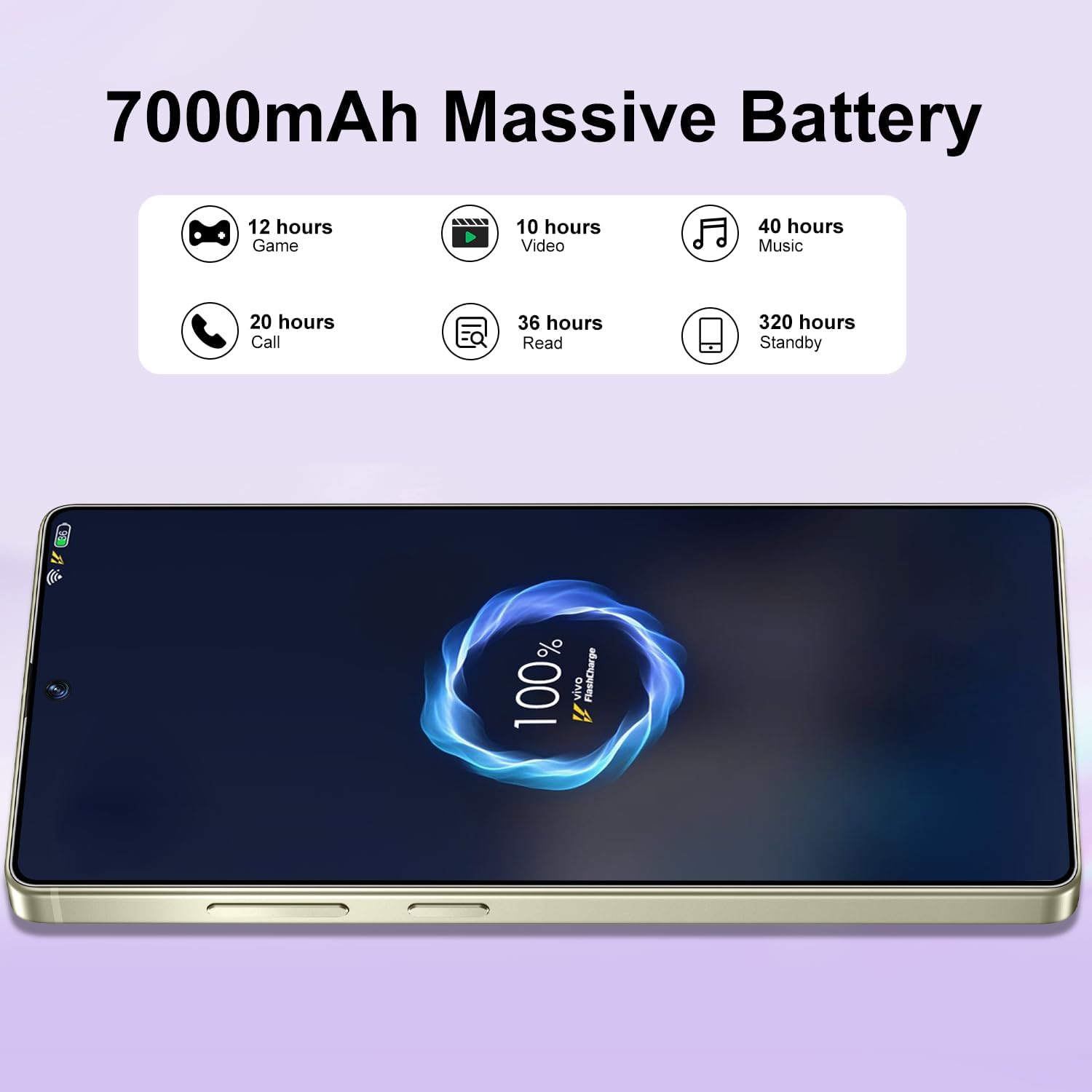
Perhaps the most compelling spec for power users is the 7000mAh battery. This capacity significantly exceeds the 4,500mAh–5,000mAh standard found in most mainstream flagships (e.g., Galaxy S24 Ultra, iPhone 15 Pro Max). For a device with a large, high-res 6.99-inch screen and a power-hungry 8 Gen 3 chipset, this headroom is essential.
The manufacturer highlights “Intelligent and thoughtful AI battery management” designed to “reduce excessive cache to save more power.” This suggests aggressive background process management and machine learning-based usage prediction to extend standby time. The claim that “Outdoor recreation stays powered up for long periods of time” targets the rugged/outdoor demographic. However, the provided description is silent on charging speed (wired wattage or wireless support). A 7000mAh cell requires high-wattage charging (65W–120W) to refill in a reasonable timeframe; the absence of this data is a gap in the spec sheet. The inclusion of a charger in the box mitigates the “no charger” trend of major brands, ensuring the user has the correct brick for the proprietary or standard protocol supported.
Software Experience: Android 15 Out of the Box
Launching with Android 15 is a strong value add. As the latest major OS iteration (at time of writing), it brings predictive back gestures, partial screen sharing, Health Connect improvements, and enhanced privacy controls (like the Privacy Sandbox). On an unlocked device, this typically implies a near-stock experience with minimal bloatware, though the “I26 Ultra” branding suggests a custom skin or launcher modifications. The promise of “AI battery management” is an OS-level feature integration. The unlocked nature ensures no carrier bloatware, delayed updates, or SIM locks—critical for international travelers or users switching MVNOs.
Connectivity: True Global Roaming with 2+1 Slots
The Dual SIM & 3 Card Slots (2+1 design) configuration is a standout feature for global users. It supports two 5G SIM cards simultaneously (DSDA – Dual SIM Dual Active or DSDS – Dual SIM Dual Standby) plus a dedicated microSD card slot (implied by “3 Card Slots” though the description says “supports two 5G SIM cards,” the 2+1 design usually denotes 2 SIMs + 1 SD). With 512GB onboard storage, the SD slot serves as a backup/local transfer medium rather than a necessity for expansion.
The “Global Band 5G Phone” claim suggests broad sub-6GHz band support (n1, n3, n5, n7, n28, n41, n77, n78, etc.), though mmWave support is unlikely at this price tier. “Excellent transmission speed” is facilitated by the Snapdragon X75 modem (integrated in 8 Gen 3), offering peak theoretical downloads up to 10Gbps.
Security and Biometrics
Security is handled via two vectors: the aforementioned Fingerprint Button Unlock (capacitive side-mounted) and Face Unlock. The side-mounted fingerprint scanner is generally faster and more reliable than optical/ultrasonic under-display sensors, working with wet fingers or screen protectors. Face Unlock provides a convenient hands-free alternative, though typically less secure for banking apps compared to Class 3 biometrics (fingerprint). The magnesium aluminum body is also noted to “better protect your privacy,” likely referring to physical durability preventing unauthorized hardware access or simply a marketing flourish regarding build quality.
The “Parts + Service” Ecosystem: Unboxing Value
The retail package is surprisingly comprehensive, harkening back to an era where phones came with everything needed to start immediately:
- Built-in Pen (Stylus): The inclusion of a stylus (“built in pen”) transforms the 6.99-inch canvas into a note-taking and sketching device. The “built-in” phrasing suggests a silo (like the Galaxy Note/Ultra series), which is a massive engineering feat for a third-party device, requiring internal space allocation that usually displaces battery capacity—yet this unit retains 7000mAh.
- Screen Protector: Pre-applied or included in box.
- Earphones: Wired (likely USB-C or 3.5mm via adapter) or potentially wireless buds; “earphones” usually implies wired in this context.
- Charger: Essential for the large battery.
This bundle adds immediate tangible value, saving the user $50–$100 in accessories.
Critical Analysis: The “Too Good To Be True” Context
A professional review must contextualize the specifications. The combination of Snapdragon 8 Gen 3 + 16GB/512GB + 7000mAh + 108MP Cam + Stylus Silo + Android 15 + Unlocked Global Bands in a magnesium chassis represents a Bill of Materials (BOM) cost that typically exceeds the retail price of established flagship phones. In the alternative/unlocked market (often associated with brands like Blackview, Ulefone, Oukitel, or generic OEMs), spec sheets are occasionally “optimistic.”
- Processor Verification: The Snapdragon 8 Gen 3 is an expensive, supply-constrained chipset. Verification via CPU-Z or AIDA64 upon receipt is mandatory to confirm it is not a re-marked older SoC (e.g., 8 Gen 1 or 888) or a MediaTek Dimensity platform spoofing the build.prop.
- Camera Reality: 108MP sensors are common (Samsung HM2/HM6), but optical quality (lens elements, OIS presence) determines actual image quality. “Algorithms” on smaller brands often struggle with HDR latency, shutter lag, and video stabilization compared to Google/Samsung/Apple computational photography stacks.
- Screen Tech: “HD” in the title (“6.99-inch HD Screen”) contradicts the “3040*1440” resolution (which is QHD+/WQHD+). “HD” usually means 720p. The resolution spec is the trustworthy metric here.
- Stylus Implementation: A siloed stylus requires a digitizer layer (Wacom/USI) or Bluetooth protocol. Passive capacitive styluses offer no pressure sensitivity. The “built-in” claim needs verification for active digitizer support.
Conclusion: A Specification Beast for the Informed Buyer
The S26 Ultra 5G (I26 Ultra) in Deep Purple presents a fascinating proposition. On paper, it outperforms $1,200 flagships in raw numbers: more RAM, more storage, larger battery, included stylus, included charger, and a headphone jack (implied by earphones/port) alongside modern 5G and Android 15.
For the informed enthusiast, this device represents a high-risk, high-reward purchase. It is ideal for:
- Power users needing maximum local storage and RAM for emulation, local LLMs, or heavy multitasking.
- Travelers/International users requiring true Dual 5G SIM standby and global band support without carrier locks.
- Media consumers wanting a massive, high-res screen and a two-day battery life.
- Note-takers wanting a siloed stylus experience without the Samsung Galaxy Ultra price tag.
For the mainstream consumer, the risks lie in software longevity (security patch frequency), camera processing consistency, after-sales support infrastructure, and the verification of the core silicon. The manufacturer’s offer to “solve the problem with you in time” is the only warranty safety net.
Ultimately, the S26 Ultra 5G is a specification monster. If the hardware validates the spec sheet—specifically the SoC authenticity and the active stylus digitizer—it offers arguably the highest “specs-per-dollar” ratio on the market today. It is a device built not for the showroom floor, but for the spec sheet reader who knows exactly what 16GB/512GB/7000mAh/SD8Gen3/Stylos means for their daily workflow.