



Price: $79.99
(as of Aug 22, 2026 12:52:02 UTC – Details)

BLU K2 Review: The Budget Heavyweight Champion with a Massive Screen and Android 15
In an era where flagship smartphones routinely breach the four-figure price ceiling, the entry-level segment has never been more critical. It is the battleground where manufacturers prove they can deliver essential utility—reliable connectivity, all-day battery life, and a usable modern OS—without demanding a mortgage payment. The BLU K2 enters this arena with a specification sheet that punches well above its weight class: a massive 6.88-inch display, a 5,000mAh battery, and the distinct advantage of launching with Android 15 out of the box.
After a thorough examination of its design language, hardware capabilities, software implementation, and carrier compatibility, the K2 presents itself not merely as a “cheap phone,” but as a strategically engineered device for the pragmatic user. Here is a detailed breakdown of what the BLU K2 brings to the table.
Design and Ergonomics: Minimalism Meets Magnitude
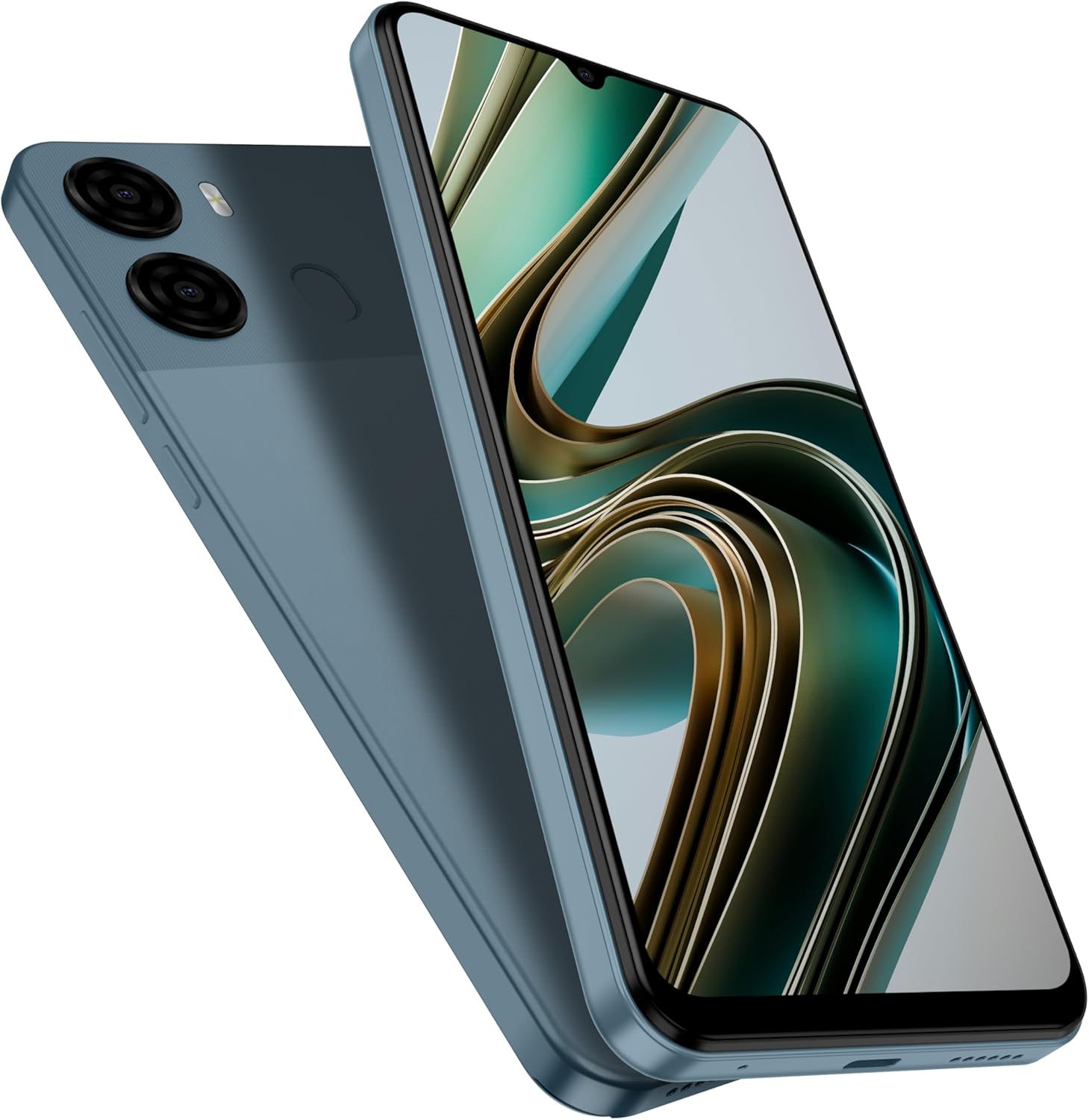
The first interaction with the K2 is defined by its scale. Housing a 6.88-inch panel inevitably results in a large footprint, yet BLU has attempted to mitigate the bulk through a “refined design” philosophy centered on a smooth, dual-tone finish. The aesthetic is described as minimalist and modern, moving away from the glossy, fingerprint-magnet plastics of yesteryear toward a texture that promises better in-hand grip.
The Blue colorway (the specific unit highlighted here) leverages this dual-tone approach to catch light dynamically, giving the device a sense of depth usually reserved for mid-range handsets. Ergonomics are a central focus of the marketing literature; the device is “crafted for comfort” with “attention to every detail.” While a 6.88-inch device will always demand two-handed operation for most users, the balanced form factor and smoothed edges prevent it from feeling like a brick in the pocket.
A notable practical inclusion is the side-mounted fingerprint sensor. Integrated into the power button (a standard implementation for this price tier), it offers a tactile, physical unlocking mechanism that is often faster and more reliable than the face-unlock alternatives found on competitors at this price point. The description emphasizes “enhanced security and effortless convenience,” positioning biometrics not as a premium add-on, but as a baseline expectation—which is a welcome standard.
Display: The “Infinity” Canvas
The headline feature is undeniably the 6.88-inch HD+ Infinity Display. In the sub-$150 category, 6.5 inches is the norm; pushing to nearly 6.9 inches transforms the K2 into a portable media consumption device.
The “HD+” resolution (typically 1640 x 720 pixels at this aspect ratio) spread across this diagonal yields a pixel density that is adequate for video streaming, social media scrolling, and reading, though power users will notice the lack of Full HD sharpness on fine text. However, the trade-off is deliberate: driving fewer pixels places less strain on the GPU and battery, directly contributing to the device’s longevity claims.
The “Infinity” branding suggests minimal bezels and a high screen-to-body ratio, likely utilizing a center punch-hole or waterdrop notch for the 8MP selfie camera. For the target demographic—seniors needing larger UI elements, young users consuming vertical video content (TikTok, Reels, Shorts), or professionals using the device as a secondary “phablet” for email and documentation—the sheer real estate is the primary selling point. Colors are described as “vibrant” and visuals “crisp,” suggesting a decent IPS LCD panel with good brightness calibration for indoor and shaded outdoor use.
Performance: The Octa-Core Daily Driver
Under the hood, the K2 utilizes an Octa-Core processor. While the specific chipset model (likely a Unisoc T606, SC9863A, or similar entry-level 12nm/28nm SoC) isn’t explicitly named in the provided specs, the architecture is tailored for “smooth everyday performance.”
The keyword here is everyday. This is not a gaming rig. The GPU accompanying these entry-level octa-core CPUs (typically Mali-G57 MP1 or PowerVR GE8322) handles standard 2D rendering, video playback up to 1080p, and basic 3D titles (Subway Surfers, Candy Crush, PUBG Mobile on lowest settings) competently. The 64GB of internal storage (eMMC 5.1) provides a functional baseline for apps and media, though the OS and pre-installed apps will consume roughly 15-20GB. The presence of a microSD card slot (standard on BLU devices, though not explicitly listed in the provided text, it is a near-certainty for this SKU) is essential for media hoarders.
Multitasking capability will be dictated by the RAM allocation (likely 3GB or 4GB LPDDR4X). Android 15’s memory management improvements—specifically the refined “Compact Caching” and improved foreground service handling—will help keep frequently used apps alive in the background longer than previous Android versions would on this hardware.
Camera System: Capturing the Essentials
The imaging suite is utilitarian: a 13MP Main Camera paired with an 8MP Selfie Camera. The marketing copy uses the phrase “Capture the Essentials,” which is an honest assessment of the hardware’s intent.
The 13MP primary sensor (likely a Samsung S5K3L6 or similar 1/3.1″ sensor) relies heavily on computational photography—multi-frame processing, HDR, and AI scene detection—to produce “sharp portraits” and “scenic shots.” In good lighting, 13MP provides enough resolution for 4×6 prints and crisp social media uploads. Low light performance will be the weak link; without Optical Image Stabilization (OIS) or large pixel binning (common on 48MP/50MP+ sensors), night shots will suffer from noise and motion blur.
The secondary rear lens (implied by “dual 13MP main camera” phrasing in the bullet points, though often the second lens is a 2MP depth or macro sensor on this tier) assists with portrait mode edge detection. The 8MP front-facing sensor is adequate for video conferencing (Zoom, Teams, Meet) and selfies, supporting the “clean selfies” claim. Features like Face Beauty, Portrait Mode, and likely a Night Mode software toggle round out the software stack. It is a camera system designed for documentation and memory-keeping, not content creation.
Battery and Charging: The 5,000mAh Anchor
If the display is the heart, the 5,000mAh battery is the spine of the K2. This capacity has become the gold standard for budget phones, and for good reason. Coupled with an HD+ display and an efficient (albeit older process node) Octa-Core processor, the K2 is marketed to last “morning to night without constant charging.”
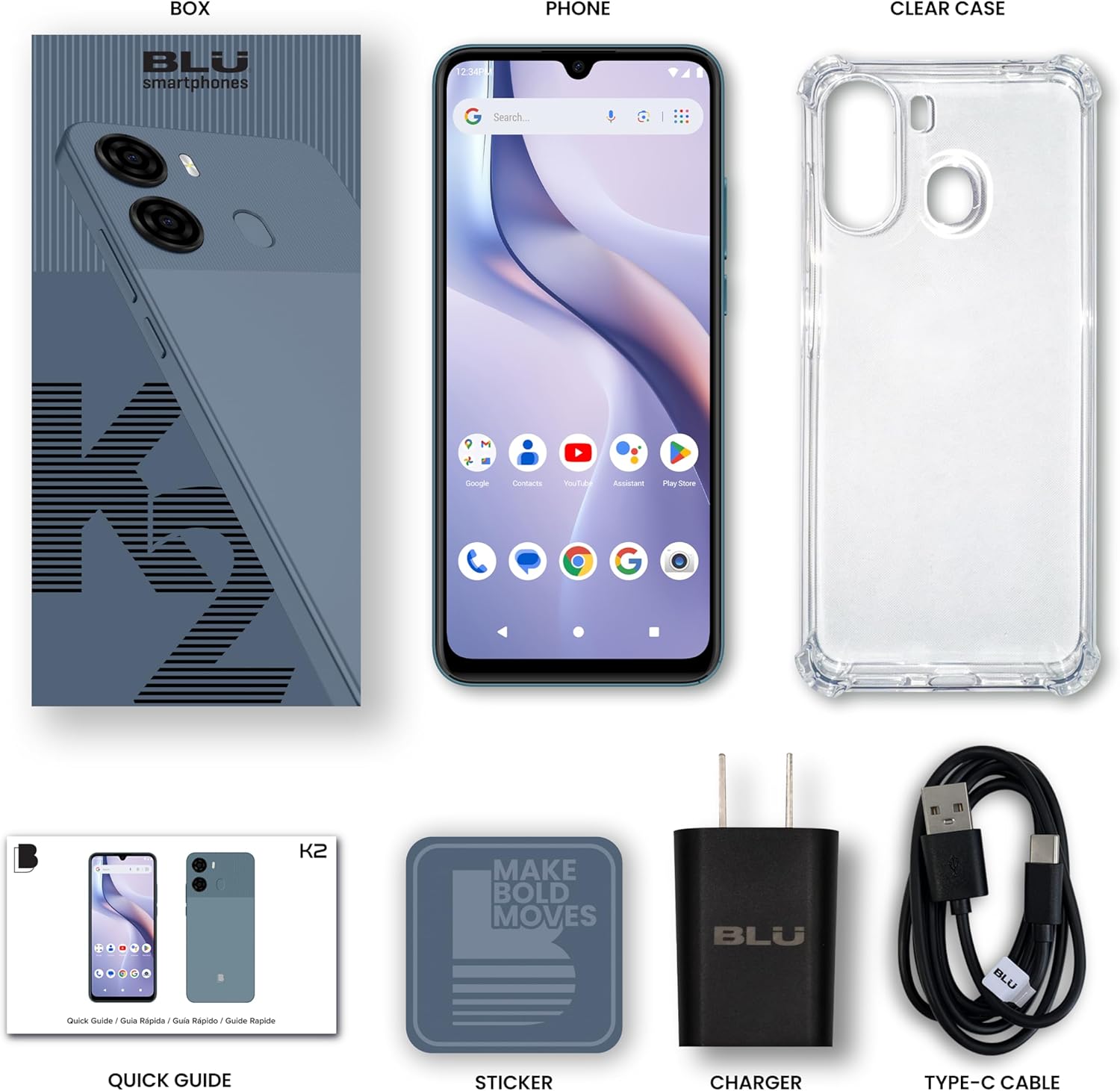
In real-world terms, this translates to 1.5 to 2 days of moderate usage (messaging, calls, 4G data, 3-4 hours screen-on-time) or a solid single day of heavy usage (navigation, streaming, hotspot tethering). The inclusion of a Type-C cable and Charger in the box is a significant value add. Many manufacturers at higher price points have excised the charger; BLU includes a 10W (likely 5V/2A) brick, ensuring the user has everything needed for wired charging immediately. There is no mention of fast charging (18W+), so users should expect a 2.5 to 3-hour full charge cycle—a reasonable overnight routine.
Software: The Android 15 Advantage
This is the K2’s sharpest competitive edge. Shipping with Android 15 out of the box is rare for this price segment, where Android 13 or 14 Go Edition is still common.
The benefits are tangible:
- Privacy & Security: Android 15 introduces the “Private Space” feature (a separate, locked container for sensitive apps), partial screen recording (recording one app instead of the whole screen), and stricter background activity controls.
- Health Connect & System Integration: Native support for health data aggregation across apps.
- Accessibility: Explicit mention of Hearing Aid Compatibility (HAC) support. This is a critical, often overlooked feature for accessibility compliance (M3/T3 or M4/T4 ratings), making the K2 a viable option for users with hearing aids.
- Longevity: Starting on Android 15 buys the user at least one major OS upgrade (to Android 16) and two years of security patches, extending the device’s secure usable lifespan significantly.
BLU typically runs a near-stock Android launcher with minimal bloatware—perhaps a BLU folder for support apps and carrier apps (removable). This “streamlined interface” ensures the limited RAM isn’t consumed by heavy manufacturer skins (like One UI Core or HyperOS), keeping the UI snappy.
Connectivity and Carrier Strategy: The GSM Caveat
The K2 is GSM Unlocked, a crucial distinction for the US market. The compatibility list is explicit: T-Mobile, Metro by T-Mobile, Mint Mobile, and other T-Mobile MVNOs.
Equally important is the explicit incompatibility list: Not compatible with AT&T/Cricket and Verizon.
This is a hardware/firmware limitation regarding VoLTE (Voice over LTE) certification and band support (specifically the lack of Band 14 for AT&T FirstNet and Verizon’s specific CDMA-less provisioning requirements). Potential buyers must heed this warning. Inserting a Verizon or AT&T SIM will likely result in “Emergency Calls Only” or data-only functionality without voice. For the intended audience on the T-Mobile ecosystem, however, the device supports the necessary LTE bands (2, 4, 12, 66, 71) for solid coverage, including Band 71 (600MHz) for rural penetration.
Dual SIM capability (typically Nano-SIM + microSD or Dual Nano-SIM hybrid) is standard for global unlocked units, though the US version often locks the second slot to microSD. The box includes a “Sticker” and “Quick Guide” alongside the protective Clear Case—a thoughtful inclusion that saves the immediate $10-15 accessory purchase.
Value Proposition and Verdict
The BLU K2 occupies a specific niche: The “Big Battery, Big Screen, Clean Software” budget phone.
Where it wins:
- Screen Size: 6.88″ is class-leading for the price.
- Battery: 5,000mAh + HD+ resolution + Android 15 efficiency = exceptional endurance.
- Software: Android 15 with HAC support and near-stock experience.
- In-box Value: Case + Charger + Cable included.
- Security: Side fingerprint sensor + Face Unlock + Android 15 Private Space.
Where it compromises:
- Carrier Lock-in: T-Mobile/MVNO only. Hard stop for Verizon/AT&T users.
- Resolution: HD+ on 6.88″ lacks the sharpness of FHD+.
- Performance Ceiling: Entry-level SoC limits gaming and heavy multitasking.
- Camera: Basic 13MP/8MP setup; no Night Mode magic, no ultrawide lens.
- Build: Plastic frame/back (implied), no IP rating mentioned.
Final Assessment:
The BLU K2 is not trying to be a flagship killer; it is trying to be the best possible tool for the basics. It succeeds by allocating budget exactly where the target user feels it: screen size, battery anxiety relief, and software modernity. The inclusion of Android 15 with Hearing Aid Compatibility elevates it from a “burner phone” to a legitimate daily driver for seniors, students, or as a robust secondary device.
If your SIM card lives on the T-Mobile network and your priorities are “large text,” “two-day battery,” and “it just works,” the K2 in Blue offers a compelling, no-nonsense package that respects the user’s wallet and intelligence.