



Price:
(as of Aug 22, 2026 14:43:29 UTC – Details)

Bridging the Gap Between Optics and Pocket: A Comprehensive Review of the Celestron NexYZ 3-Axis Universal Smartphone Adapter
In the evolving landscape of amateur astronomy and nature observation, the smartphone has quietly become the most ubiquitous imaging sensor on the planet. Yet, for all their computational photography prowess, smartphones remain fundamentally ill-suited for afocal projection—holding a flat, rectangular device steady over a circular, often recessed eyepiece. For years, the solution was a frustrating spectrum of universal adapters: spring-loaded clamps that slipped, rigid brackets that blocked buttons, and friction mounts that required three hands and infinite patience to align.
Enter the Celestron NexYZ 3-Axis Universal Smartphone Adapter. Marketed as a paradigm shift in digiscoping convenience, the NexYZ attempts to solve the alignment equation not through friction, but through precision machining and patented three-dimensional adjustment. Based on the manufacturer’s specifications and design philosophy, this review explores the mechanical architecture, optical compatibility, workflow integration, and build quality of the NexYZ to determine if it successfully bridges the gap between high-end optics and the camera in your pocket.
The Core Innovation: Deconstructing the 3-Axis Mechanism
The defining feature of the NexYZ—and the primary differentiator from the crowded market of “universal” adapters—is its patented 3-axis adjustment system. Traditional adapters typically offer two degrees of freedom: a vertical slide for height (Y-axis) and a horizontal slide for lateral centering (X-axis). The critical missing link has always been the Z-axis: the distance between the phone’s camera lens and the eyepiece eye lens.
On paper, the NexYZ addresses this via three distinct, machined control knobs.
- X-Axis (Horizontal): Centers the camera sensor left-to-right over the optical axis.
- Y-Axis (Vertical): Raises and lowers the phone platform to match the eyepiece height.
- Z-Axis (Depth): Moves the phone platform forward and backward, controlling the critical eye relief distance.
The theoretical advantage here is immense. In afocal photography, the “sweet spot” where the camera’s entrance pupil aligns perfectly with the eyepiece’s exit pupil is a tiny three-dimensional volume. If the phone is too close (Z-axis error), you get vignetting (dark corners) or the camera crashes into the eyepiece. Too far, and you lose field of view and resolution. Lateral misalignment (X/Y) results in crescent-shaped vignetting or a complete loss of image.
By decoupling these adjustments into independent, geared knobs, the NexYZ promises to turn a trial-and-error process into a deterministic one. The manufacturer claims alignment can be achieved “in seconds.” While real-world variables (phone case thickness, eyepiece eye relief) always introduce friction, the mechanical capacity for micro-adjustment without loosening and retightening thumb screws represents a significant engineering step up from friction-based sliders.
Universal Smartphone Interface: The Spring-Loaded Platform
The phone-side interface is governed by a spring-loaded clamp mechanism designed to accommodate “virtually any smartphone, even larger ‘Pro’ models.” The specification notes compatibility with the latest iPhone, Samsung Galaxy, and Google Pixel models, “even with most cases on.”
This is a critical practical consideration. Many adapters force the user to remove protective cases—a non-starter in dew-heavy night environments or dusty birding trails. The NexYZ utilizes a tension adjustment system to hold heavier phones (like the iPhone Pro Max or Samsung Ultra series) firmly. The spring-loaded slider design also facilitates the “star party” use case: rapid phone swapping. In a group setting, the ability to eject one phone and seat another in seconds without re-aligning the optical axis (assuming the Z-axis remains constant for similar phone thicknesses) is a distinct workflow advantage.
However, the universal nature introduces a variable: camera module placement. Modern smartphones feature wildly different camera bump geometries—centered, corner-mounted, diagonal arrays, massive single lenses. The NexYZ platform positions the phone based on its center of gravity and chassis edges, not its optical center. Therefore, the X/Y knobs must possess enough travel range to offset the camera module from the mechanical center of the phone body. The product description implies sufficient range for “virtually any” device, but users with phones featuring extreme corner-mounted modules (e.g., some foldables or older designs) would need to verify the X-axis travel limits against their specific device dimensions.
Optical Interface: The Claw Clamp and Eyepiece Ecosystem
On the business end, the NexYZ employs a “robust claw clamp” mechanism. This design choice—reminiscent of a lathe chuck or a high-end camera tripod head—is generally superior to simple rubber compression rings or set screws for two reasons: concentricity and surface preservation. A three-jaw (or multi-jaw) claw centers the adapter body automatically on the eyepiece barrel, ensuring the adjustment axes remain orthogonal to the optical axis. It also distributes clamping force evenly, preventing marring on expensive anodized eyepiece barrels.
The stated compatibility range is impressive: 35mm to 60mm in diameter. This covers the vast majority of 1.25-inch telescope eyepieces (barrel ~28.5mm, but top housings often 40mm–55mm), 2-inch eyepieces (housings typically 50mm–60mm), and most spotting scope/binocular eyepieces.
Crucially, the package includes two adapters for microscopes, extending the minimum clamp diameter down to 25mm. This transforms the NexYZ from a purely astronomical tool into a viable lab and field microscopy documentation solution. The ability to move seamlessly from a 2-inch Nagler-type eyepiece at a star party to a 30mm microscope ocular in a lab setting underscores the “universal” claim.
Orientation Freedom: Portrait and Landscape Without Re-alignment
A subtle but powerful feature highlighted in the description is the ability to “switch between portrait and landscape orientation without removing your phone.”
On most clamp-style adapters, rotating the phone 90 degrees shifts the camera module’s position relative to the optical axis (because the phone’s width and height dimensions differ). This usually demands a complete re-alignment of X and Y axes. The NexYZ design appears to position the pivot point of the phone clamp such that the camera sensor remains on the optical axis during rotation, or the X/Y travel is sufficient to compensate instantly via the knobs. For videographers capturing vertical content for social media (Reels, Shorts, TikTok) and horizontal content for traditional displays or astrophotography stacking software, this flexibility eliminates a major friction point in the creative process.
Build Quality and Field Ergonomics
The materials specification reads: “Durable metal frame and polymer body.” This hybrid construction is the industry standard for high-end accessories. The metal frame (likely aluminum alloy) provides the rigidity necessary for the precision gears of the 3-axis system to function without flex. If the frame flexed under the torque of the Z-axis knob, alignment would be lost the moment the user let go. The polymer body reduces weight and thermal conductivity—a welcome feature for winter observing where metal parts become heat sinks for fingers.
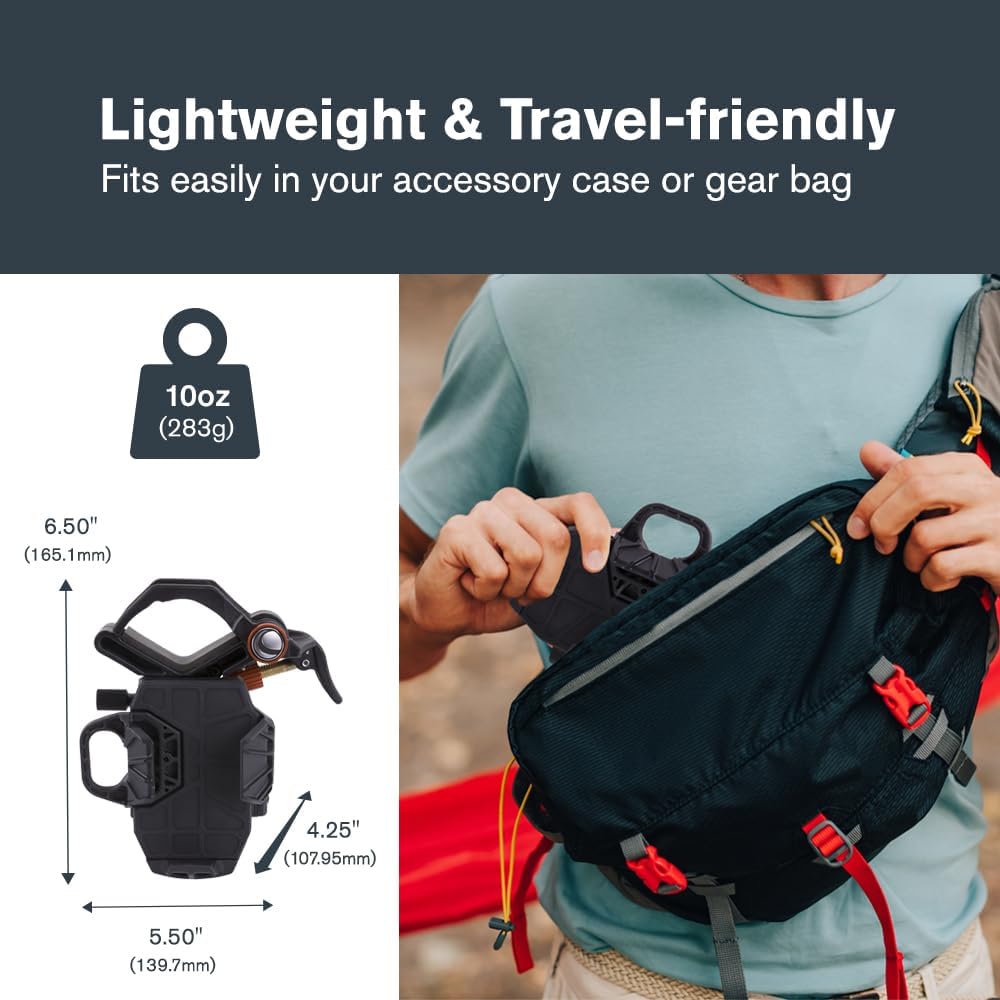
The descriptor “worry-free use in the field” and “compact design fits easily in your gear bag” suggests a form factor that balances robustness with portability. At roughly the size of a fist, it adds negligible bulk to an accessory case. The inclusion of a 2-Year US Warranty and “unlimited support from US-based experts” signals Celestron’s confidence in the mechanical durability of the geared adjustment system, which is the most likely point of failure if manufacturing tolerances are loose.
Workflow Analysis: From Setup to Capture
Based on the feature set, the theoretical user workflow for the NexYZ looks like this:
- Mount: Open claw clamp, seat on eyepiece, tighten clamp knob. (Self-centering).
- Seat Phone: Pull spring-loaded slider, insert phone (case on), release. Tension adjustment ensures grip.
- Coarse Alignment: Use X/Y knobs to roughly center camera over eyepiece glass. Live view on phone screen assists.
- Critical Focus (Z-Axis): Adjust Z-axis knob until vignetting disappears and the full field of view is illuminated on the screen. This replaces the “push/pull/guess” method of older adapters.
- Fine Tune: Micro-adjust X/Y for perfect centering.
- Capture: Shoot photo/video.
- Rotate (Optional): Flip phone to portrait/landscape. Verify framing (minor X/Y tweak if needed).
- Swap (Group Use): Eject phone, hand to next observer, insert new phone. Re-verify Z-axis only (if phone thickness differs).
This workflow removes the “three-handed juggle” (hold phone, hold adapter, tighten screw) that plagues simpler devices.
Use Case Scenarios
Planetary and Lunar Imaging (High Magnification):
This is the NexYZ’s killer application. High-power planetary imaging requires precise centering of a tiny planetary disk (often < 1 arcminute) on a small sensor. The Z-axis control is vital here; the depth of field of the afocal system is razor-thin. The ability to “dial in” the exact eye relief distance allows the user to maximize resolution and minimize chromatic aberration introduced by the phone lens/eyepiece interface.
Deep Sky / Wide Field (Low Magnification):
Less demanding on Z-axis precision but benefits from the secure claw clamp and vibration damping of the metal frame. The ability to shoot landscape orientation natively suits wide-field Milky Way shots through fast refractors.
Digiscoping (Birding/Wildlife):
Spotting scopes often have angled eyepieces and long eye relief. The NexYZ’s secure clamp handles the vibration of a 60mm+ spotter well. The rapid phone swap is ideal for guided tours.
Microscopy:
The included 25mm adapters open the door for digital documentation in education, QC, or hobbyist microscopy (coin/stamp inspection, biological slides). The Z-axis is critical here to match the specific tube length/eye relief of the microscope ocular.
Potential Limitations (Inferred from Specs)
While the provided description is overwhelmingly positive, a technical analysis reveals areas where user expectation must be managed:
- Weight and Balance: A “durable metal frame” plus a “heavy Pro model phone” creates a significant cantilever load on the eyepiece. On lightweight travel refractors or spotting scopes with helical focusers, this torque can induce image shift or focuser sag. A counterweight or a sturdy mounting platform is advisable.
- Vignetting Physics: No adapter can overcome physics. If the phone’s camera entrance pupil is smaller than the eyepiece exit pupil (common with wide-angle eyepieces and small phone sensors), vignetting is inevitable. The Z-axis minimizes it but cannot eliminate the optical mismatch.
- Button Interference: Universal clamps often cover power/volume buttons. The description mentions “tension adjustments hold even the heaviest phones,” implying the clamp grips the sides. Users must verify the clamp pads clear their specific phone’s buttons.
- Knob Stiffness vs. Precision: High-precision gears require tight tolerances. If the knobs are too stiff, micro-adjustments are jerky; too loose, and vibration shifts alignment. The “patented” design suggests a custom solution, but long-term gear wear is a variable only time reveals.
The Verdict: A Professional Tool for the Prosumer
The Celestron NexYZ 3-Axis Universal Smartphone Adapter is not merely a bracket; it is a precision opto-mechanical interface. By treating the three spatial variables of afocal coupling (X, Y, Z) as independent, controllable parameters rather than compromises, it elevates smartphone astrophotography and digiscoping from a “lucky shot” endeavor to a repeatable, controllable imaging discipline.
For the beginner, it removes the frustration barrier that causes many to abandon smartphone imaging. For the seasoned observer, it offers the speed and precision required to capture fleeting moments—Jupiter’s Great Red Spot transiting, a rare bird taking flight, a microscopic crystal structure—without the setup overhead of a dedicated cooled astronomy camera and laptop.
The inclusion of microscope adapters, the robust claw clamp, the case-friendly spring loader, and the orientation freedom collectively build a compelling value proposition. Backed by Celestron’s legacy (since 1960) and a 2-year US warranty, the NexYZ presents itself not as a disposable accessory, but as a durable, central component of a modern observer’s kit. It effectively transforms the smartphone from a passive viewer into an active, precision imaging instrument, fully realizing the potential of the sensor we already carry in our pockets.