


Price: $599.99
(as of Aug 22, 2026 04:01:57 UTC – Details)

FOSSIBOT F115 Ultra Review: Redefining the Rugged Smartphone Paradigm with Thermal Imaging, Laser Ranging, and Monumental Battery Life
In the rapidly evolving landscape of rugged smartphones, the line between a durable tool and a high-performance daily driver has historically been a wide chasm. Manufacturers often forced consumers to choose: either carry a tank-like device with mediocre internals, or baby a flagship glass slab that shatters at the first sign of gravel. The FOSSIBOT F115 Ultra arrives with a singular mission: to obliterate that compromise. Positioned as the flagship of the FOSSIBOT lineup—a brand forged by “years of technical accumulation and continuous innovation” by outdoor explorers—this device packs a specification sheet that reads less like a rugged phone and more like a specialized field instrument wrapped in a modern smartphone chassis.
Design Philosophy: Built for the Extremes
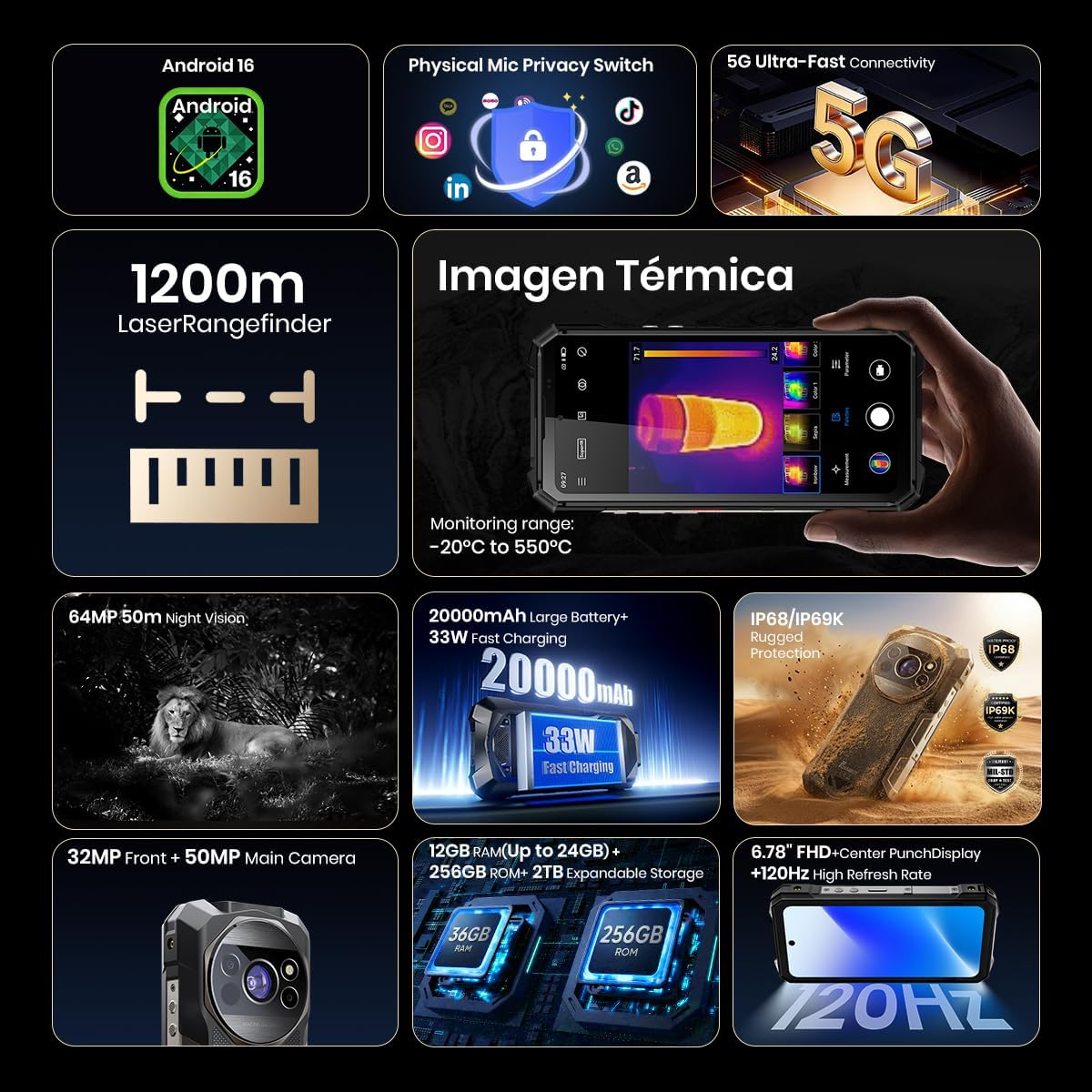
The F115 Ultra makes no apologies for its physical presence. It adheres to the brand’s core tenet: “unmatched rugged toughness, pairing seamless user experience with premium crafted build quality.” The device carries the holy trinity of durability certifications: IP68, IP69K, and MIL-STD-810H. This isn’t just marketing jargon; it translates to survival in 1.5 meters of water for 30 minutes (IP68), resistance to high-pressure, high-temperature jet washes (IP69K), and validated survival against shock, vibration, humidity, and extreme temperatures per military standards.
The front is dominated by a 6.78-inch FHD+ (2.4K) display protected by Corning Gorilla Glass. In a segment where 60Hz or 90Hz panels are still common, the inclusion of a 120Hz refresh rate is a significant quality-of-life upgrade. It ensures that whether you are scrolling through topographic maps, navigating a UI heavy with sensor data, or simply gaming during downtime, the visual fluidity matches mainstream flagships. The durability of the glass ensures that the primary interface—the screen—remains the last line of defense against drops and scratches.
A distinct hardware feature is the dedicated Privacy Button. In an era of software-based security toggles, a physical hardware switch offers instantaneous, tangible control over privacy functions—be it muting microphones, disabling cameras, or locking sensitive apps. For professionals in secure facilities or users valuing immediate physical agency over their data, this is a thoughtful inclusion.
The “Swiss Army Knife” Sensor Suite: Thermal, Night Vision, and LiDAR
What truly separates the F115 Ultra from the rugged pack is its triad of professional-grade optical tools. Most rugged phones offer a token “night vision” IR camera. The F115 Ultra goes significantly further.
1. Thermal Imaging (The Professional Eye)
The integrated thermal imaging module is not a gimmick; it is a calibrated instrument. It supports temperature detection, 15 distinct color filters (Iron Red, Rainbow, White Hot, Black Hot, etc.), hot/cold spot tracking, Picture-in-Picture (PiP) mode, and edge enhancement. For an electrician tracing a hot breaker, a HVAC technician checking duct leakage, a hunter tracking game through brush, or a search-and-rescue operator finding a heat signature in debris, this transforms the phone into a dedicated thermal scope. The ability to overlay thermal data on the visual feed (PiP) provides crucial context that standalone thermal monoculars often lack.
2. 64MP 4K Night Vision (Seeing the Unseen)
Complementing the thermal sensor is a dedicated 64MP Night Vision camera capable of 4K video recording. Utilizing high-sensitivity infrared sensors, it captures clear photos and videos in total darkness up to 50 meters. The support for 10X zoom allows for identification of distant targets without physical approach—a critical safety feature for perimeter security or wildlife observation. Unlike standard night modes that require ambient light, this is active IR illumination, rendering pitch-black environments as clear as day.
3. 1200m Laser Rangefinder (Precision Metrology)
Perhaps the most unique feature is the built-in Laser Rangefinder. Capable of measuring distances up to 1,200 meters (approx. 3,900 ft), it supports 17 professional measuring modes. This includes single distance, continuous scan, height measurement, angle calculation, area, volume, and Pythagorean theorem calculations (indirect height/distance). For surveyors, construction foremen, golfers, architects, and outdoor explorers, this replaces a dedicated handheld rangefinder. The integration into the phone’s OS allows for instant annotation, photo tagging with measurement data, and cloud sync—workflows impossible on standalone optical devices.
Performance Architecture: Dimensity 7100 & Android 16
Under the hood, the F115 Ultra runs on the MediaTek Dimensity 7100 processor. Built on a 6nm process with an octa-core architecture clocking up to 2.6GHz, this chipset sits comfortably in the upper-mid-range to flagship-adjacent tier. It delivers sufficient horsepower for heavy multitasking, rendering complex 3D assets in engineering apps, and high-frame-rate gaming (Genshin Impact, PUBG Mobile) without thermal throttling—aided no doubt by the massive chassis acting as a heatsink.
Crucially, the device launches with Android 16 out of the box. This is a remarkable commitment to software longevity for a niche brand. Android 16 brings predictive back animations, enhanced privacy sandboxing, health connect improvements, and deeper Material You theming. FOSSIBOT’s promise of a “smarter and more efficient experience” is backed by a clean, near-stock Android implementation, free of the bloatware that plagues many competitor rugged devices.
Memory configuration is aggressive: 36GB RAM (12GB physical + 24GB virtual expansion) and 256GB UFS storage, expandable via TF card up to 2TB. The 12GB physical LPDDR4X/5X base ensures apps stay resident in memory; the virtual RAM extension handles extreme edge cases. For a device expected to run mapping software, thermal apps, camera processing, and comms simultaneously, this headroom is essential.
Connectivity: The 5G Caveat
The Dimensity 7100 integrates a 5G modem supporting SA/NSA dual SIM. The spec sheet explicitly lists compatibility with T-Mobile, Metro by T-Mobile, Mint, Straight Talk, Consumer Cellular, Ultra Mobile, and Red Pocket. However, it carries a bold, upfront disclaimer: Not compatible with AT&T, Cricket, Verizon, or Verizon-based MVNOs.
This is a critical purchasing factor. In the US market, the “Big Three” carrier compatibility is often assumed. The F115 Ultra is explicitly a T-Mobile ecosystem device. Buyers on AT&T or Verizon networks will not get service. This limitation stems from band support and carrier certification whitelists (IMEI registration). For the target audience—often using specialized MVNOs or T-Mobile for rural coverage—this is acceptable, but it requires bold highlighting in any review.
Power Plant: The 20,000mAh Monolith
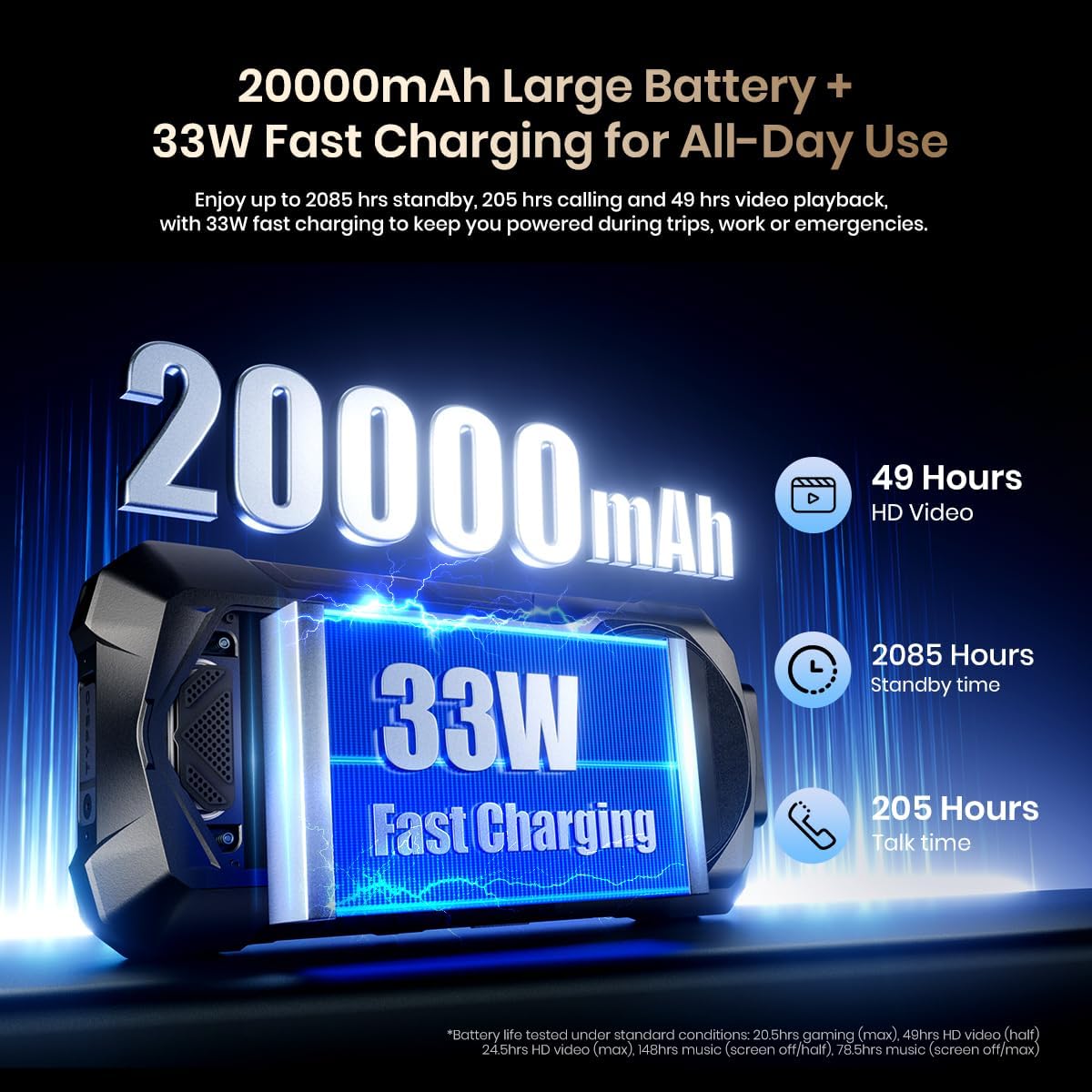
If the sensor suite is the brain, the battery is the heart. 20,000mAh. Let that number settle. A typical flagship phone holds 5,000mAh. The F115 Ultra holds four flagships worth of energy.
The claimed metrics are staggering: 2,000 hours of standby (83 days) and 175 hours of talk time (7+ days). In real-world rugged usage—GPS tracking active, screen on for map reading, thermal camera scanning, 5G modem hunting signal—this battery effectively eliminates “battery anxiety.” A weekend camping trip, a week-long job site rotation, or a multi-day hike becomes feasible without a power bank.
Charging is handled via 33W Fast Charging. While not the 120W speeds seen on some Chinese flagships, charging a 20,000mAh cell requires physics-respecting currents. 33W will likely take 2.5–3 hours for a full top-up, which is reasonable for an overnight charge.
The 18W OTG Reverse Charging turns the phone into a massive power bank. You can charge a smartwatch, earbuds, a colleague’s dying phone, or a headlamp directly from the F115 Ultra. In an emergency kit, this device is the power reserve.
Navigation, Comms, and Software Experience
Positioning is handled by a sextet of constellations: GPS, GLONASS, Galileo, Beidou, QZSS, and NavIC. This 6-system support ensures rapid lock and sub-meter accuracy globally, vital for the laser rangefinder and mapping apps to function correctly in urban canyons or deep valleys.
Connectivity is rounded out by Wi-Fi 6/6E, Bluetooth 5.4, and NFC (supporting Google Pay/contactless entry). The inclusion of Bluetooth 5.4 offers lower latency for wireless headsets and better throughput for external sensors (like thermal scopes or GNSS receivers).
FOSSIBOT backs the hardware with a 2-year replacement warranty (not just repair), 30-day free returns, and dedicated support (fossibotphone@163.com). For a brand operating direct-to-consumer via their “Official US Flagship Store,” this service commitment reduces the risk typically associated with lesser-known rugged brands.
Value Proposition and Market Positioning
The product description lists a price tier for “5G-Rugged-Phone: 219.99 – 254.99$”. If the F115 Ultra lands in this $220–$255 window, the value proposition is disruptive.
Consider the Bill of Materials (BOM) competition:
- FLIR Thermal Camera attachment: $200–$400+
- Leica/ Bosch Laser Rangefinder (1200m): $150–$300+
- High-end Night Vision Monocular: $300–$1000+
- Rugged Phone (Cat S75 / Ulefone Armor 24 / Doogee V Max): $400–$800+ (often with weaker SoCs or smaller batteries).
- 20,000mAh Power Bank: $40–$60.
The F115 Ultra integrates all of the above into a single pocketable device running Android 16 with 5G, for roughly the price of a mid-range standard smartphone. Even at the higher end of the “Flagship Phone” tier mentioned ($379–$599), it remains a compelling consolidation of gear.
The Trade-offs: Physics and Ergonomics
No review is complete without acknowledging the physical cost of this integration.
- Weight and Thickness: A 20,000mAh battery, thermal module, laser emitter, and rugged chassis necessitate bulk. This will likely weigh 350g–400g+ and measure 18mm–22mm thick. It will not slide into a skinny jeans pocket. It requires a belt clip, chest harness, or pack.
- Charging Time: 33W on 20,000mAh is slow by modern standards. You plan charging around sleep cycles, not coffee breaks.
- Carrier Lock-in: The T-Mobile exclusivity in the US is a hard blocker for ~60% of the US subscriber base.
- Camera Versatility: While the Night Vision and Thermal are exceptional, the main daytime camera sensor isn’t explicitly detailed in the spec sheet (only the 64MP NV is named). It likely uses a standard mid-range sensor (e.g., OV64B or similar). It will take “good enough” daylight photos but won’t challenge a Pixel or iPhone for computational photography.
Verdict: A Specialized Instrument, Not Just a Phone
The FOSSIBOT F115 Ultra is a category-defining device. It does not merely “survive” the outdoors; it empowers the professional in the field. By integrating a calibrated thermal imager, a 1.2km laser rangefinder with 17 survey modes, a 50m 4K night vision scope, and a week-long battery into a MIL-STD-810H chassis running the latest Android 16 on a capable 6nm 5G chipset, FOSSIBOT has built a legitimate field computer.
It is not for the casual user who wants a phone that survives a toilet drop. It is for the lineman scanning transformers, the surveyor staking corners, the SAR volunteer searching ravines at 2 AM, the facility manager auditing insulation, and the overlander navigating the Pan-American Highway.
If you operate on the T-Mobile network (or compatible MVNOs) and your work or passion demands thermal vision, precision distance measurement, and absolute power autonomy, the F115 Ultra is currently peerless at its price point. It represents the maturation of the rugged smartphone from “durable communication tool” to “multi-sensor field platform.”