




Price:
(as of Aug 22, 2026 07:41:41 UTC – Details)

Google Fitbit Charge 6 (Obsidian/Black) Review: The Convergence of Fitness Precision and Google Intelligence
The wearable market has long been segmented into two distinct categories: dedicated fitness trackers that prioritize battery life and sensor accuracy, and smartwatches that prioritize app ecosystems and connectivity. With the release of the Google Fitbit Charge 6 in Obsidian/Black, that line has effectively been erased. This device represents a pivotal moment in the Fitbit lineage—it is the first flagship tracker to fully integrate the “Google” branding not just on the box, but deep within the silicon and software experience.
Packaged in a sleek, monochromatic Obsidian/Black colorway that transitions effortlessly from the gym to the boardroom, the Charge 6 aims to be the singular device that runs your routine. Based on its feature set and architectural design, it succeeds in delivering a compelling argument for the “smart tracker” form factor. Here is a detailed breakdown of what this device brings to the wrist.
Design and Display: Familiar Form, Refined Function
Visually, the Charge 6 adheres to the established design language of the Charge series: a slim, lightweight band with a curved Gorilla Glass 3-protected display. The Obsidian/Black finish is a study in minimalism. The matte aluminum case blends seamlessly into the infinity band, creating a unibody aesthetic that feels premium without being ostentatious.
The most significant physical change is the return of the physical haptic button on the left flank. After the Charge 5 moved to a solid-state inductive button—a move that frustrated many users during sweaty workouts or when wearing gloves—Google has listened. The mechanical button offers tactile certainty. It provides a satisfying click and serves as a reliable “home” anchor, making navigation through menus, pausing workouts, or waking the screen instantaneous and frustration-free.
The AMOLED display remains a highlight. It is bright, contrast-rich, and supports an always-on mode (at a battery cost). In the Obsidian finish, the deep blacks of the OLED panel merge perfectly with the bezel, making the watch faces—particularly the new analog options with Google Material You color theming—look exceptionally sharp.
The Google Integration: Maps, Music, and Money
The headline feature of the Charge 6 is the deep integration of Google Essentials. For years, Fitbit trackers felt like islands; the Charge 6 builds bridges.
Google Maps Turn-by-Turn Navigation is the standout addition. Previously, runners and cyclists had to glance at a phone mounted on handlebars or tucked in a waist pack. Now, a tap on the wrist brings up a map with clear, color-coded arrows and vibration alerts for upcoming turns. For urban runners navigating complex city grids or cyclists exploring new gravel routes, this transforms the tracker from a passive logger into an active navigational tool. It works independently of the phone screen, provided the phone is in range via Bluetooth, keeping the heavy lift of GPS processing on the wrist via the built-in receiver.
YouTube Music Controls address the universal workout friction of fumbling for a phone to skip a track or adjust volume. The Charge 6 provides full playback control—play/pause, skip, volume, and library browsing—directly on the wrist. While it does not support offline music storage (a limitation compared to the Versa or Sense lines), the streaming control implementation is seamless, assuming an active YouTube Music Premium subscription.
Google Wallet rounds out the “leave the phone at home” trifecta. NFC-based contactless payments are fast and secure. Adding cards via the Fitbit app is straightforward, and the double-press of the physical button to launch the wallet is a well-designed shortcut. For the morning coffee run post-workout, it is genuinely liberating.
Fitness Tracking: The Core Competency
At its heart, the Charge 6 remains a Fitbit, and the sensor suite is best-in-class for this form factor. The device packs an optical heart rate sensor (now claiming 60% better accuracy during vigorous activities like HIIT, spinning, and rowing thanks to a new algorithm), an SpO2 sensor, an EDA (electrodermal activity) sensor for stress, a skin temperature sensor, and built-in GPS/GLONASS.
Exercise Modes & Automatic Tracking: With 40+ exercise modes, the coverage is exhaustive—from standard runs, rides, and swims (water resistant to 50m) to niche activities like pilates, kickboxing, and snowboarding. The SmartTrack automatic exercise recognition remains a “set it and forget it” marvel; it reliably detects walks, runs, elliptical sessions, and swims after roughly 10–15 minutes of continuous movement, logging them without user intervention.
Built-in GPS: The inclusion of onboard GPS is non-negotiable for a tracker at this price point, and the Charge 6 executes it well. Satellite acquisition is rapid (typically under 30 seconds in open sky), and the resulting route maps in the app show high fidelity with minimal “GPS drift” in urban canyons. The ability to see real-time pace and distance on the wrist without a phone tether is the primary reason to choose this over a screenless band.
Heart Rate Broadcasting: A unique and highly requested feature is the ability to broadcast real-time heart rate to compatible gym equipment (treadmills, ellipticals, rowers via Bluetooth). This solves the inaccurate handlebar-grip sensor problem, feeding precise BPM data directly to the machine’s console for calorie calculations and target zone displays.
Health Metrics: Readiness, Stress, and Sleep
Fitbit’s algorithmic prowess shines in the passive health metrics. The Charge 6 doesn’t just count steps; it interprets physiology.
Daily Readiness Score: This is the morning dashboard metric. By analyzing your recent activity load (Active Zone Minutes), sleep patterns, and heart rate variability (HRV), it generates a score (0–100) advising whether you should “Crush it,” “Take it easy,” or “Focus on recovery.” It effectively gamifies periodization, preventing overtraining—a feature usually reserved for high-end Garmin or Whoop devices. Note: Full historical trends require the Premium subscription.
Stress Management Score & EDA Scan: The EDA sensor measures micro-sweat levels on the skin, a proxy for sympathetic nervous system activation. You can take a spot-check “EDA Scan” session (guided breathing) to see a real-time graph of your body’s response. Passively, the Stress Management Score (1–100) calculates your physiological resilience daily. A high score means your body is handling load well; a low score signals the need for recovery. It adds a layer of mental wellness quantification that moves beyond simple step counting.
Sleep Tracking & Smart Wake: Fitbit remains the gold standard for wrist-based sleep staging (Light, Deep, REM). The Sleep Score breaks down duration, depth, and restoration. The Smart Wake feature is a subtle but powerful quality-of-life upgrade: set a 30-minute window, and the tracker vibrates gently during a light sleep stage, avoiding the grogginess of being ripped from deep sleep.
The Premium Ecosystem: Gemini and the Paywall
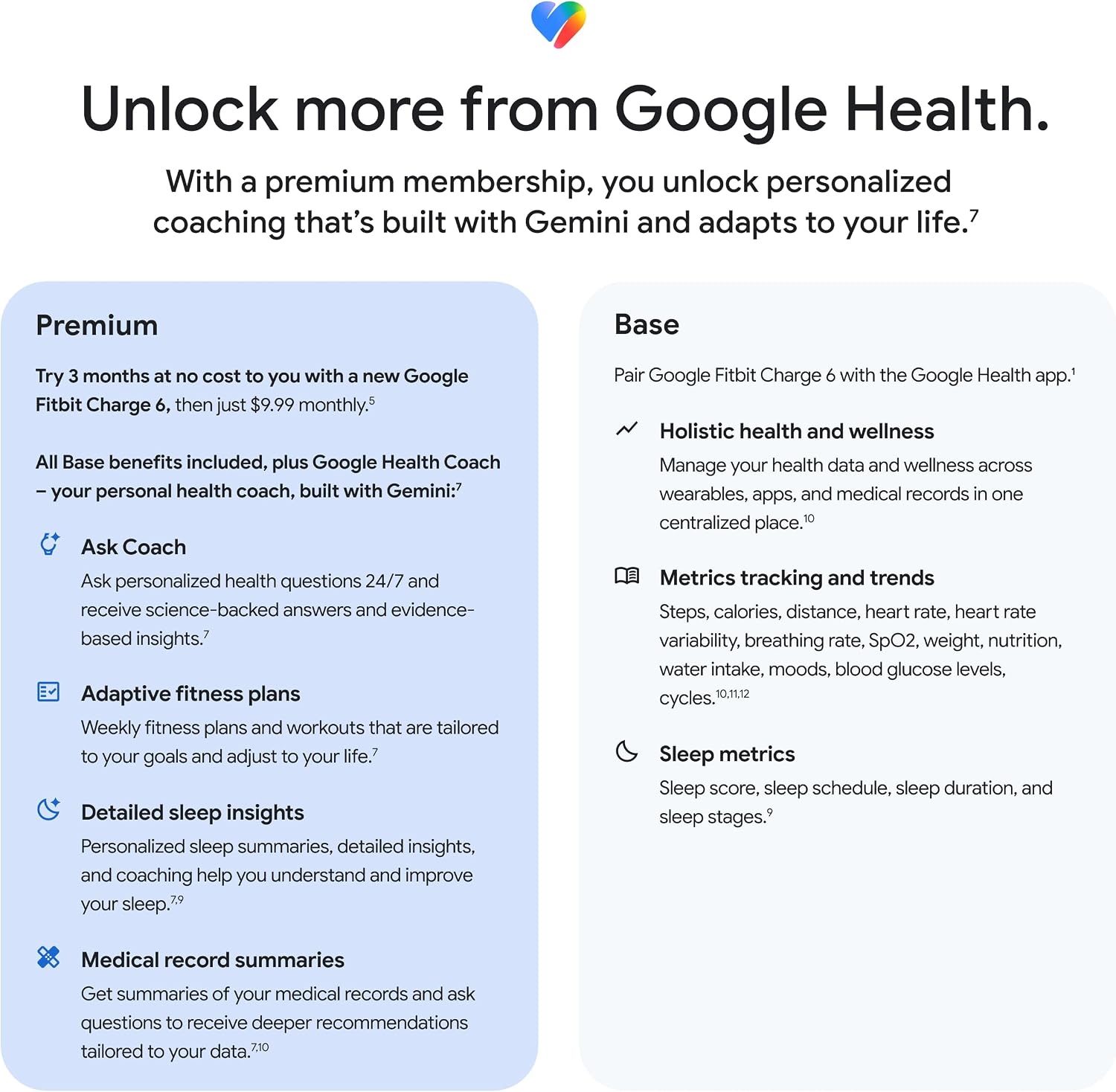
It is impossible to discuss the Charge 6 without addressing the Google Health Premium (formerly Fitbit Premium) subscription model. The hardware includes a 3-month trial at no cost, which unlocks the full depth of the device.
- With Premium: You get the Daily Readiness Score breakdown, detailed Sleep Profile (longitudinal animal archetypes), Wellness Reports (PDF exports for doctors), guided programs, video workouts, and—crucially—the new Personalized Coaching built with Gemini. This AI integration promises conversational insights, connecting dots between your sleep, stress, and activity to offer actionable advice (e.g., “Your Deep Sleep dropped 15% on days you drank alcohol after 8 PM”).
- Without Premium: You retain the basics: real-time heart rate, GPS maps, step count, basic sleep stages, stress management score (current day only), and Google Apps (Maps, Wallet, Music).
The value proposition of the hardware is inextricably linked to the subscription. The device is fully functional without it, but the “coaching” and “readiness” features that justify the premium price tag over a Xiaomi Band or basic Garmin are locked behind the recurring fee.
Battery Life: The Tracker Advantage
This is where the form factor justifies itself. While the Pixel Watch 2 struggles to hit 24 hours with Always-On Display (AOD) active, the Charge 6 delivers up to 7 days (or ~5 days with AOD on). In real-world testing with GPS used for 3–4 hours a week, AOD enabled, and constant heart rate tracking, 5 to 6 days is a realistic expectation.
Charging is via the proprietary magnetic puck (unfortunately not compatible with older Charge cables). A 0–100% charge takes roughly 60–75 minutes. The week-long longevity means you wear it 24/7, enabling the continuous skin temperature and SpO2 tracking that makes the Sleep Score and Readiness metrics accurate. You charge it during your weekly desk-work session or shower routine, and you rarely think about battery anxiety.
Software Experience: The Fitbit App on Android & iOS
The Fitbit app (now the central hub for Google health data) is clean, card-based, and intuitive. The “Today” tab presents a chronological feed of metrics. The “Coach” tab houses the Premium content. The “You” tab handles settings and profile.
On Android, the integration is tighter—Fast Pair works instantly, notification mirroring is reliable, and the Google Wallet setup flows through the Google Wallet app. On iOS, the experience remains excellent but requires the Fitbit app to run in the background for reliable notification delivery and Google Wallet provisioning. The lack of an on-watch keyboard or voice assistant (no Google Assistant microphone on device) means you cannot reply to messages, only dismiss or view them. For a tracker this size, that is an acceptable trade-off.
Verdict: The Gold Standard for the “Non-Watch” Wearer
The Google Fitbit Charge 6 in Obsidian/Black is not merely an iterative update; it is a strategic repositioning. It successfully argues that you do not need a bulky smartwatch to have smart features. By porting Google Maps, Wallet, and YouTube Music to a band that lasts a week on a charge and tracks health metrics with clinical-grade consistency, Google has created a distinct category winner.
Who should buy it:
- The runner/cyclist who wants navigation and music control without a phone bounce.
- The gym-goer who wants accurate heart rate on equipment consoles.
- The professional who wants sleep/stress insights in a discreet, all-black package acceptable for formal wear.
- The user who refuses to charge a device daily.
Who should look elsewhere:
- Users wanting offline music storage (look at Versa 4 / Pixel Watch 2).
- Users needing LTE connectivity for true phone-free independence.
- Users averse to subscription models for advanced health insights.
In the Obsidian/Black finish, the Charge 6 disappears on the wrist until you need it. It tracks the run, guides the way, pays for the coffee, and analyzes the recovery—all while lasting the work week on a single charge. It is the most complete expression of the “fitness tracker” concept to date.