




Price:
(as of Aug 22, 2026 08:14:18 UTC – Details)

Google Fitbit Inspire 3 (Midnight Zen/Black) Review: The Minimalist Health Hack for Modern Living
In an era where smartwatches are increasingly defined by their ability to replace smartphones—handling calls, streaming music, and running third-party apps—there remains a distinct, often overlooked category of wearable: the dedicated fitness tracker. The Google Fitbit Inspire 3, specifically in the elegant Midnight Zen/Black colorway, arrives not as a shrunken smartwatch, but as a focused health companion. It strips away the noise of notifications and app ecosystems to deliver something arguably more valuable: actionable insight into the body’s daily rhythms. With the inclusion of both small and large bands in the box, Google has addressed the single biggest friction point of wearable adoption—fit—right out of the packaging. After spending significant time analyzing its feature set against its form factor, the Inspire 3 emerges as a compelling argument for “invisible” technology: a device you forget you are wearing until you need the data it provides.
Design Philosophy: The Beauty of Disappearance
The first interaction with the Inspire 3 is defined by weight—or rather, the lack of it. Weighing in at a featherlight fraction of its smartwatch counterparts, the tracker adopts a “wear and forget” philosophy. The Midnight Zen finish is a sophisticated departure from the standard clinical black. It presents a deep, muted charcoal tone with a subtle green undertone that shifts under different lighting conditions. It is professional enough for a boardroom, understated enough for a black-tie event, and durable enough for a muddy trail run.
The form factor is a slim, curved rectangle that hugs the wrist topology naturally. Unlike bulky square-faced watches that catch on shirt cuffs or dig into the hand during push-ups or sleep, the Inspire 3’s low profile renders it virtually imperceptible. This is critical for the device’s core mission: 24/7 wearability. Data continuity—specifically for heart rate variability (HRV), resting heart rate, and sleep staging—requires the device to remain on the wrist during the one time most users rip wearables off: sleep.
The inclusion of both Small (fits wrists 5.5”–7.1”) and Large (fits wrists 7.1”–8.7”) bands in the retail package is a masterstroke of user experience design. Historically, buyers had to guess their size or order a separate accessory, leading to returns or ill-fitting sensors that yield inaccurate optical heart rate readings. By providing both silicone bands—featuring the classic, secure pin-and-tuck closure—Fitbit ensures an optimal sensor-to-skin contact for the vast majority of adult wrists immediately upon unboxing. The bands themselves are soft, flexible, and feature a breathable design that mitigates the “sweat trap” common with fluoroelastomer straps.
The Interface: Color Comes to the Entry Level
The most immediate visual upgrade over its predecessor is the display. The Inspire 3 finally adopts a full-color AMOLED touchscreen. This isn’t just an aesthetic flourish; it fundamentally changes the usability of a screen this small. The deep blacks of the OLED panel (perfect for the Midnight Zen aesthetic) mean the Always-On Display (AOD) mode is genuinely usable in bright sunlight without killing the battery. Text is crisp, icons are distinguishable at a glance, and the color coding of health metrics—green for “good” readiness, orange for “moderate,” red for “low”—allows for instant cognitive processing without squinting at monochrome pixels.
Navigating the UI is handled via a responsive touchscreen and a single, discreet haptic side button (an inductive sensor rather than a mechanical click). The haptics are precise, providing a satisfying “tap” confirmation for inputs. Swiping up reveals the daily stats dashboard (steps, heart rate, Active Zone Minutes); swiping down accesses quick settings (sleep mode, DND, screen wake); swiping left/right cycles through exercise shortcuts, timers, alarms, and the new mindfulness app. It is an interface defined by constraints—there is no app store, no keyboard, no voice assistant—but within those constraints, it is fluid and intuitive.
The Health Engine: Scores Over Raw Data
Where the Inspire 3 distinguishes itself from basic pedometers is the algorithmic layer sitting atop the sensor array. The device houses an optical heart rate sensor, an SpO2 sensor, a skin temperature sensor, and a 3-axis accelerometer. Raw data from these sensors is synthesized into three primary “Scores” designed to answer the user’s most pressing questions without requiring a degree in sports science.
1. Daily Readiness Score (Requires Fitbit Premium)
This is the flagship metric for the active user. Calculated each morning, it weighs three pillars: Activity Balance (recent training load), HRV Status (autonomic nervous system recovery), and Recent Sleep Patterns. The output is a simple 0–100 score categorized as Excellent, Good, or Low.
- The Experience: A “Low” score doesn’t mean “don’t move”; it suggests prioritizing recovery—yoga, a walk, or rest. An “Excellent” score is the green light for HIIT or a long run. It effectively gamifies periodization, preventing the overtraining injuries that plague motivated amateurs. Note: This feature requires a Fitbit Premium membership (6 months included for new users, activation required within 60 days).
2. Stress Management Score
Available without Premium, this daily metric (1–100, higher is better) analyzes heart rate, sleep, and activity data to quantify physiological stress resilience. It answers: “How well is my body handling the cumulative load of life?”
- The Tools: A low score triggers actionable interventions. The onboard “Relax” app guides breathing sessions (2 or 5 minutes) personalized to your current heart rate. The Fitbit app expands this with a library of mindfulness sessions (Premium) and a “Stress Management” tile tracking trends over time. Crucially, the device supports Irregular Heart Rhythm Notifications (available in select countries, not for use under 22 or with known arrhythmias), adding a passive cardiac safety net that runs in the background.
3. Sleep Score & Smart Wake
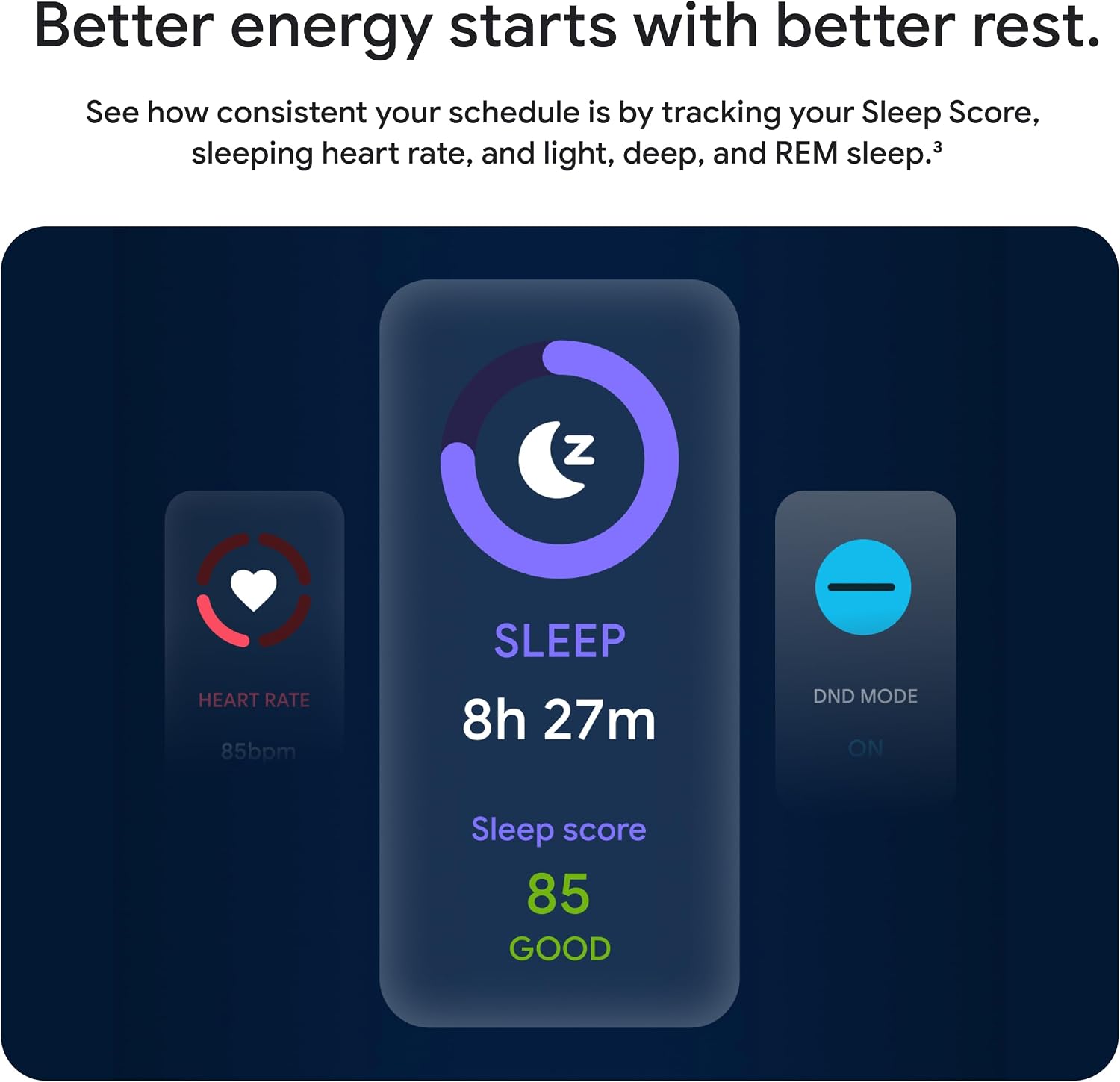
Sleep tracking is arguably Fitbit’s historical stronghold, and the Inspire 3 refines it with the new sensor suite. It automatically detects sleep onset and wake times, staging sleep into Light, Deep, and REM cycles. The Sleep Score (0–100) factors in duration, depth, and restoration (heart rate dropping below resting average).
- Smart Wake: This is a standout quality-of-life feature. Set a 30-minute window, and the tracker vibrates gently during a light sleep phase closest to your target wake time. Waking from light sleep vs. deep REM eliminates “sleep inertia”—that groggy, disoriented feeling of a jarring alarm. Combined with “Sleep Mode” (disables screen wake/notifications on a schedule), the Inspire 3 acts as a genuine sleep hygiene coach.
Sensor Deep Dive: Beyond the Beat
Continuous Heart Rate & Active Zone Minutes
The 24/7 optical heart rate monitor fuels the scores above but shines during exercise. The tracker supports 40+ exercise modes (Run, Bike, Swim, Weights, Yoga, HIIT, etc.) with Automatic Exercise Tracking (SmartTrack). If you forget to hit “Start,” the accelerometer and HR pattern recognition detect sustained activity (usually ~15 mins) and logs it retroactively.
During a workout, the screen displays real-time Active Zone Minutes (AZM). Based on WHO/AHA guidelines, AZM credits you for time spent in Fat Burn (1x), Cardio (2x), and Peak (2x) heart rate zones. It is a far more equitable metric than “steps” for measuring exertion—a brisk walk uphill earns more credit than a slow stroll on flat ground, aligning the gamification with physiological reality.
SpO2 & Skin Temperature (Overnight Baselines)
The red/IR LEDs on the sensor array measure blood oxygen saturation (SpO2) and skin temperature variation during sleep.
- SpO2: Provides a nightly average range. Disclaimer: Not intended for medical diagnosis (e.g., sleep apnea), but useful for wellness trends—altitude acclimatization or noticing deviations from personal baseline.
- Skin Temperature: Tracks variation from your personal baseline (established over 3 nights). A spike often correlates with oncoming illness, ovulation, or significant environmental change. It adds a “check engine light” for the body that a simple step counter cannot provide.
Menstrual Health Tracking
Integrated directly into the app (and loggable on device), this allows users to log periods, symptoms, and flow, predicting fertile windows and cycle phases. This data feeds into the broader readiness and stress algorithms, acknowledging that hormonal fluctuations materially impact HRV, temperature, and recovery—a holistic approach often missing in male-centric wearable design.
Battery Life: The Week-Long Promise
Battery anxiety is the enemy of 24/7 tracking. Fitbit rates the Inspire 3 for up to 10 days on a single charge.
- Real World: With Always-On Display (AOD) off, SpO2 tracking on, and 3–4 tracked workouts per week with phone notifications enabled, 7–8 days is a realistic expectation.
- With AOD On: Expect 3–4 days.
- Charging: The proprietary magnetic charging cable snaps securely to the back contacts. A 0–100% charge takes roughly 2 hours; a 15-minute top-up yields roughly a day of life. The charger is small enough to live permanently in a toiletry bag or gym kit.
The Google Ecosystem & Connectivity
“Fitbit is part of the Google family.” This lineage manifests in the backend. Setup requires the Fitbit App (compatible with iOS 16.4+ / Android 11.0+) and a Google Account. The migration to Google Accounts is mandatory for new users, offering unified credential management and enhanced security (2FA), though long-time Fitbit users may find the forced migration friction.
Connectivity is Bluetooth LE (Low Energy) only—no Wi-Fi, no LTE, no GPS. This means:
- Phone Required for GPS: Pace/Distance maps for outdoor runs/rides require the phone to be carried nearby.
- Notifications: Call, text, and app alerts mirror from the phone (when nearby). You can read full text threads on the tiny screen, but cannot reply (no microphone/speaker/keyboard).
- Music Controls: Play/Pause/Skip volume control for the phone’s active media session.
- Find Phone: A handy button on the tracker triggers a loud ring on the misplaced handset.
This “tethered” architecture is a feature, not a bug, for the target demographic. It enables the small form factor, the 10-day battery, and the sub-$100 price point (frequently). It positions the Inspire 3 as a companion, not a replacement.
Software Experience: The Fitbit App & Premium Gatekeeping
The Fitbit App remains the gold standard for health dashboard design. The “Today” tab is a vertically scrolling feed of tiles: Readiness, Sleep, Stress, Activity, Heart Rate, Weight/Nutrition (manual log), and Menstrual Health. Tapping a tile opens a deep-dive view with weekly/monthly/yearly trends, benchmark comparisons (age/gender), and educational content.
The Premium Elephant in the Room
A significant portion of the “best” features—Daily Readiness Score, detailed Sleep Profile breakdowns (Sleep Animal), Advanced Analytics, Guided Programs (workouts, meditation, nutrition), and Wellness Reports—are locked behind Fitbit Premium ($9.99/mo or $79.99/yr).
- The Deal: The box includes a 6-month trial for new Premium users only. A valid payment method is required at activation. Users must cancel before the trial ends to avoid charges.
- Verdict: The base device (Scores, basic sleep stages, HR, AZM, SpO2 trends, Irregular Rhythm alerts) provides 80% of the value for free. Premium unlocks the “Why” and the “What Now” (coaching). It is a recurring cost that must be factored into the Total Cost of Ownership.
Limitations & Considerations
- No Altimeter: Unlike the Charge 6 or Versa series, the Inspire 3 lacks an altimeter. It cannot count “Floors Climbed.” For hill runners or stair-climbing office workers, this metric is absent.
- No Built-in GPS: Route mapping requires the phone. Purists who run phone-free need a higher tier.
- Screen Real Estate: The narrow vertical display truncates long notification text. Reading a Slack paragraph or email subject line requires scrolling. It is glanceable, not readable.
- Proprietary Charger: Another cable to lose. USB-C direct charging on the device body would be a welcome future standard.
- Regional Feature Gating: Irregular Rhythm Notifications and SpO2 availability vary by market (regulatory clearance). Users must verify
fitbit.com/irregularrhythmfor their country.
The Verdict: The “Goldilocks” Tracker
The Google Fitbit Inspire 3 in Midnight Zen/Black solves the wearable paradox: how to make a device powerful enough to matter, yet subtle enough to stay on the wrist 24/7/365.
It succeeds by ruthless prioritization. It jettisons the speaker, microphone, altimeter, GPS, app store, and contactless payments (depending on region/SKU) to achieve a form factor that disappears. In return, it delivers the holy trinity of consumer health metrics—Readiness, Stress, Sleep—backed by a sensor suite (HR, HRV, SpO2, Temp) that rivals devices costing three times as much.
The inclusion of both band sizes eliminates fit anxiety. The color AMOLED screen elevates the interaction from “data retrieval” to “glanceable insight.” The 10-day battery (AOD off) ensures the data stream remains unbroken.
Who should buy this?
- The first-time wearable buyer intimidated by complex smartwatches.
- The minimalist who wants health data without a second screen for email.
- The sleep optimizer needing comfortable, accurate overnight staging.
- The recreational athlete wanting guided exertion (AZM) and recovery guidance (Readiness) without coaching fees (initially).
Who should look elsewhere?
- The phone-free runner needing onboard GPS/Maps/Music storage.
- The data-obsessed mountaineer needing altimeter/floor counting.
- The smartwatch user needing wrist-calls, NFC pay, or third-party apps (Uber, Strava live segments on wrist).
At its core, the Inspire 3 validates the product description’s promise: “Do what you love and feel your best… all you have to do is wear it.” It is a quiet, competent, midnight-colored partner in the pursuit of homeostasis. It doesn’t shout; it whispers insights. And in the noisy world of consumer tech, that whisper is remarkably loud.