


Price: $89.99
(as of Aug 22, 2026 13:38:10 UTC – Details)

MIRO C67 Smartphone Review: Big Screen, Light Frame, and Expandable Storage on a Budget
In an era where flagship smartphones routinely breach the four-figure price ceiling, the budget segment has become a battleground for pragmatic engineering. Consumers increasingly demand modern essentials—large displays, all-day battery life, and ample storage—without the premium tax. Enter the MIRO Smartphone Ultra-Light 6.75″ Big Screen (Model C67), a device that positions itself squarely as a “budget-friendly all-day entertainment phone.” With a spec sheet boasting a 6.75-inch HD+ display, a replaceable 4900mAh battery, 1TB expandable storage, and Android 14 out of the box, the C67 attempts to punch well above its weight class. After a thorough analysis of its design, hardware, software, and camera capabilities based on the manufacturer’s specifications, here is a detailed breakdown of what this device offers.
Design and Ergonomics: The “Ultra-Light” Proposition
The most immediate physical characteristic of the MIRO C67 is its claim to an “Ultra-Light 192g Body.” In the current landscape of 6.7-inch-plus phones, the average weight typically hovers between 200g and 220g. At 192 grams (6.77oz), the C67 sits comfortably on the lighter side of the spectrum. This is a deliberate engineering choice that pays dividends in usability. The manufacturer highlights reduced hand fatigue during long hours of use—binge-watching sessions, extended reading, or marathon gaming—and the weight distribution supports this claim.
The form factor is described as fitting easily into pockets and bags, facilitating one-handed operation despite the expansive screen real estate. While the materials aren’t explicitly detailed as glass-and-metal (likely a polycarbonate chassis to achieve this weight), the benefit is structural: a lighter phone is less prone to screen-shattering momentum drops simply due to physics. The Black finish offers a classic, understated aesthetic that hides smudges well. A standout physical feature, increasingly rare in 2024, is the removable back cover necessitated by the replaceable battery. This adds a layer of tactile utility; the back panel removal grants access to the dual SIM slots and the microSD card tray, harkening back to an era of true user serviceability.
Display: The 6.75-Inch Canvas
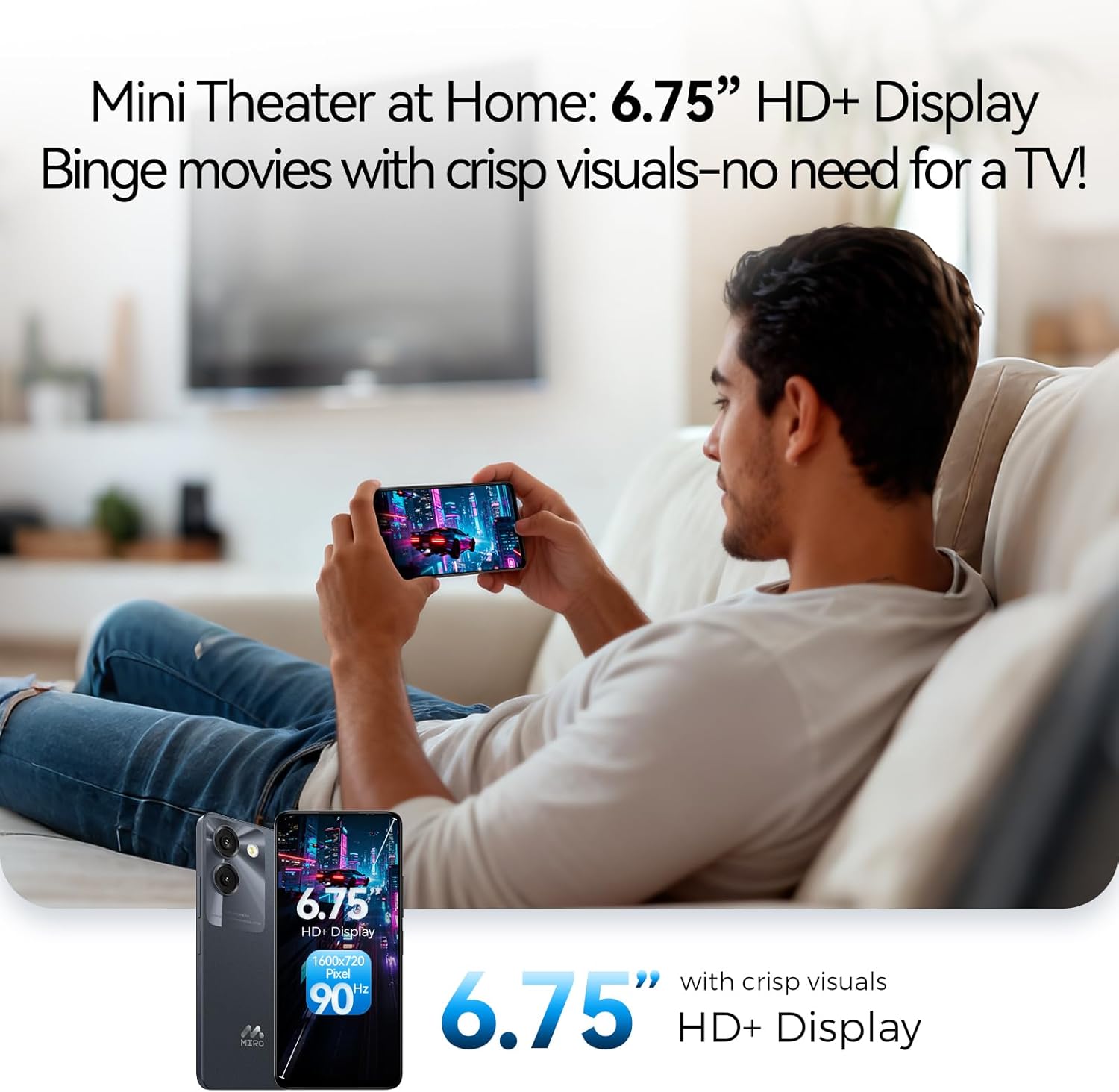
The centerpiece of the “entertainment phone” marketing is the 6.75-inch HD+ Display. The specification lists an HD+ resolution (likely 1600 x 720 pixels), which on a 6.75-inch panel yields a pixel density of roughly 260 PPI. While this doesn’t match the sharpness of Full HD+ (1080p) panels found on mid-rangers, it is perfectly serviceable for the target demographic. For video streaming—Netflix, YouTube, TikTok—the larger physical size trumps raw pixel count for immersion. The “mini-theater visuals” description is apt; the 20:9 aspect ratio (implied by the HD+ resolution on this diagonal) provides a cinematic letterbox-free experience for most modern content.
The display supports multi-function split-screen, a feature enabled by the horizontal real estate. This allows for genuine productivity: running a messaging app alongside a browser, or taking notes while watching a tutorial. While the brightness levels and panel technology (likely IPS LCD) aren’t specified, the sheer scale makes it an excellent device for media consumption, senior users needing larger UI elements, or anyone who finds modern compact phones too cramped.
Performance and Software: Android 14 and 4GB/64GB Baseline
Under the hood, the MIRO C67 runs Android 14 out of the box. This is a significant value add. Many budget devices still launch on Android 12 or 13 with vague update promises. Android 14 brings native improvements to privacy (photo picker permissions), health connect integration, better font scaling for accessibility, and refined battery management APIs. For a budget device, launching on the current major version extends the functional lifespan of the software experience.
The memory configuration is 4GB RAM + 64GB Internal Storage (ROM). This is the standard entry-level configuration. 4GB of RAM is sufficient for the core Android experience and standard multitasking—social media, web browsing, email, and video playback. However, heavy multitasking or keeping many heavy apps suspended in the background will trigger reloads. The 64GB internal storage is the baseline, but the headline feature here is the 1TB Expandable Storage via microSD.
This is where the C67 differentiates itself. 1TB support via microSDXC transforms the device into a portable media server. Users can offline entire seasons of shows for flights, store thousands of RAW photos, or carry a massive local music library without relying on cloud subscriptions or data connectivity. The “Never delete files to free up space again” pitch is genuinely realized here, provided the user invests in a high-capacity card.
Battery Architecture: The 4900mAh Replaceable Advantage
The 4900mAh battery is the specification that demands the most attention. In a market segment where 5000mAh sealed cells are becoming standard, 4900mAh is competitive on capacity alone. But the replaceable nature of this cell is a paradigm shift for the modern user.
The manufacturer explicitly frames this as a solution to “low-battery anxiety.” The logic is sound: instead of tethering to a power bank or hunting for a wall outlet (and waiting for a charge), the user carries a charged spare battery. A 30-second swap restores 100% capacity instantly. For travelers, outdoor workers, festival-goers, or emergency preparedness kits, this is functionally superior to 120W fast charging. It also solves the long-term degradation issue; when the cell holds less charge after two years, you buy a $15 replacement rather than a new phone or an expensive repair.
The marketing notes “stable all-day battery life for calls, streaming, browsing.” Combined with the HD+ (lower resolution) display and Android 14’s efficiency, a single charge should comfortably clear a standard 16-hour day with 20-30% remaining. The inclusion of a charging brick and cable in the box (standard for this segment) completes the package.
Imaging: 13MP AI Dual Camera and 5MP Front Shooter
The camera system is modest but functional: a 13MP AI Dual Rear Camera and a 5MP Front Camera. The “AI Dual” designation typically implies a primary 13MP sensor paired with a secondary depth sensor (VGA or 2MP) for portrait mode bokeh effects, or perhaps a macro lens. The marketing copy focuses on “sharp details and vibrant colors” for “family gatherings, outdoor adventures, and sunsets.”
Realistically, a 13MP sensor in this price bracket (likely a standard 1/3.1″ or similar sensor without OIS) will perform admirably in good lighting—daylight, well-lit interiors. Dynamic range will be limited; blown-out highlights in backlit sunset shots are expected. Low light performance will rely on software multi-frame processing (Night Mode), resulting in softer images with noise reduction artifacts. The 5MP front camera is adequate for video calls (Zoom, WhatsApp, Teams) and social media selfies, supporting “natural selfies and smooth casual video calls.” This is not a computational photography powerhouse; it is a documentation tool. It captures memories legibly, which aligns with the “preserving all the good things in your life” positioning.
Connectivity: Global Dual SIM and Carrier Strategy
The Dual SIM Dual Standby (DSDS) implementation is a core utility feature. The tray accommodates two Nano-SIMs (or one SIM + one microSD, though the 1TB support suggests a dedicated slot or hybrid tray favoring storage). The manufacturer explicitly confirms compatibility with major US carriers: AT&T, T-Mobile, and Mint Mobile (T-Mobile MVNO).
Crucially, the absence of Verizon from the “compatible” list suggests a lack of CDMA fallback support or specific band certification (specifically Band 13/66/5) required for Verizon’s network. This is standard for many global unlocked devices. For the vast majority of users on GSM-based networks (AT&T, T-Mobile, and their vast MVNO ecosystems like Cricket, Metro, Mint, Visible via T-Mo), the device supports “postpaid, prepaid plans with zero extra setup.” Band support likely includes LTE bands 2, 4, 5, 12, 17, 66, 71—covering the core low-band (rural penetration) and mid-band (capacity) layers for North America. 4G LTE connectivity is the ceiling here; there is no 5G modem, a reasonable omission at this price point to preserve battery and cost.
The “Budget-Friendly” Value Proposition
The concluding marketing tag—“Budget-Friendly All-Day Entertainment Phone”—is the thesis statement. The MIRO C67 does not pretend to be a gaming rig (no dedicated GPU specs, 4GB RAM), a camera flagship (13MP), or a design icon (polycarbonate build). It targets a specific user archetype:
- The Senior/Accessibility User: Large screen, light weight, Android 14 accessibility features, replaceable battery (easy swap for dexterity issues), loud speaker (implied for media).
- The Traveler/Minimalist: Dual SIM for local/international lines, 1TB storage for offline maps/media, replaceable battery for off-grid days, light weight for carry-on limits.
- The Secondary/Backup Device: A reliable “glovebox phone” or kid’s first smartphone where loss/theft risk is high, but functionality (WhatsApp, YouTube, GPS) must remain intact.
- The Media Consumer: Prioritizing screen inches and storage over refresh rate or resolution.
Potential Drawbacks (Inferred from Specs)
A balanced review must acknowledge limitations inherent to the spec sheet:
- No 5G: Future-proofing is limited to LTE.
- HD+ Resolution: Text rendering isn’t as crisp as 1080p; VR/AR unsupported.
- Performance Ceiling: 4GB RAM / Entry-level SoC (unnamed, likely Unisoc T606 or similar) limits heavy gaming (Genshin Impact, CoD Mobile max settings).
- Biometrics: Not mentioned. Likely relies on Face Unlock (via 5MP front cam) or rear fingerprint (if present) / Pattern/PIN. No in-display sensor.
- Charging Speed: Not specified. Likely standard 10W-15W. The replaceable battery mitigates slow charging, but top-ups take time.
- Durability: No IP rating mentioned. Water resistance unlikely.
Final Verdict
The MIRO C67 (Model C67) is a masterclass in feature-per-dollar prioritization. It strips away the marketing fluff of macro cameras, 120Hz screens on weak GPUs, and glass sandwich designs to deliver the “Holy Trinity” of budget utility: Screen Size, Battery Agency, and Storage Freedom.
The replaceable 4900mAh battery is the killer feature. It fundamentally changes the ownership psychology from “managing battery health” to “managing energy logistics.” Paired with 1TB expandable storage, it removes the two biggest friction points of modern smartphone ownership: cloud dependency and charger hunting.
Running Android 14 ensures software relevance, and US carrier compatibility (AT&T/T-Mobile) makes it a viable daily driver immediately. At 192g, it refuses to punish the user for wanting a big screen.
If you need a phone to run the latest 3D games at 60fps, shoot RAW photos for printing, or survive a drop in a pool, this is not the device. But for the vast silent majority who use a phone for WhatsApp, YouTube, Maps, Banking, Photos, and Calls—and want to do it on a big, light screen for two days without a wall outlet—the MIRO C67 presents a remarkably coherent, honest, and high-value proposition. It knows exactly what it is, and it executes that vision without apology.