






Price: $1,499.99
(as of Aug 22, 2026 07:12:05 UTC – Details)

Samsung Galaxy S26 Ultra (512GB, Cobalt Violet) Review: Automating the Everyday with Galaxy AI
The flagship smartphone landscape has long been defined by iterative hardware improvements—faster chips, brighter screens, and sharper lenses. With the Samsung Galaxy S26 Ultra, however, the narrative shifts decisively from raw specifications to intelligent automation. Arriving in a striking Cobalt Violet finish and equipped with a generous 512GB of internal storage, this unlocked Android device positions itself not merely as a communication tool, but as a proactive digital assistant designed to anticipate needs, secure privacy, and elevate creativity. Based on the manufacturer’s feature set, the S26 Ultra represents a holistic integration of on-device and cloud-based intelligence, wrapped in a package built for the demands of modern digital life.
Design and the Privacy-First Display
The aesthetic identity of the S26 Ultra is immediately anchored by the Cobalt Violet colorway, a sophisticated hue that moves away from standard black or silver options, offering a premium tactile impression. As an unlocked device, it offers carrier flexibility straight out of the box, a crucial factor for travelers or users preferring MVNO freedom. The 512GB storage tier alleviates the anxiety of local media management, particularly vital for a device heavily marketed around high-resolution content creation and AI-generated assets.
However, the display technology is where the hardware makes its boldest statement. Samsung has integrated a built-in Privacy Display directly into the panel. This is not a software overlay or a stick-on filter; it is a hardware-level feature designed to narrow the viewing angle instantly. The utility here is granular and context-aware. The system can be preset to engage automatically under three specific triggers: when receiving notifications, when typing passwords, or when using specific user-designated applications.
This approach solves the modern dilemma of “shoulder surfing” in open-plan offices, public transit, or coffee shops. A notification lighting up the lock screen no longer broadcasts sensitive message previews to neighbors. Banking apps or password managers trigger the shield the moment they launch. It is a feature that requires manual enabling in settings, but once configured, it operates passively, restoring full viewing angles the moment the sensitive context passes. It fundamentally changes the ergonomics of public phone usage, turning privacy from a setting into a dynamic state.
Galaxy AI: The Engine of Automation
The central thesis of the S26 Ultra is Galaxy AI. Samsung frames this not as a single app, but as a system-level layer that “automates your life.” The company delineates a clear structure: basic Galaxy AI features are provided free of charge (listed under “Advanced Intelligence” in the Terms), while enhanced Samsung features and third-party AI integrations may carry separate terms or fees. This transparency is welcome in an era where “AI” is often a marketing term for subscription traps.
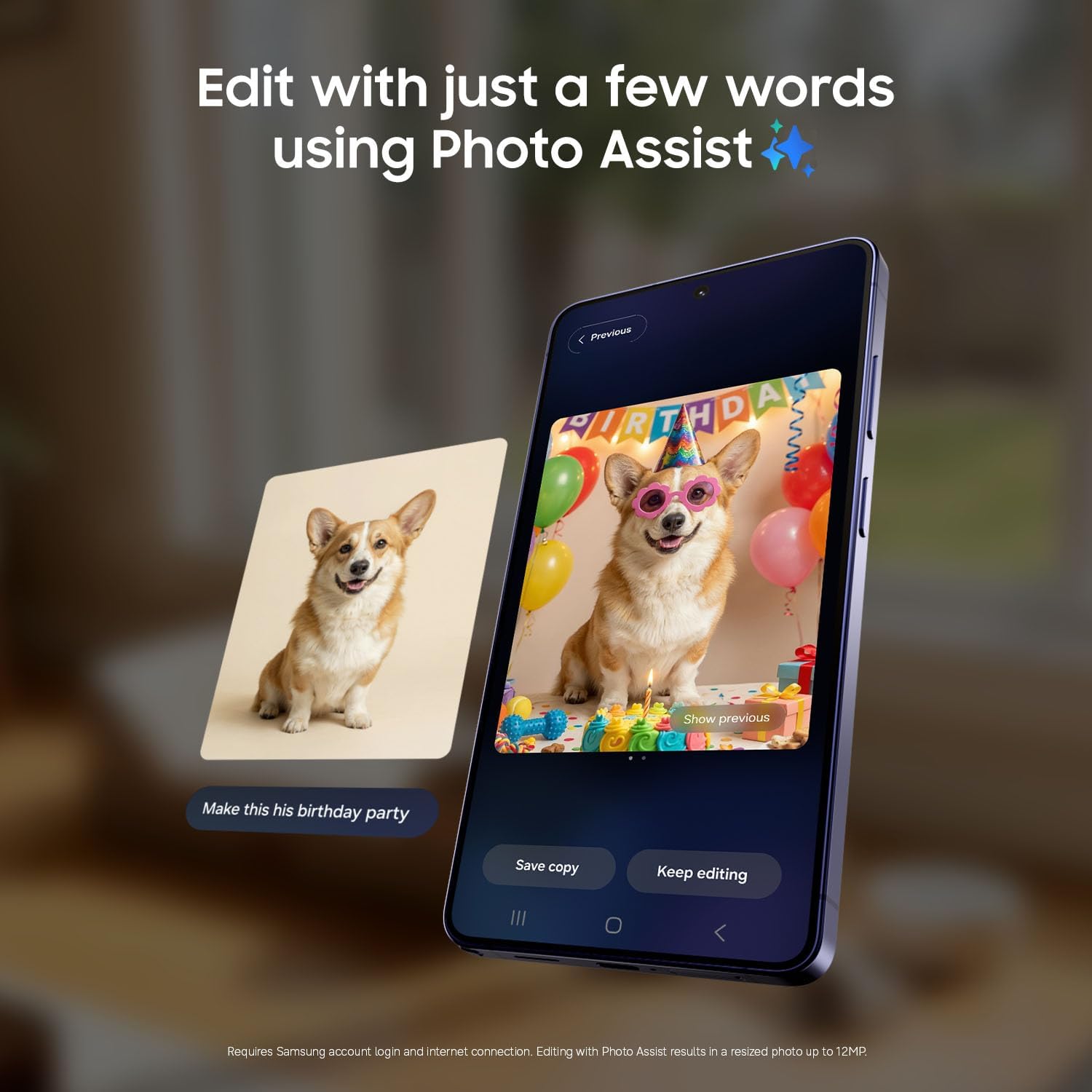
The crown jewel of this suite is Photo Assist. Moving far beyond simple filters, this tool utilizes generative AI to restructure reality within the frame. The capability to “fill in missing elements and naturally blend objects with existing lighting and shadows” suggests a deep understanding of scene geometry and physics. Users can add objects, restore details lost to cropping or obstruction, or apply entirely new artistic styles through text prompts or tap selections.
Crucially, the workflow is designed for speed: “Type it in. Transform it fast.” However, the footnotes reveal necessary guardrails. Photo Assist requires a Samsung account login and an active internet connection, indicating cloud processing for the heavy generative lifting. The output is resized to a maximum of 12MP, and edited images carry a visible AI watermark. This standardization ensures ethical transparency—viewers know the image has been synthesized—while the resolution cap manages server load and output consistency.
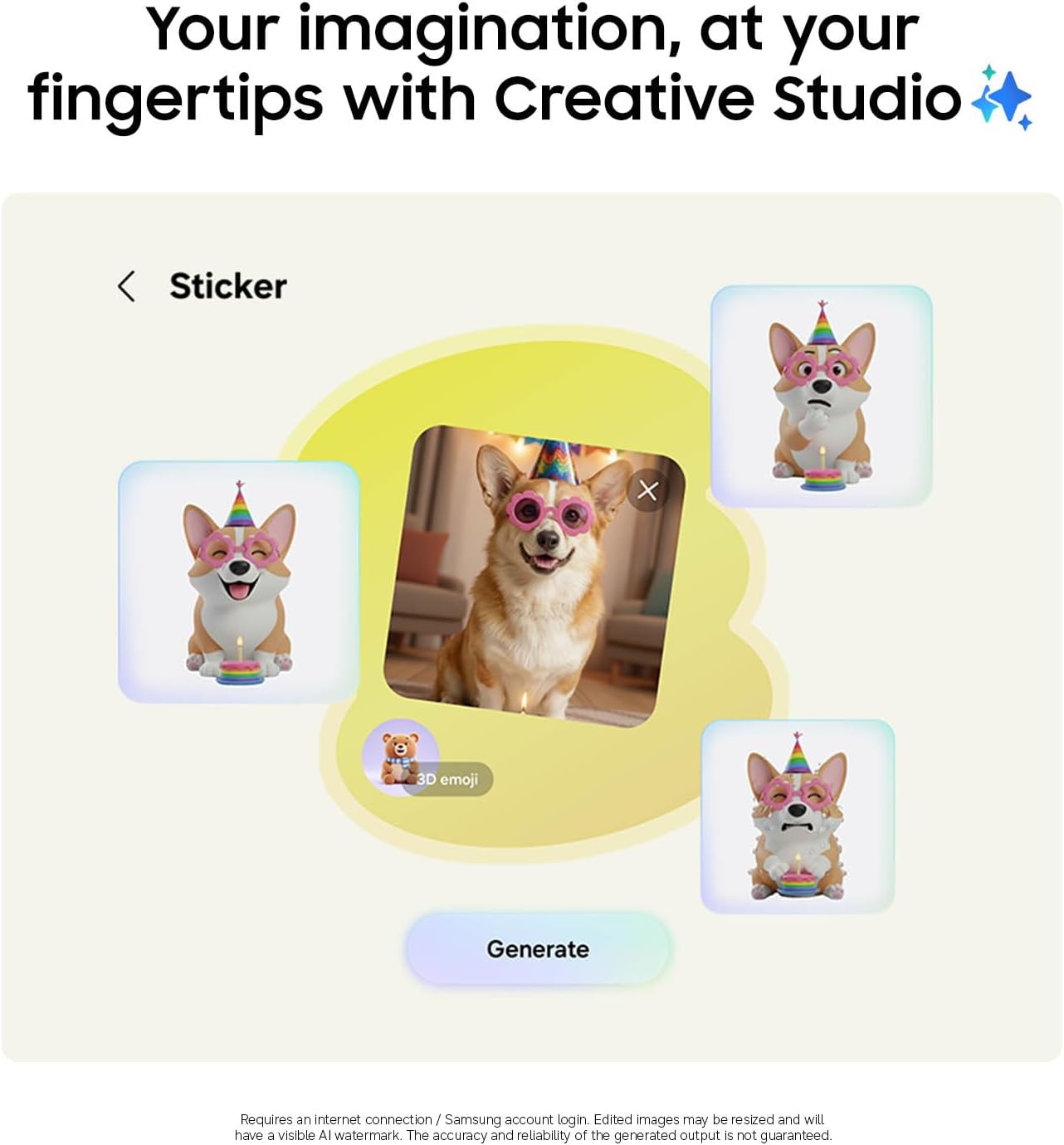
Complementing Photo Assist is the Creative Studio. This feature targets the social creator, allowing the generation of playful illustrations and 3D cartoons for custom wallpapers, stickers, and contact photos. Like Photo Assist, it requires an internet connection and Samsung account, outputs resized images with watermarks, and carries a disclaimer that “accuracy and reliability of the generated output is not guaranteed.” It positions the phone as a content generation engine, not just a capture device.
Computational Photography: Nightography and the Wider Selfie
While AI generates, the camera hardware captures. The S26 Ultra leans heavily on Nightography, Samsung’s brand for low-light computational photography. The claim here is “real-time adjustment” to illuminate low-light videos and photos. This implies multi-frame processing and noise reduction algorithms that operate on the viewfinder feed, not just the final saved file, allowing users to see the brightened result before pressing the shutter. For concert-goers, city explorers, or dimly lit dinner parties, this promises to turn “unusable” darkness into “crisp and clear” assets.
On the front, the Wider Selfie Capture addresses a persistent physical limitation: arm length. Utilizing a wider front camera and lens compared to the S25 series, the field of view expands significantly. The practical benefit is immediate: large groups fit without the “stretch,” architectural backgrounds remain visible, and the need for retakes diminishes. It is a hardware upgrade justified by a specific, relatable user pain point.
Performance: The “Fastest, Smoothest, Most Powerful” Processor
Underpinning the AI workloads is a new flagship System-on-Chip (SoC), described simply as Samsung’s “fastest, smoothest and most powerful processor yet.” While specific model numbers (e.g., Snapdragon 8 Gen 4 for Galaxy or Exynos 2500) are absent from the provided literature, the performance targets are explicit: AI-accelerated performance.
This silicon drives Now Nudge, a proactive intelligence feature that works “behind the scenes.” Unlike voice assistants that wait for a wake word, Now Nudge prioritizes apps, reminders, and notifications based on context—time, location (requiring location permissions), and usage patterns. The goal is surfacing “the most relevant information right when you need it.” If you typically order coffee at 8:00 AM, the app surfaces then. If you have a boarding pass in Samsung Wallet, it appears at the airport. It is a shift from app-centric to intent-centric computing.
The Ecosystem Play: Wallet, Charging, and Audio
A flagship phone does not exist in isolation. The S26 Ultra doubles down on the Samsung ecosystem.
Samsung Wallet aims to replace the physical leather bifold. It securely stores payment cards (requiring compatible NFC cards from participating banks), boarding passes, membership cards, and digital keys. The security architecture relies on Samsung Knox, though the provided text emphasizes the convenience: “Leave your bulky wallet at home.” Specific limitations apply per feature, directing users to the Samsung Wallet FAQ for granular compatibility.
Power management centers on Super-Fast Charging 3.0. The device is “ready” for this standard, capable of recharging “in a snap.” The critical caveat is hardware dependency: it requires a 60W Super Fast Charger sold separately. Charging speed is variable, dependent on battery level and thermal conditions, and Samsung sternly warns against non-approved or damaged cables due to safety risks. This separates the phone’s capability from the in-box experience (or lack thereof, as chargers are typically absent in modern flagships).
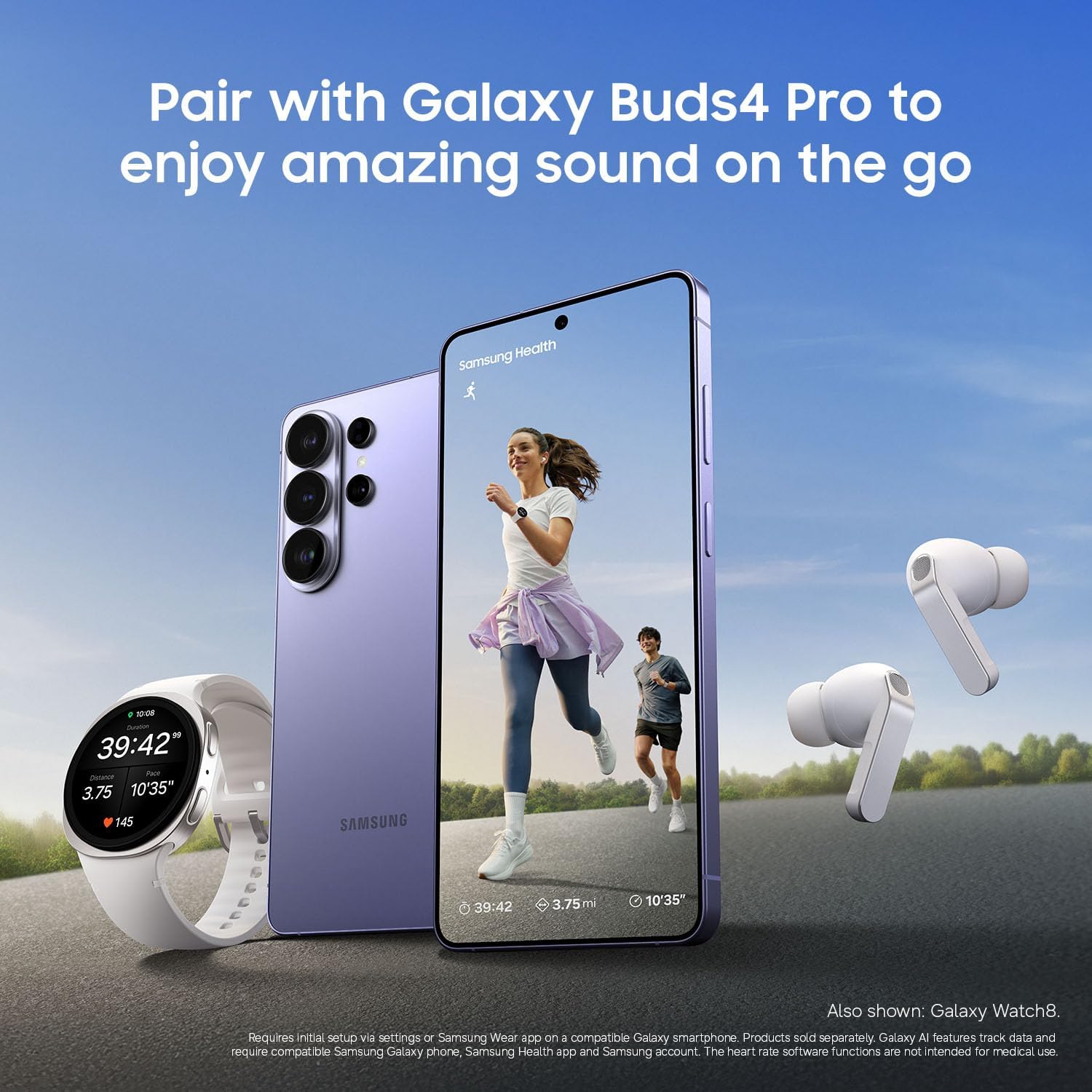
Audio fidelity is addressed through a partnership with the Galaxy Buds4 Pro (sold separately). The pairing unlocks Hi-Res Audio, promising capture of “small reverbs to subtle textures.” Setup requires the Samsung Wear app on a compatible Galaxy or Android device. This creates a high-fidelity pipeline: Phone (Source/Decode) -> Buds (DAC/Transducer), targeting audiophiles who stream lossless codecs.
Software Nuances and Footnote Realities
A thorough review must navigate the disclaimers, as they define the actual user experience versus the marketing promise.
- Connectivity Dependency: Almost every headline AI feature (Photo Assist, Creative Studio, generative wallpapers) requires an internet connection and Samsung Account. This is not an offline-first device for AI; it is a thin client for Samsung’s cloud models.
- Output Constraints: Photo Assist outputs at 12MP. For a 200MP sensor (implied by Ultra lineage, though not explicitly stated in text), this is a significant downsample. It suggests the generative pipeline works at a standard diffusion resolution, not native sensor resolution.
- Watermarking: All AI-generated or edited content carries a visible watermark. This is a responsible AI stance but limits “clean” professional use without post-processing cropping.
- Accessory Costs: The 60W charger and Buds4 Pro are separate purchases. The “Super Fast Charging 3.0 ready” badge on the box implies potential, not inclusion.
- Regional/Banking Variance: Samsung Wallet features are highly dependent on participating banks and regional regulations.
The Verdict: Intelligence as the New Spec Sheet
Evaluating the Samsung Galaxy S26 Ultra 512GB in Cobalt Violet requires a shift in criteria. If judged solely on hardware specs omitted from this brief—screen refresh rate, exact battery mAh, zoom optical range, build materials (titanium/armor aluminum), IP rating—it is incomplete. But judged on the provided feature set, it presents a cohesive vision: The Smartphone as an Agent.
The Privacy Display solves a physical security flaw. Nightography and Wider Selfie solve optical physics flaws. Photo Assist and Creative Studio solve creative skill gaps. Now Nudge solves cognitive load. Samsung Wallet solves pocket bulk. Super Fast Charging 3.0 solves time poverty.
The 512GB storage is the correct baseline for this vision; AI generation, 8K video (implied by “Hi-Res” multimedia focus), and local model caching demand headroom. The unlocked status ensures the user owns the agent, not the carrier.
The Cobalt Violet finish adds a touch of humanity to a device defined by silicon intelligence. The Samsung Galaxy S26 Ultra does not just ask “what can this phone do?” It answers “what can this phone do for you?”—automating the mundane, securing the private, and illuminating the dark. It is a compelling argument that the next evolution of mobile is not faster, but smarter.