

Price: $71.00
(as of Aug 22, 2026 12:48:14 UTC – Details)

The Brick Smartphone Access Blocker: A Hands-On Review of the Subscription-Free Digital Wellness Tool
In an era defined by the attention economy, the battle for focus has migrated from the desktop to the pocket. Smartphones, while indispensable tools for modern life, are engineered with surgical precision to capture and retain user attention. The result is a global epidemic of “doom scrolling,” context switching, and fragmented productivity. While software-based solutions—screen time limits, focus modes, and app blockers—have proliferated, they share a fundamental flaw: they rely on the very device they are trying to regulate to enforce the rules. It is remarkably easy to tap “Ignore Limit” or disable a focus mode when the urge to check social media strikes.
Enter The Brick Smartphone Access Blocker. Marketed as a “Subscription-Free Phone Lock,” this product represents a paradigm shift in digital wellness: the introduction of physical friction. By moving the “off switch” for distracting apps off the screen and onto a tangible, Near Field Communication (NFC) enabled device, The Brick attempts to solve the willpower gap that software alone cannot bridge. This review explores the hardware, software ecosystem, setup process, practical utility, and overall value proposition of this unique approach to digital minimalism.
The Core Philosophy: Hardware-Enforced Friction
The central thesis of The Brick is simple but profound: software breaks are broken by software. If the barrier between you and Instagram is a popup on the same screen displaying Instagram, the barrier has already failed. The Brick introduces “real-world friction.” To unlock your blocked apps, you must physically locate the device, pick up your phone, and tap the two together. This requirement for physical proximity and deliberate action creates a “pause”—a micro-moment of mindfulness that often suffices to break the dopamine loop and allow the prefrontal cortex to reassert control over the impulse.
This is not a Faraday cage, nor is it a timed safe (like the popular “Kitchen Safe” containers). Your phone remains fully functional for calls, texts, maps, and any apps you designate as “essential.” It is a selective, software-defined blindfold held in place by a physical key.
Hardware Design and Build Quality
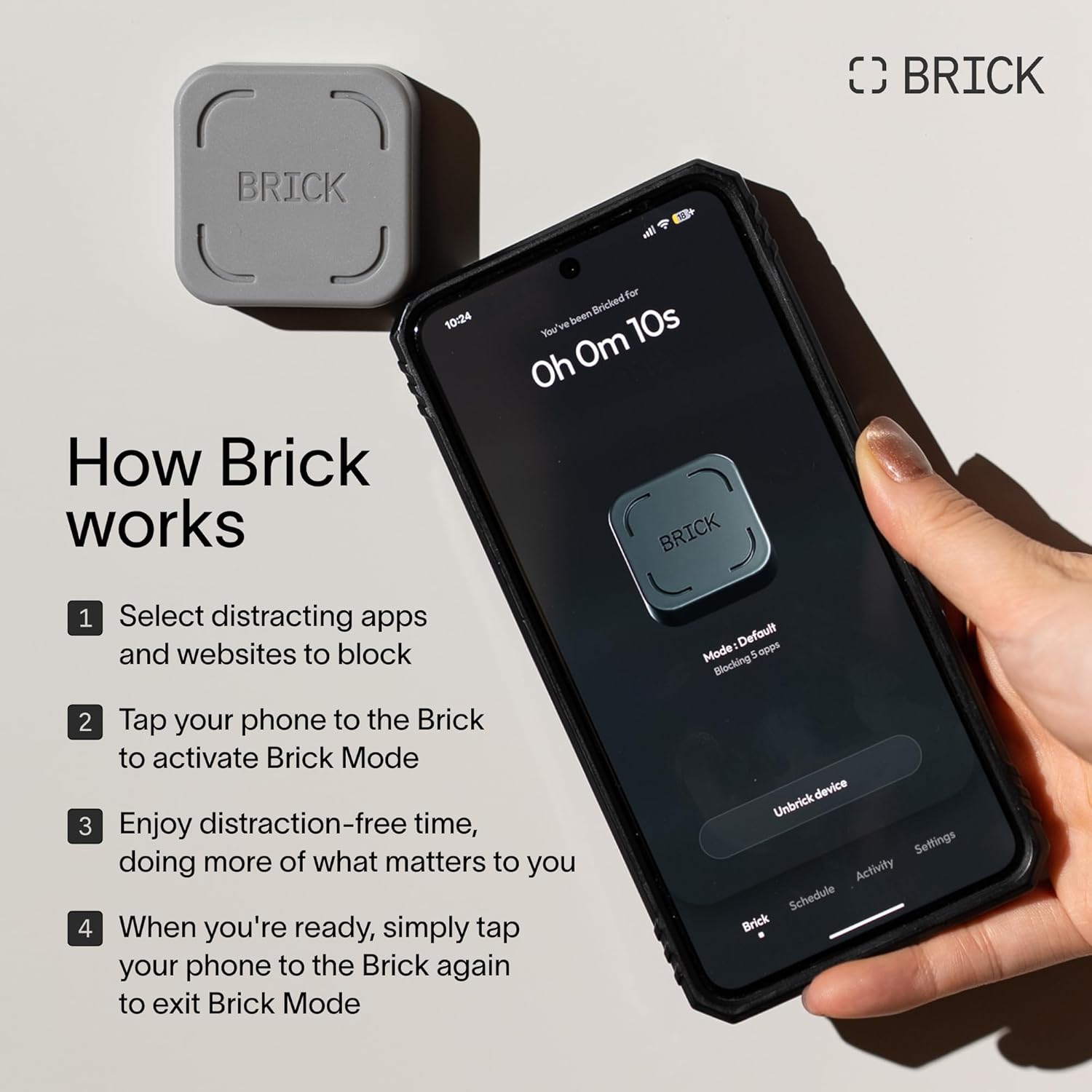
Out of the box, The Brick lives up to its name. It is a solid, weighty rectangle—roughly the size of a thick coaster or a small matchbox car—molded from a matte, soft-touch grey polymer. The industrial design is deliberately unobtrusive. It lacks blinking LEDs, charging ports, or buttons. It is entirely passive, drawing power from the NFC field of the smartphone during the tap interaction. This means zero battery maintenance, a significant advantage over competing hardware solutions that require weekly charging.
The heft is reassuring; it feels like a “tool” rather than a toy. The grey finish is neutral enough to blend into a home office, a bedside table, or a kitchen counter without clashing with decor. The bottom features a subtle non-slip pad, preventing it from sliding on polished surfaces. There is a satisfying tactile finality to placing a phone down onto it. The build quality suggests durability; with no moving parts, no battery to degrade, and no screen to crack, this is a device likely to outlast several phone upgrade cycles.
Setup and the Brick App Ecosystem
The onboarding process is streamlined, living up to the “Effortless Control” promise. The workflow is as follows:
- Download the Brick app (iOS or Android).
- Grant the necessary permissions: Accessibility services (to monitor foreground apps), Notification Access (to suppress alerts), and Device Admin privileges (to prevent easy uninstallation during a session).
- Tap the phone to The Brick to pair the unique NFC tag ID to the account.
- Configure blocklists.
The app interface is clean, modern, and utilitarian. The dashboard centers on a large “Brick” button visualizing the current state (Locked/Unlocked). The permission granting process is the only friction point—standard for any serious digital wellness tool on modern OS architectures—but the app guides the user through each toggle with clear screenshots and explanations.
Crucially, the app operates locally first. The blocking logic resides on the device. There is no mandatory cloud account, no login required to start a session, and no data harvesting of usage patterns for advertising. This architecture underpins the “Subscription-Free” claim: there are no servers to maintain for the core blocking functionality, hence no recurring revenue requirement.
Feature Deep Dive: Custom Modes and Granular Control
Where The Brick differentiates itself from a simple “kiosk mode” toggle is its Custom Modes system. Recognizing that “distraction” is context-dependent, the app allows users to create distinct profiles, each with its own curated blocklist.
- Work Mode: Block social media, news apps, games, and shopping sites. Allow Slack, Email, Calendar, Browser (for research), and CRM tools.
- Deep Work / Study Mode: Block everything except a calculator, a dictionary, and a note-taking app. Browser access can be restricted to specific allowlisted domains (e.g., documentation sites) or blocked entirely.
- Family / Evening Mode: Block work email, Slack, news, and infinite-scroll apps. Allow Camera, Photos, Music, Messaging (specific contacts), and Smart Home controls.
- Sleep Mode: Block all stimulating apps. Allow only Alarm, Meditation/White Noise apps, and Emergency contacts.
The granularity extends to Website Blocking. Using a local VPN profile (configured automatically), The Brick can block specific URLs or entire categories (Adult, Gambling, Social) at the network level, preventing the common workaround of accessing blocked platforms via the mobile browser.
The Unblock Workflow is where the hardware shines. When a mode is active, attempting to open a blocked app triggers a full-screen overlay: “This app is bricked. Tap your phone to The Brick to unlock.” There is no “Ignore for 15 minutes” button. There is no passcode entry. The only way to dismiss the overlay is the physical tap. This binary choice—do the work to unlock, or put the phone down—is the product’s killer feature.
The “Subscription-Free” Value Proposition
In a SaaS-saturated market, the pricing model is refreshing. The Brick retails as a single upfront hardware purchase. The app, future firmware updates, cloud sync for settings (optional), and usage analytics are included for the lifetime of the product. There are no “Pro” tiers gating features like Website Blocking, Custom Modes, or Usage History.
For the consumer, this eliminates subscription fatigue. For the manufacturer, it aligns incentives: they make money by selling a durable good that works well enough to generate word-of-mouth, not by trapping users in a recurring billing cycle. It also guarantees longevity; if the company pivots or shuts down servers tomorrow, the NFC tag and the local blocking logic on the phone will continue to function indefinitely.
Usage Tracking and Digital Health Metrics
The Brick treats digital wellness as a quantifiable habit. The app features a dedicated Insights tab that tracks:
- Total Bricked Time: Cumulative hours the device has been locked.
- Daily Average: Rolling average of focus time.
- Streaks: Consecutive days with Bricked time > 0.
- Session History: Timestamped log of every Lock/Unlock cycle, including duration and Mode used.
- Unlock Attempts: A log of how many times you tried to open a blocked app (even if you didn’t unlock).
This data is presented without gamification gimmicks (no badges, confetti, or leaderboards). It is raw, honest data designed for self-reflection. Seeing a high “Unlock Attempts” count relative to “Bricked Time” is a powerful diagnostic indicator of specific behavioral struggles.
Practical Use Cases and Workflow Integration
The Morning Routine: Placing The Brick on the bathroom counter or kitchen table forces a “tap to start the day” ritual. Activating “Morning Mode” (blocking email/news) prevents the reactive stress spiral before coffee.
The Deep Work Session: At the desk, The Brick sits to the right of the keyboard. A tap activates “Deep Work.” The phone becomes a brick—useful only for 2FA codes, timers, or critical calls. The physical distance required to unlock (standing up, walking to the kitchen where the “Family Brick” might live) raises the “activation energy” of distraction significantly.
The Bedroom Boundary: This is perhaps the highest ROI use case. Keeping The Brick on the nightstand—but requiring a tap to unlock “Sleep Mode” in the morning—prevents the 6:00 AM doom scroll. Conversely, tapping it at 10:00 PM to engage “Sleep Mode” physically separates the user from the device’s infinite scroll.
Shared Accountability: Because the NFC tag is not biometric, partners, parents, or colleagues can use the same Brick. A family can share a “Dinner Time” brick on the dining table. A team can share a “Meeting Brick” in a conference room. This social layer adds accountability without surveillance.
Limitations and Considerations
No product is without trade-offs, and an objective review must highlight where The Brick fits—and where it doesn’t.
1. The “NFC Only” Constraint: The Brick requires a phone with NFC capability. While standard on all modern iPhones (iPhone 7+/iOS 13+) and Android devices, older devices or extremely budget models may lack the hardware. Cases can interfere; thick rugged cases (OtterBox Defender, etc.) or metal plates for magnetic mounts often block the NFC antenna. Users must test tap reliability with their specific case/phone combo.
2. OS-Level Limitations (The “Nuclear Option”): On Android, the Accessibility/Device Admin implementation is robust; the overlay is system-level and difficult to bypass without a reboot or ADB commands. On iOS, Apple’s sandboxing is stricter. The Brick utilizes Screen Time API and Focus Filters (iOS 16+). While effective, a determined user can navigate to Settings > Screen Time > Brick App > “Turn Off” if they know the Screen Time passcode (or if one isn’t set). The Brick mitigates this by prompting users to set a random Screen Time passcode stored in a password manager or given to a partner, but it remains a software-layer vulnerability inherent to iOS, not a flaw in The Brick itself.
3. No Scheduling/Automation (Yet): Currently, modes must be started manually via the tap. There is no “Auto-Brick at 9 PM” or “Brick when I arrive at the Office” geofencing automation. The philosophy is intentionality—you decide now to focus. However, power users accustomed to Shortcuts/Tasker integration may find the lack of API or Shortcuts support limiting.
4. Single Point of Failure: If you lose The Brick, you cannot unlock your apps unless you have set up a “Recovery Method” in the app (typically a long, complex passcode generated during setup). Losing the Brick without the recovery code requires an app reinstall (and potential data loss of local history). Buying a 2-pack or storing the recovery code securely is advised.
5. Single Device per Session: The Brick pairs with one phone at a time for active blocking. While you can pair multiple phones to the same Brick (sequentially), you cannot brick two phones simultaneously with one tap. Households with multiple heavy users may need multiple Bricks.
The Competitive Landscape
- vs. Software Blockers (Opal, Freedom, Forest, Screen Time): Software is free/cheap and offers scheduling. The Brick wins on enforcement integrity. Software relies on willpower; The Brick relies on physics.
- vs. Timed Containers (Kitchen Safe, K-Safe): Containers lock the entire phone away. You lose maps, camera, 2FA, emergency calls. The Brick wins on utility preservation. You keep the tool; you lose the toys.
- vs. Minimalist Phones (Light Phone, Punkt): These require carrying a second device or swapping SIMs. The Brick wins on ecosystem continuity. You keep your primary smartphone, camera, banking apps, and 2FA, simply toggling a “dumb phone mode” on demand.
Verdict: A High-Leverage Tool for Intentional Living
The Brick Smartphone Access Blocker is not a magic wand. It cannot make you want to work, nor can it physically restrain your hand. What it does—exceptionally well—is raise the cost of distraction from near-zero (a thumb tap) to non-trivial (physical relocation + tap).
In behavioral economics, this is “increasing friction.” In psychology, it is “implementation intention.” In practice, it is the difference between “I’ll just check Twitter for a second” (three taps, 45 minutes lost) and “I would have to walk to the kitchen, tap my phone, walk back… nah, I’ll finish this paragraph first.”
The subscription-free model is the cherry on top, respecting the user’s autonomy and wallet. The hardware is durable, the software is privacy-respecting and feature-complete (Custom Modes, Web Blocking, Analytics), and the core interaction—The Tap—is satisfyingly final.
Who should buy this?
- Knowledge workers fighting context switching.
- Students needing enforced study blocks.
- Parents modeling healthy tech boundaries for kids (and enforcing them).
- Anyone who has tried software limits and found themselves tapping “Ignore” daily.
- Privacy advocates wanting a local-first, cloud-optional solution.
Who might skip this?
- Users needing automated, scheduled blocking without manual initiation.
- Users with non-NFC phones or thick metal-backed cases they refuse to remove.
- Users who require absolute tamper-proof enforcement on iOS (where OS limitations allow a settings bypass if the passcode is known).
For everyone else, The Brick represents the most elegant, durable, and philosophically sound implementation of “digital friction” currently on the market. It turns the smartphone back into what it was meant to be: a tool you pick up, use, and put down—not a slot machine you carry in your pocket.