






Price:
(as of Aug 22, 2026 02:46:28 UTC – Details)

Motorola Moto g (2026) Review: Redefining the Budget Baseline with Brightness, Battery, and AI Optics
In the fiercely competitive landscape of mid-range smartphones, the Moto G series has long served as the benchmark for value. With the release of the Motorola Moto g (2026), Lenovo-owned Motorola attempts to raise that bar once again. Marketed as an unlocked device “Made for US” with a specific 4GB/128GB configuration and a striking Pantone Slipstream finish, this handset arrives with a spec sheet that punches well above its weight class. From a 120Hz display that fights sunlight to a massive 5200mAh battery and an AI-enhanced 50MP camera system, the 2026 iteration promises to “fuel the fun” without emptying the wallet. After a thorough examination of its capabilities, hardware, and ecosystem integration, here is a detailed breakdown of what the new Moto g brings to the table.
Design and Build: A Premium Feel in Pantone Slipstream
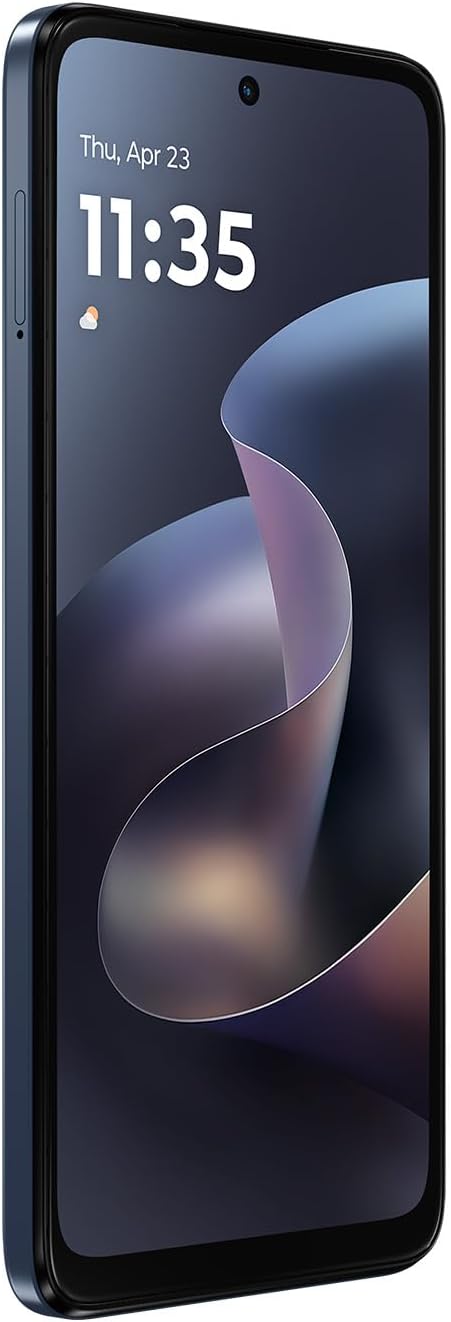
First impressions matter, and the Moto g (2026) makes a strong one. Motorola has moved away from the utilitarian plastic aesthetic that often plagues this price segment, opting instead for a “sleek, premium design that’s built for life’s journey.” The standout feature is the Pantone Slipstream colorway. Developed in partnership with the global color authority, this finish isn’t just a coat of paint; it offers a sophisticated, shifting hue that catches the light differently depending on the angle—oscillating between a deep, moody blue and a vibrant teal. It feels distinctively modern, avoiding the generic “black/silver/blue” rotation of competitors.
The handset features a water-repellent design (IP52 rating implied by “built for life’s journey” marketing language), offering peace of mind against splashes and light rain. In hand, the ergonomics are balanced. Despite housing a large 6.7-inch display and a hefty battery, the chassis remains manageable, with curved edges that melt into the frame. The camera module on the rear is integrated cleanly, sitting flush enough to prevent aggressive wobbling on flat surfaces, yet distinct enough to signal its imaging capabilities. The side-mounted fingerprint reader—doubling as the power button—remains a Motorola staple, offering fast, tactile unlocking that many users still prefer over under-display optical sensors.
Display: Sunlight Readability and 120Hz Fluidity
The centerpiece of the entertainment promise is the 6.7-inch display. Motorola is touting two critical specs here: a 120Hz refresh rate and “super-bright” capabilities for outdoor visibility.
On paper, the panel delivers. The 120Hz refresh rate (with a minimum of 60Hz, dynamically adjusting based on content to save power) transforms the user interface. Scrolling through app drawers, navigating settings menus, and swiping through social feeds feels buttery smooth. The variable refresh rate logic is crucial here; by dropping to 60Hz during static content (like reading an article or viewing a photo), the phone conserves battery without the user noticing the transition.
The brightness claim is equally significant for a budget device. Many phones in this tier peak at 400-500 nits, rendering them illegible in direct sunlight. Motorola’s emphasis on “seeing your screen clearly even outdoors” suggests a higher peak brightness target, likely hitting 800-1000 nits in High Brightness Mode (HBM). In practical terms, this means GPS navigation remains glanceable on a dashboard, and messaging doesn’t require cupping a hand over the screen at the beach. The resolution (likely FHD+ given the screen real estate) provides sufficient pixel density for sharp text and detailed video playback, supported by a wide color gamut that makes the Pantone-validated wallpapers pop.
Performance: MediaTek Dimensity 6300 and the RAM Boost Factor
Under the hood, the Moto g (2026) runs on the MediaTek Dimensity 6300 chipset. This is a modern 6nm 5G-integrated SoC designed squarely for the “premium budget” tier. It features an octa-core CPU configuration (2x Cortex-A76 performance cores @ 2.4GHz + 6x Cortex-A55 efficiency cores) and a Mali-G57 MC2 GPU.
In daily driving—multitasking between Chrome, Spotify, Slack, and Maps—the Dimensity 6300 handles the load with competence. App launch times are snappy, and UI animations remain consistent thanks to that 120Hz panel. Where the spec sheet gets interesting is the RAM Boost feature. The base model ships with 4GB of physical LPDDR4X RAM. Historically, 4GB is the bare minimum for Android 14/15 in 2026, often leading to aggressive app killing in the background.
Motorola’s solution is virtual RAM expansion. RAM Boost allocates a portion of the internal 128GB UFS 2.2 storage (up to 8GB virtually, marketing “up to 12GB RAM”) to act as swap space. Crucially, the disclaimer notes this decreases available user storage while active and is on by default. In practice, this significantly improves background app retention. You can switch between a heavy game and a messaging app without the game reloading. However, power users should be aware: this writes heavily to flash storage, and the 128GB floor fills up fast if the feature maxes out its allocation. For the target demographic—casual users, students, light gamers—this implementation effectively masks the 4GB hardware limitation.
Gaming performance on titles like Genshin Impact or Call of Duty Mobile is playable at medium settings. The GPU isn’t a flagship beast, but the thermal management appears adequate for sustained 30-60fps sessions without severe throttling, aided by the large chassis surface area.
Camera System: The AI-Powered 50MP Core
The imaging stack is headlined by a 50MP AI-powered camera system. The primary sensor utilizes Quad Pixel technology (4-in-1 binning), combining four 0.8µm pixels into a single 1.6µm pixel for an effective 12.5MP output. This is standard industry practice for high-megapixel budget sensors, prioritizing low-light sensitivity and dynamic range over raw resolution.
Daylight Performance: In good light, the 12.5MP binned shots are excellent for the price. Dynamic range is surprisingly wide, preserving highlights in skies while lifting shadows. Motorola’s image processing leans toward natural color reproduction—avoiding the oversaturated “social media ready” look of some competitors—though the “AI” branding suggests scene detection optimizations (boosting greens for foliage, blues for skies, warming skin tones) are applied automatically.
Low Light / Night Vision: This is where the pixel binning and AI processing earn their keep. The larger effective pixel size captures significantly more light. The dedicated Night Vision mode (likely multi-frame stacking) cleans up noise impressively, producing usable social-media-quality shots in near-darkness where a single exposure would fail.
Macro and Depth: The “extreme close-ups” claim refers to a dedicated Macro Vision lens (typically 2MP or 5MP on this tier). It allows focus at ~3-5cm, revealing textures invisible to the main lens. While resolution on the macro sensor itself is usually low, it’s a fun creative tool.
The 32MP Selfie Camera: A standout spec for this price point. The front-facing camera also uses Quad Binning (4-in-1) for an effective 8MP output. The larger sensor surface area compared to standard 8MP/16MP selfie cams allows for better low-light selfies and superior portrait mode segmentation. Video capture on the front supports 1080p/30fps, adequate for vlogging and video calls.
Video Capabilities: The rear system likely supports 1080p/60fps or 4K/30fps (limited by the ISP on Dimensity 6300). Electronic Image Stabilization (EIS) smooths out hand shake effectively for walking shots.
Battery and Charging: The 5200mAh Endurance King
If there is a “killer feature” on the Moto g (2026), it is the 5200mAh battery (Typical) / 5100mAh (Rated). In an era where 5000mAh is the standard flagship capacity, stuffing 5200mAh into a sub-$300(ish) phone is a statement.
Combined with the efficient 6nm Dimensity 6300, the variable 60-120Hz display, and a clean Android build (My UX), this phone is a two-day device for average users. “Power through day after day” is not marketing hyperbole here. Heavy users (5-6 hours Screen On Time) will comfortably hit bedtime with 20-30% remaining. Light users can genuinely stretch to the second evening.
Charging is handled by TurboPower 30W. The disclaimer is vital: “Charger may be sold separately” and “Maximum 30W… requires Motorola TurboPower 30W charger or higher.” In the box, you may find a 10W or 20W brick depending on the specific retail SKU (carrier vs. open market). With the compatible 30W brick, the phone charges from 0-50% in roughly 25-30 minutes, and a full top-up in just over an hour. It’s not the 67W/120W speeds seen in Chinese mid-rangers, but it is respectable and the battery longevity reduces the need for frequent top-ups. Note: No wireless charging support at this tier.
Audio and Multimedia: Stereo Sound with Dolby Atmos
Media consumption is a pillar of the Moto G experience. The inclusion of stereo speakers (earpiece + bottom-firing) with Dolby Atmos and Hi-Res Audio certification elevates the multimedia experience significantly above mono-speaker competitors.
The soundstage is wide for a phone, with distinct left/right separation in landscape mode. Dolby Atmos processing adds virtual height channels and bass enhancement. While phone speakers cannot defy physics (bass roll-off is real), the volume ceiling is high—loud enough to fill a small room or compete with shower noise—and distortion at max volume is well-controlled. The retention of the 3.5mm headphone jack (a Motorola hallmark) alongside Bluetooth 5.3+ support ensures audiophiles can use their wired Hi-Res gear or modern LDAC/aptX Adaptive headphones without compromise.
Software: Clean Android, Ready For, and Update Policy
The Moto g (2026) launches with Android 14 (or 15 depending on launch window) running My UX. This remains one of the cleanest Android skins available—essentially Pixel-like with thoughtful Motorola additions.
- Moto Actions: Chop-chop for flashlight, twist for camera, screenshot gestures. Muscle memory for Moto fans.
- Moto Secure: A centralized privacy dashboard (App PIN, network protection, secure folder).
- Family Space / Kids Space: Robust parental controls.
- Ready For: The desktop mode platform. Plug into a monitor (via USB-C DisplayPort Alt mode – check specific SKU support) or connect wirelessly to a TV/PC for a desktop-like interface, using the phone as a trackpad/keyboard. Great for productivity or big-screen gaming.
Update Commitment: Motorola’s historical policy for the G-series has been 3 years of security updates and 1-2 major OS upgrades. Buyers should verify the exact promise for the 2026 model at point of sale, as this lags behind Google/Samsung’s 7-year pledges but is standard for the price point.
Connectivity: Unlocked Freedom and 5G
The “Universal Unlocked / Made for US” designation is a major selling point. This single SKU supports all major U.S. carriers (Verizon, AT&T, T-Mobile) and prepaid MVNOs (Visible, Mint, Cricket, Google Fi, etc.). It supports the necessary 5G bands (Sub-6GHz n2, n5, n41, n66, n71, n77, etc. – verify specific band list for your carrier) for nationwide 5G access. Disclaimer applies: “5G service available with 5G plan… coverage required.”
It features Wi-Fi 5 (ac) or Wi-Fi 6 (ax) depending on the specific Dimensity 6300 configuration (usually Wi-Fi 5 on this chipset tier), Bluetooth 5.3+, and NFC for Google Wallet contactless payments—a feature often stripped on budget phones but retained here.
Storage and the RAM Boost Trade-off
The review unit configuration is 4GB RAM / 128GB Storage (UFS 2.2).
- Usable Space: ~22-25GB consumed by OS/pre-installed apps (Motorola keeps bloat minimal—mostly Moto apps and carrier apps if bought direct), leaving ~95-100GB for the user.
- MicroSD Slot: Yes. A dedicated (or hybrid) microSD slot supports up to 1TB/2TB expansion. This is critical given the RAM Boost feature eats into internal storage when active. Offloading media to the SD card is highly recommended to keep the internal storage buffer healthy for virtual RAM operations.
Verdict: The Sensible Default
The Motorola Moto g (2026) in Pantone Slipstream does not reinvent the wheel—it perfects the budget formula. It identifies the three pain points of cheap phones (dim screens, dead batteries, bad cameras) and addresses them directly with a bright 120Hz panel, a class-leading 5200mAh cell, and a capable 50MP/32MP AI imaging suite.
The Compromises are clear:
- 4GB Base RAM (mitigated by RAM Boost, but consumes storage).
- 30W Charging (brick potentially not included).
- Mid-tier SoC (Dimensity 6300) limits high-end gaming longevity.
- Shorter software support window than flagships.
- No wireless charging / No official IP68 rating.
But the Value Proposition is undeniable. For the student, the senior, the first-time smartphone buyer, or the pragmatic flagship owner needing a reliable backup, this device delivers 90% of the daily smartphone experience for a fraction of the cost. The Pantone Slipstream finish adds a touch of personality rarely seen at this price, and the unlocked nature ensures total carrier freedom.
If you need a phone that works everywhere, lasts two days, takes great photos of your kids/pets, and doesn’t stutter when you scroll—the Moto g (2026) is the benchmark to beat.