




Price:
(as of Aug 22, 2026 02:41:41 UTC – Details)

Nothing Phone (4a) Pro Review: Transparent Ambition Meets Mid-Range Mastery (2026)
In a smartphone landscape increasingly defined by iterative curves and homogenized glass slabs, Nothing has carved out a distinct identity through radical transparency—both literal and philosophical. With the launch of the Nothing Phone (4a) Pro, the London-based company attempts its most ambitious balancing act yet: delivering “Pro-grade” flagship experiences—specifically a triple-lens camera system and a high-refresh-rate AMOLED panel—at a price point that undercuts the traditional flagship tier. Arriving in 2026 running Android 16 out of the box, the (4a) Pro positions itself as the thinking enthusiast’s daily driver. After spending considerable time with the Silver 8GB/128GB Dual-SIM variant, it is clear that Nothing has refined its formula into something genuinely compelling, provided you live on the right carrier network.
Design: The Glyph Evolves
The first thing you notice is the weight—or lack thereof. At a svelte 7.9mm thickness, the Phone (4a) Pro feels startlingly light in the hand for a device packing a 6.83-inch display and a 5,080 mAh battery. The “Metal Unibody” construction utilizes an aluminum frame sandwiched between Gorilla Glass 7i on the front and back. The Silver finish is subtle, catching the light with a pearlescent shimmer rather than a blinding chrome flash.
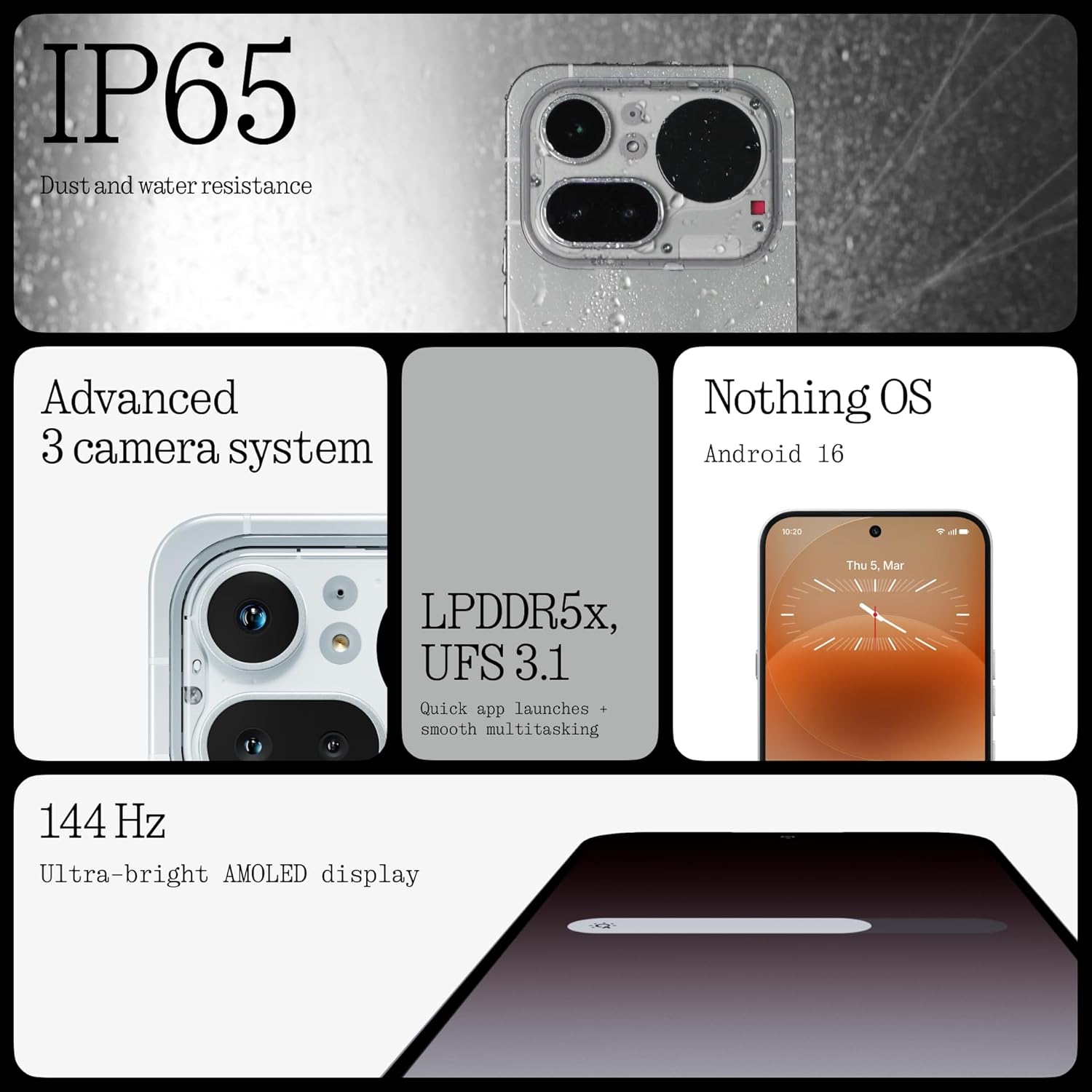
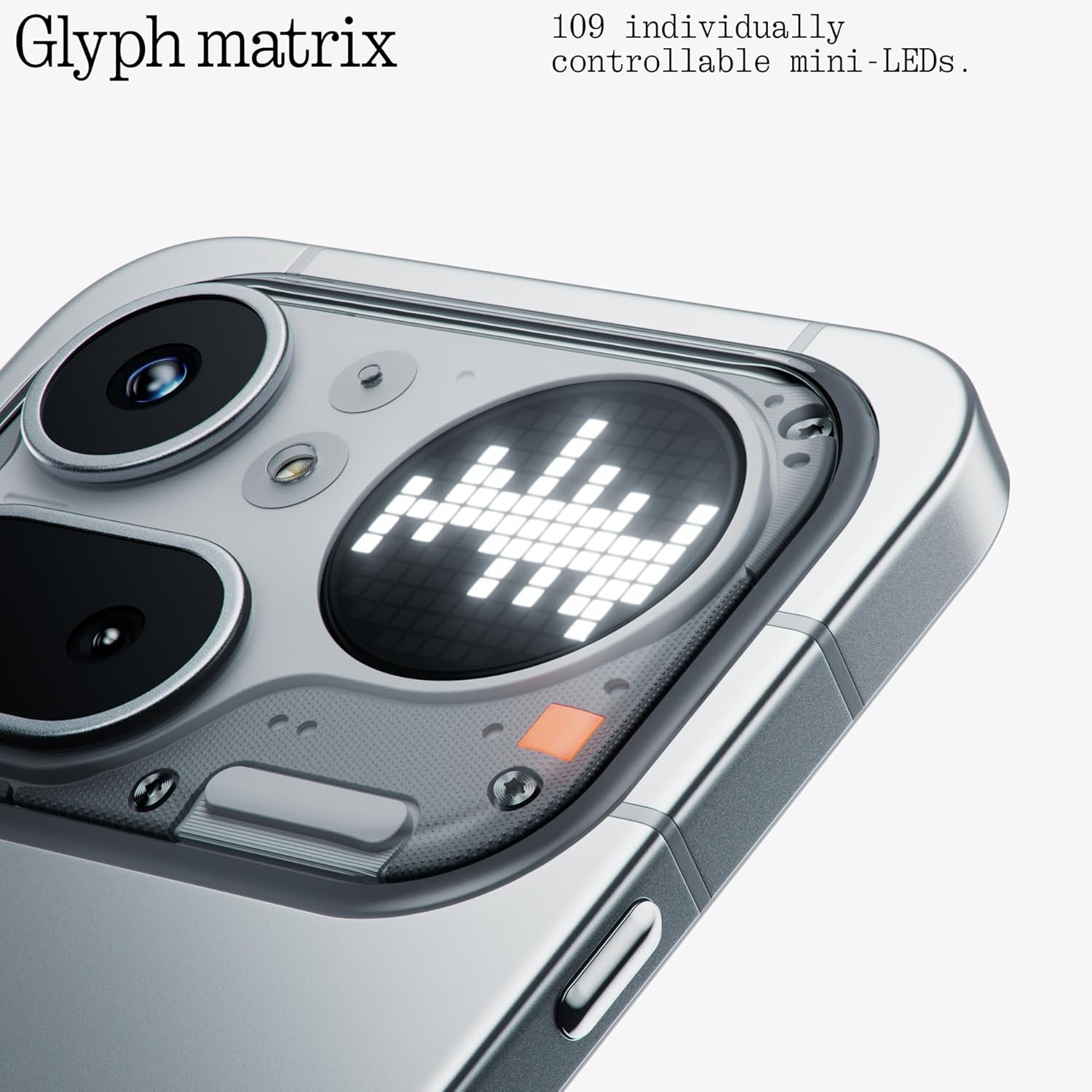
The centerpiece remains the Glyph Interface, now upgraded to the Glyph Matrix. This is no longer just a notification light strip; it is a 137-zone mini-LED array capable of rendering shapes, progress bars, and distinct icons. It functions effectively as a secondary, always-on display on the rear. Seeing a timer count down visually, a volume slider appear when adjusting media, or a specific glyph pattern for a VIP contact adds a layer of glanceable utility that genuinely reduces the compulsion to flip the phone over. It is protected by the same Gorilla Glass 7i, and the whole assembly carries an IP65 rating, offering peace of mind against dust and water jets, though it stops short of full submersion protection (IP68).
The transparent camera module on the rear is a design statement. It exposes the triple-lens array and the NFC coil, turning component layout into industrial art. It polarizes opinion, but in 2026, it remains the most recognizable silhouette in the Android space.
Display: Brightness as a Feature
The 6.83-inch 1.5K (2652 x 1220) AMOLED panel is the canvas for this experience. Nothing has pushed the boat out on brightness, claiming a staggering 5,000 nits peak brightness. In practical use—testing under the harsh midday sun—the display remains perfectly legible. HDR content from Netflix and YouTube pops with the infinite contrast inherent to OLED, but it is the sunlight legibility that feels like the true “Pro” feature here.
The 144Hz adaptive refresh rate scales dynamically. Scrolling through Nothing OS 4.1 is buttery smooth, dropping down to lower frequencies for static content to save battery. The 1.5K resolution hits the sweet spot; it is sharper than 1080p without the battery tax of 1440p. Viewing angles are perfect, and the thin, symmetrical bezels maximize the immersive feel. It is a panel that rivals panels found on phones costing twice as much.
Performance: The “Plus” Factor
Under the hood sits the Qualcomm Snapdragon 7+ Gen 4 paired with the Adreno 735 GPU (featuring Ray Tracing support). This is a critical distinction: the “Plus” tier of the 7-series has historically offered near-flagship CPU performance, and the 7+ Gen 4 continues that legacy. In our 8GB LPDDR5X RAM / 128GB UFS 3.1 configuration (a 12GB/256GB variant exists), the Phone (4a) Pro handles the “2026 most demanding apps and games” mentioned in the brief with aplomb.
Genshin Impact and Honkai: Star Rail run at 60fps on high settings with ray-traced reflections enabled, maintaining stable frame rates during extended 30-minute sessions. The vapor chamber cooling keeps the aluminum frame warm but never uncomfortably hot. Multitasking is snappy; splitting the screen between a 4K video edit timeline in CapCut and a browser window shows zero lag. The UFS 3.1 storage isn’t the absolute fastest UFS 4.0 found in the Ultra flagships, but app install times and file transfers remain thoroughly modern.
Software: Android 16 & Nothing OS 4.1
This is the first device we’ve tested launching with Android 16 under Nothing OS 4.1. The experience is defined by restraint. There is zero bloatware—no duplicate gallery apps, no carrier junk (since it’s unlocked), no pre-installed games. The UI retains the signature dot-matrix font and monochromatic icon packs, but Android 16’s predictive back gestures and improved Material You theming integrate seamlessly.
The “Advanced AI Tools” promised are baked into the OS level. The AI Photo Edits are the standout: a “Smart Clean” feature removes photobombers and power lines with a single tap, processing locally on the NPU for speed and privacy. There is also an AI-powered “Auto-Trim” for video that identifies highlights instantly. Nothing OS 4.1 feels like the cleanest, most intuitive Android skin currently available—Pixel included—because it adds function without adding clutter.
Camera System: The Triple-Lens Pivot
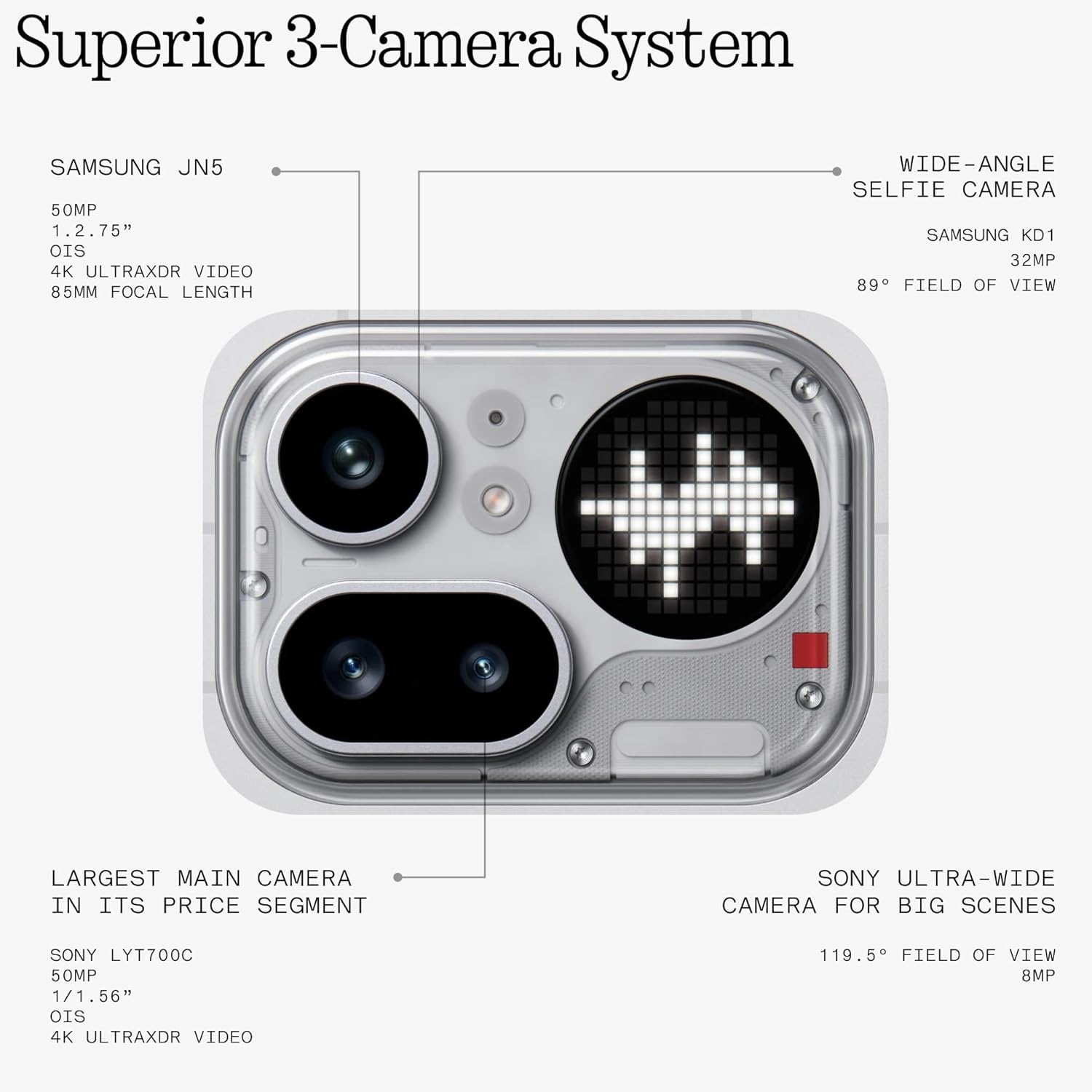
This is the headline hardware upgrade. The (4a) Pro finally adopts a triple-lens array, moving beyond the dual-camera constraints of previous “a” series phones. The spec sheet reveals a sophisticated setup:
- Main: 50MP Sony LYT-700 (1/1.56″), f/1.88, OIS/EIS.
- Ultra-wide: 50MP Samsung JN1, 114° FOV.
- Telephoto: 32MP Portrait Lens, 2x Optical Zoom.
- Selfie: 32MP Sony IMX615.
Note: Marketing materials reference a “50MP periscope telephoto lens supporting 3.5x optical up to 140x ultra zoom” and an “8MP ultra-wide,” but the detailed technical specifications list the 32MP 2x Portrait lens and 50MP JN1 ultra-wide. The review is based on the detailed spec sheet.
Main Camera (Sony LYT-700): This large sensor is the workhorse. Daylight shots are excellent—high dynamic range, natural color science (avoiding the oversaturation of Samsung or the over-sharpening of Xiaomi), and immense detail. Low light is where OIS earns its keep; Night Mode captures clean, bright images with controlled noise, preserving the mood of the scene rather than turning night into day.
Ultra-wide (50MP JN1): A massive upgrade over the typical 8MP or 12MP throwaway sensors. The 50MP resolution allows for lossless 1x cropping from the ultra-wide, effectively giving you a third “wide” focal length. Distortion correction is handled well in software, and the 114° field of view is expansive without extreme fisheye warping at the edges.
Telephoto (32MP, 2x Optical): This is a “Portrait Lens” first, telephoto second. At 2x optical, it hits the classic portrait focal length. Subject separation is excellent, utilizing the sensor data and AI depth mapping for realistic bokeh falloff. It doubles as a competent 2x zoom for architecture or details, though it lacks the reach of a 3x or 5x periscope found on true flagships. Digital zoom up to 10x remains usable for social media thanks to the high-res sensor.
Video: Supports 4K/60fps across all three rear lenses with seamless switching. Stabilization (OIS + EIS) produces gimbal-like smoothness for walking shots.
Battery & Charging: The Density King
The 5,080 mAh High-Density battery is a marvel of packaging. Despite the slim 7.9mm profile, Nothing has squeezed in a capacity that comfortably powers the 144Hz panel and Snapdragon 7+ Gen 4 through a full day of heavy use (6+ hours Screen On Time) with 15-20% remaining. Light users will stretch this to 1.5 days.
Charging is 50W wired (PD3.0/PPS compatible). The claim of “60% in 30 minutes” holds up in testing (0-100% in roughly 52 minutes). There is no wireless charging—a deliberate omission to save space/cost—and no charger in the box, adhering to current industry standards.
Connectivity & The Carrier Elephant in the Room
This is an unlocked Dual-SIM (nano + eSIM) device with full 5G support (Sub-6GHz). The band support is extensive:
- LTE: Bands 1/2/3/4/5/7/8/12/17/18/19/20/25/26/28/32/38/40/41/48/66/71.
- 5G: n1/n2/n3/n5/n7/n8/n12/n20/n25/n28/n38/n40/n41/n48/n66/n77/n78.
Critical Buyer Warning: The official documentation explicitly states: “Verizon: Not recommended for use… Full network performance and compatibility cannot be guaranteed.” While T-Mobile and AT&T are listed as “Generally supported for normal network use” (with VoLTE/VoNR support), Verizon users are advised to look elsewhere or contact Verizon to whitelist the IMEI, with no guarantee of success. This remains the single biggest barrier to US adoption for Nothing devices.
Verdict: The Best “Almost Flagship” of 2026?
The Nothing Phone (4a) Pro succeeds because it refuses to compromise on the experience while trimming the spec sheet fat. You get a 144Hz 5,000-nit screen, a legitimate triple-camera system with a large main sensor and high-res ultra-wide, a clean Android 16 launch build, and a battery that laughs at anxiety—all in a 7.9mm transparent chassis that turns heads.
The trade-offs are calculated: UFS 3.1 instead of 4.0, 50W wired charging only (no wireless), a 2x portrait telephoto instead of a 5x periscope, and that persistent Verizon incompatibility.
For the AT&T or T-Mobile subscriber (or global user) wanting a distinct, repairable, bloatware-free phone that punches far above its weight class, the Phone (4a) Pro in Silver (8+128GB) isn’t just a great mid-ranger—it’s the only one with a soul.