


Price: $359.99
(as of Aug 22, 2026 14:21:37 UTC – Details)

Titan T1 Pro Rugged Armor: A Deep-Dive Analysis of the 7-Inch, 12800mAh Powerhouse
In a smartphone market increasingly defined by fragile glass sandwichs and planned obsolescence, the rugged niche has traditionally demanded compromise: thicker bezels, mediocre screens, outdated processors, and cameras that function merely as document scanners. The Titan T1 Pro Rugged Armor Unlocked Cell Phone enters the arena with a spec sheet that aggressively refuses those compromises. Boasting a flagship-tier Snapdragon 8 Gen 3 processor, a massive 7-inch Ultra HD display, a class-leading 12800mAh battery, and a distinctive Pink armor finish, this device positions itself not merely as a tool for construction sites, but as a legitimate daily driver for power users, outdoor enthusiasts, and anyone tired of hunting for a charger by noon.
This review analyzes the hardware, software, and design philosophy of the Titan T1 Pro based on its manufacturer specifications, exploring where this device rewrites the rules for rugged hardware and where the physical realities of its form factor remain evident.
Design Philosophy: Armor as an Aesthetic
The “Rugged Armor” moniker is not marketing fluff. The Titan T1 Pro is built to survive environments that would destroy a standard flagship. While specific IP68/IP69K and MIL-STD-810H ratings are standard expectations for this class, the description emphasizes a philosophy: “Brave the downpour. Ride the waves. Shake off the sand and dust.” This suggests a chassis engineered with sealed port covers (or waterproof ports), reinforced corners rated for significant drop heights, and a structural rigidity that prevents flex—a common failure point for large-screen devices.
The standout design choice is the Pink colorway. Rugged phones have historically been relegated to tactical black, camouflage, or high-visibility orange. Offering a distinct Pink finish signals a shift: durability is no longer gendered or strictly industrial. It allows the device to transition from a hiking backpack to a desk setup without looking like a piece of safety equipment.
However, physics dictates the footprint. Accommodating a 7-inch display and a 12,800mAh cell necessitates significant heft and thickness. This is not a phone for skinny jeans; it is a device for cargo pockets, tool belts, and bag compartments. The ergonomics will rely heavily on textured grip surfaces—essential when handling the device with wet or gloved hands.
Display: The 7-Inch Ultra HD Canvas
The centerpiece of the front fascia is the 7-inch Ultra HD display (3840 x 2160 resolution). This is a specification rarely seen even in mainstream flagships, which typically hover around 6.7 to 6.9 inches with QHD+ (3200 x 1440) resolutions.
- Pixel Density: At 7 inches, a 4K (3840 x 2160) panel yields a pixel density well above 600 PPI. The marketing copy claims you can “see every strand of hair in a movie, every leaf on a tree.” In practice, this renders text with print-like sharpness and eliminates the “screen door effect” visible on lower-resolution panels when viewed up close.
- Aspect Ratio & Usability: A 7-inch 16:9 (implied by 3840×2160) or near-16:9 panel is significantly wider than the tall 20:9 ratios common today. This is a double-edged sword. It is superb for media consumption—watching 16:9 video content without letterboxing—and for split-screen multitasking (a key Android 15 feature). However, one-handed reachability is non-existent.
- Rugged Integration: Integrating a panel this large into a rugged chassis requires a substantial bezel or a recessed mounting system to protect the glass from direct impact on corners. The “HD” label in the title contrasts with the “Ultra HD” spec in the description; the latter is the definitive spec here.
Performance: Flagship Silicon Meets Absurd Memory
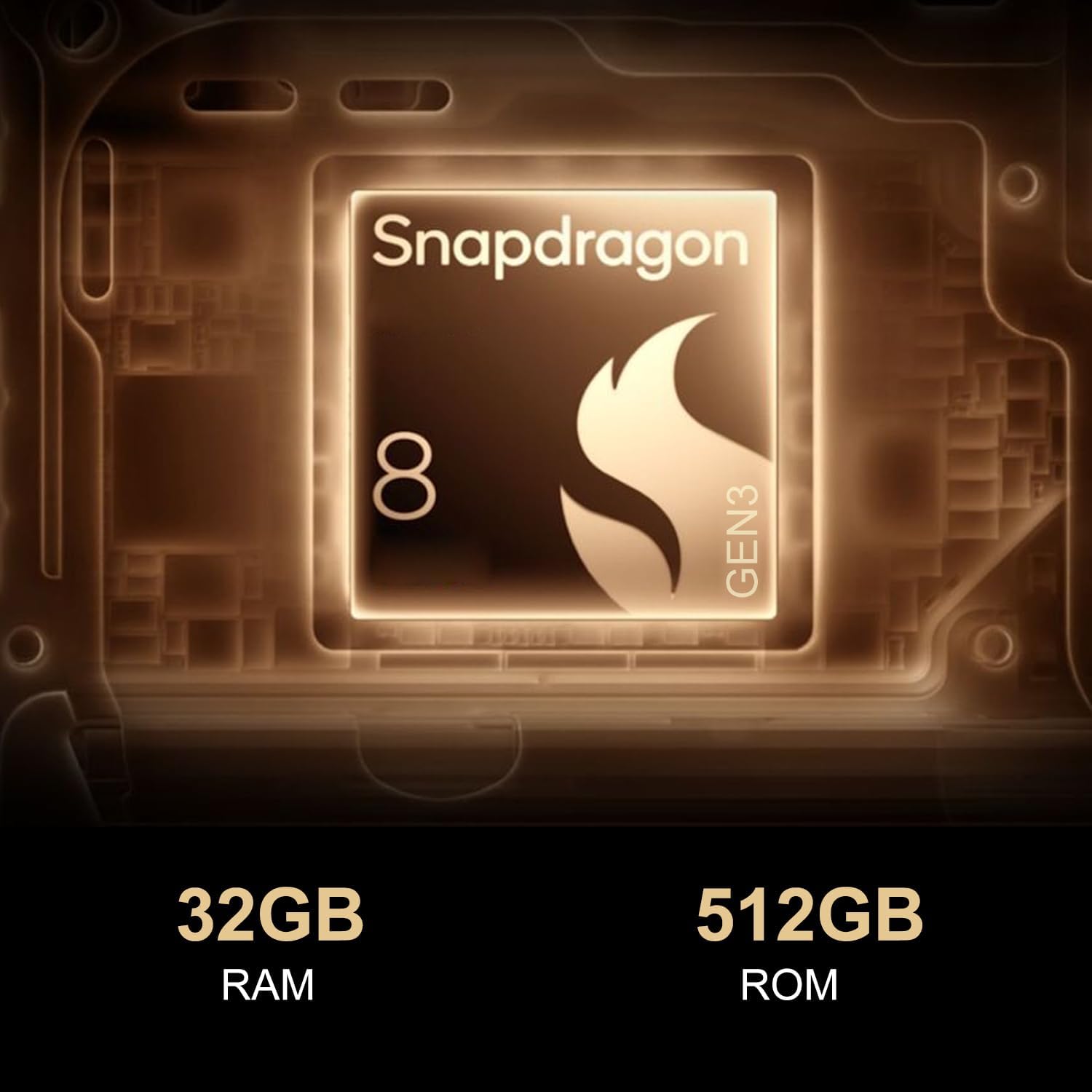
The inclusion of the Snapdragon 8 Gen 3 processor is the single biggest differentiator between the Titan T1 Pro and 99% of the rugged market. Most competitors utilize MediaTek Dimensity 7000/8000 series or older Snapdragon 7/8 Gen 1 chips to manage costs and thermals. The 8 Gen 3 brings:
- Generative AI On-Device: The “AI Unlocked Phone” branding is backed by the NPU capabilities of the 8 Gen 3, enabling local LLM execution, advanced photo remastering, real-time translation, and voice assistants without cloud latency.
- Gaming & Sustained Performance: The Adreno 750 GPU handles Genshin Impact, Honkai: Star Rail, or emulation at high settings. The challenge for a rugged phone is thermal throttling. Thick rubberized armor acts as an insulator. The internal thermal architecture (vapor chamber, graphite sheets, perhaps copper heat pipes touching the metal mid-frame) must be exceptional to sustain 8 Gen 3 performance without the phone becoming uncomfortably hot to hold.
The memory configuration is unprecedented: 32GB RAM + 512GB Storage (UFS 4.0 implied).
- 32GB RAM: This is workstation territory. Android 15’s memory management will keep dozens of apps in a suspended state indefinitely. For field workers running GIS mapping apps, CAD viewers, drone controllers, and communication tools simultaneously, the phone will never reload an app. It also future-proofs the device for 5–7 years of OS updates.
- 512GB Storage: Ample for offline maps, 4K/8K video recording (supported by the ISP), and massive local AI model files.
Battery & Charging: The Week-Long Phone
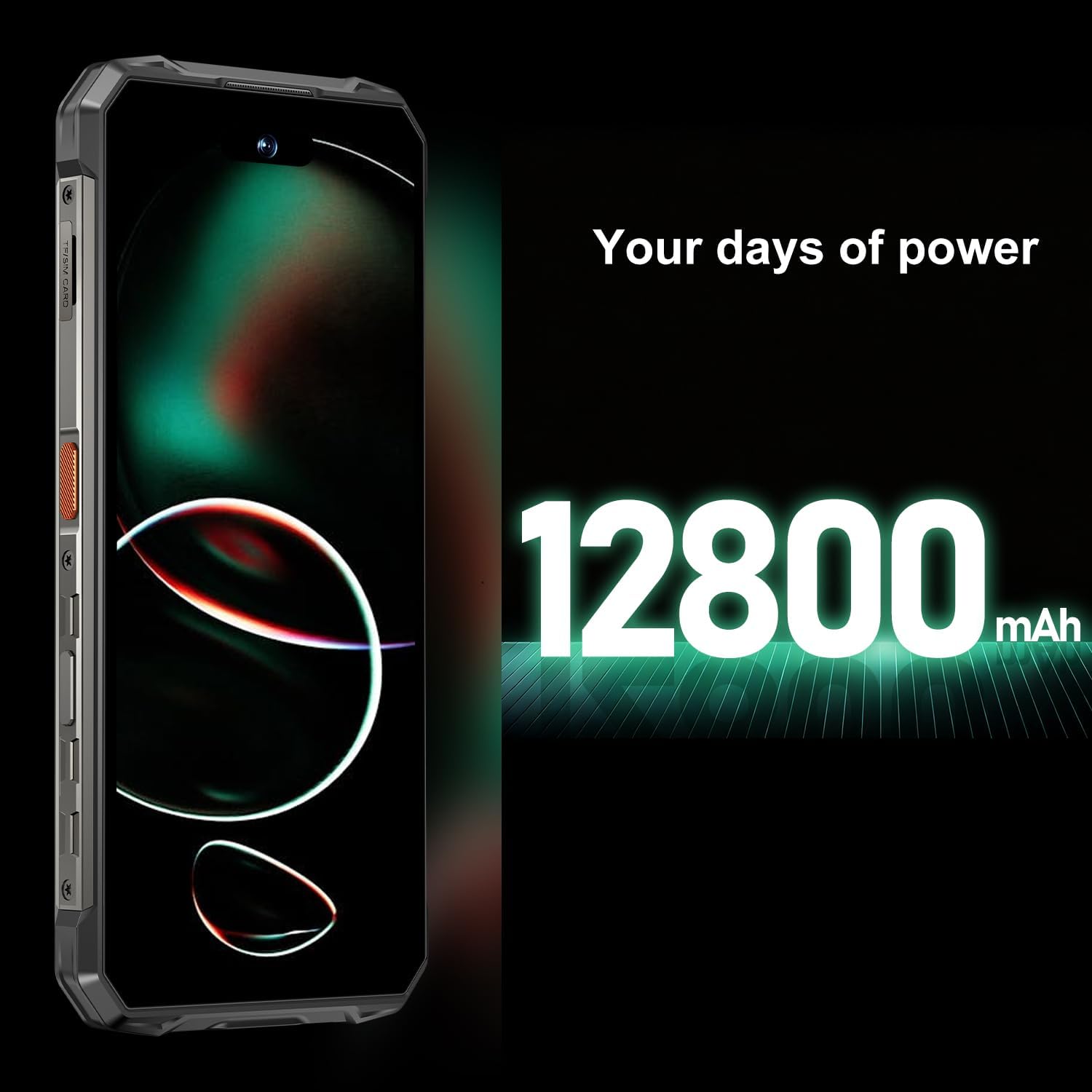
The 12,800mAh battery is the headline feature. For context, a standard flagship packs 5,000mAh. The Titan T1 Pro offers 2.5x that capacity.
- Real-World Endurance: With the efficient 4nm Snapdragon 8 Gen 3 and a large but efficient display, light users could realistically see 5–7 days of usage. Heavy users (screen-on time 8+ hours) should still clear 2 full days easily. This eliminates “battery anxiety” entirely.
- Reverse Charging (OTG): The ability to act as a power bank for headphones, smartwatches, a colleague’s dying phone, or a drone controller transforms the T1 Pro into a piece of survival gear.
- Charging Speed: The description does not list wattage (e.g., 66W, 120W). Charging a 12,800mAh cell at 30W would take 3+ hours. At 120W, it could hit 80% in ~30 mins. This is a critical missing spec for potential buyers, though the reverse charging capability implies USB-PD support.
Camera System: Documenting the Dark
Rugged phones historically treat cameras as an afterthought. The Titan T1 Pro specifies a 108MP Main Camera and a 68MP Selfie Camera.
- 108MP Main Sensor: Likely a Samsung ISOCELL HM6 or similar 1/1.67″ sensor. High megapixel counts allow for lossless 3x zoom cropping (outputting 12MP) and detailed daylight shots. The large sensor size aids low light, but the “Night Vision” and “Night Mode” branding suggests dedicated multi-frame processing and potentially an IR filter switch for true infrared night vision (monochrome) vs. computational low-light photography (color).
- 68MP Front Camera: Unusually high resolution for a front-facing unit. This facilitates high-quality video conferencing, detailed biometric enrollment for Face ID, and cropping for group selfies without quality loss.
- Underwater Photo Mode: This implies a specific camera tuning profile that corrects color cast (removing the green/blue tint) and locks focus/exposure for submersion scenarios, usable up to the device’s pressure rating.
Connectivity & Utility: The Swiss Army Knife
The T1 Pro loads the connectivity suite:
- 5G & Dual SIM: Global bands (implied by “Unlocked”) with dual nano-SIM or SIM+eSIM support for separating work/personal lines or using local data abroad.
- NFC: “Tap to pay… breeze through subway turnstiles.” Standard but essential for a modern daily driver.
- IR Blaster: A dying feature in flagships, retained here. Controlling AC units, TVs, projectors, or DSLR cameras via the phone is invaluable for technicians and travelers.
- Biometrics: Face ID + Fingerprint Unlock. The inclusion of both is critical for a rugged device. Fingerprint sensors (likely side-mounted capacitive or ultrasonic) work with gloves or wet fingers where optical/ultrasonic under-display sensors fail. Face ID (likely 2D IR-based given the rugged bezel) works with dirty hands or gloves on.
Software: Android 15 Out of the Box
Launching with Android 15 ensures the latest privacy dashboard, predictive back gestures, satellite connectivity APIs (if hardware supports), enhanced partial screen sharing, and the aforementioned advanced multitasking on the 7-inch canvas. The “AI Unlocked” tag suggests a clean OS with manufacturer AI tools (object eraser, summary, writing assist) layered on top, rather than heavy bloatware.
The “Pink” Variant: Market Positioning
The specific SKU reviewed here—Titan T1 Pro Pink, 512GB—targets a demographic often ignored by rugged OEMs. It retains the exact same internal specifications as the standard tactical models but offers a form of self-expression. It challenges the notion that a phone capable of surviving a mud run or a drop onto concrete must look industrial.
Critical Considerations & Trade-offs
Based solely on the provided specifications, a few realities emerge:
- Weight & Thickness: A 12,800mAh battery + 7-inch screen + rugged chassis likely pushes this device over 350g and 18-20mm thickness. It requires commitment to carry.
- Charging Speed Unknown: The omission of wired charging wattage is a notable gap in the provided data.
- Audio: No mention of stereo speakers or headphone jack. Rugged phones often feature a single, extremely loud mono speaker for job sites; audiophiles should temper expectations.
- Thermals: Sustaining Snapdragon 8 Gen 3 peaks inside a thermally insulated rubber shell is an engineering challenge. Performance graphs would be needed to verify zero-throttle claims.
- Camera Processing: 108MP/68MP hardware is only as good as the ISP tuning. Without sample images, “Night Vision” marketing must be taken at face value.
Verdict: A Category Redefiner
The Titan T1 Pro Rugged Armor does not feel like a typical rugged phone; it reads like a flagship smartphone that happens to be indestructible. By pairing the Snapdragon 8 Gen 3 with 32GB RAM and a 12,800mAh battery, it solves the two biggest pain points of modern mobile computing: performance longevity and battery life. The 7-inch 4K display makes it a viable laptop replacement for field reporting or media consumption, while the IR blaster, NFC, and dual biometrics ensure it retains utility features the mainstream market has abandoned.
The Pink 512GB variant adds a layer of personality to a category defined by utility. If the thermal management holds up under the 8 Gen 3 load and the charging speeds are competitive, the Titan T1 Pro stands as a compelling argument that “rugged” no longer means “compromised.” It is a specialized tool built with flagship ambition.